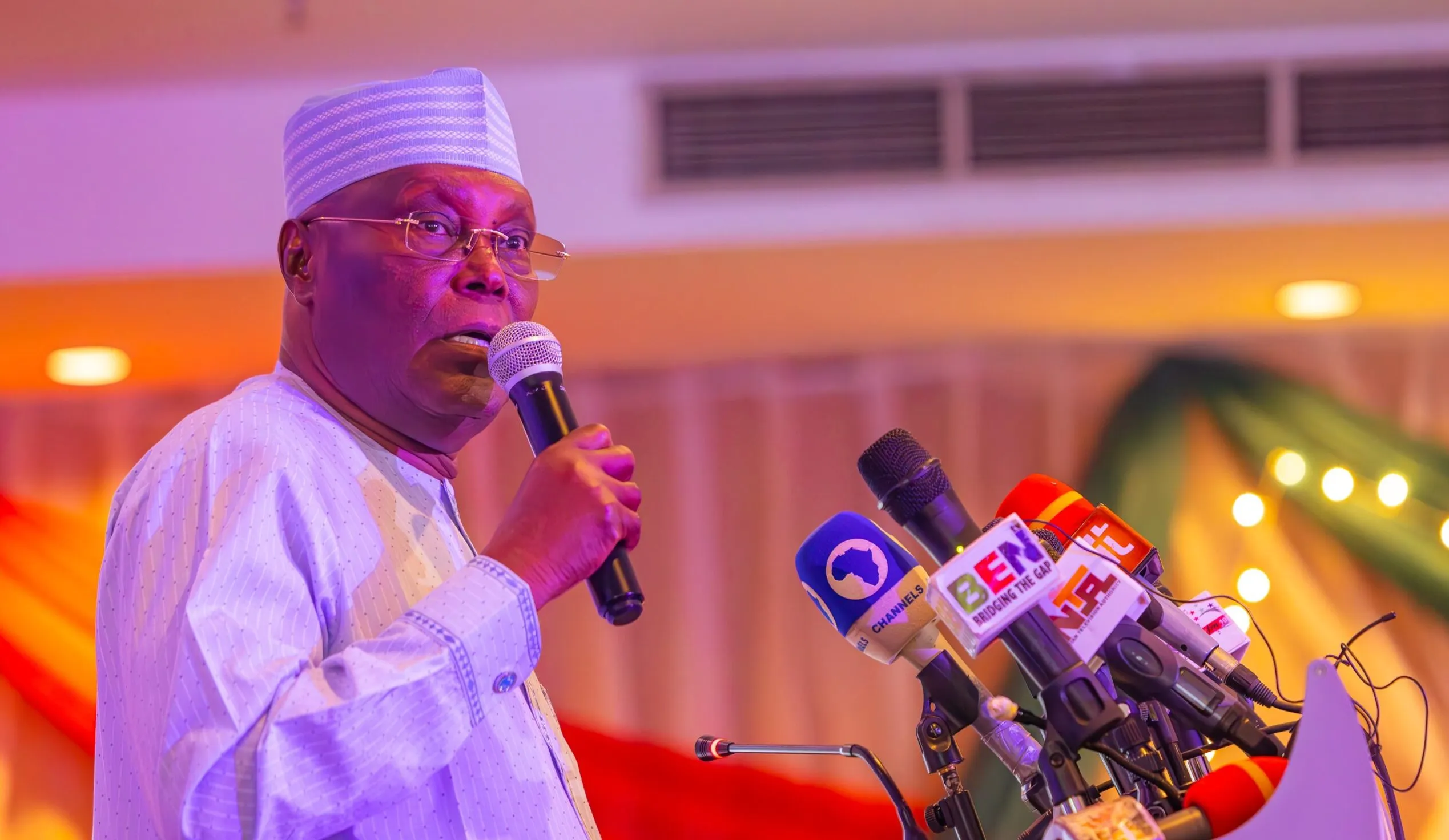
Former Vice President and African Democratic Congress (ADC) presidential candidate Atiku Abubakar has issued a pointed challenge to his vast army of online supporters: stop merely hashtagging and start actually voting.
Speaking at the inauguration of state coordinators for the RiseUpNaija Movement (RUN), a youth arm of the ADC, during a leadership retreat in Abuja, the former vice president delivered one of his most direct appeals yet to Nigeria’s digitally engaged youth population.
He challenged young Nigerians to transform their influence on social media into active political participation by registering to vote, volunteering during elections, serving as polling agents, and peacefully defending the electoral process.
In a line likely to be quoted widely, Atiku told the gathering plainly that online engagement alone changes nothing at the ballot box. “Hashtags do not count votes. Livestreams do not secure polling units. Tweets do not defend democracy. Only citizens do,” he said.
The appeal comes as part of a broader mobilization drive. Atiku has launched a nationwide campaign to mobilize 20 million votes for the ADC ahead of the 2027 election, urging Nigerians to reject vote-buying and defend democracy.
The Abuja event marked a shift in his campaign strategy from coalition-building toward grassroots mobilization, with plans to establish party structures from the national level down to every polling unit across the country.
Central to his message was a warning against vote-buying, which he framed as a generational betrayal rather than a simple transaction.
Atiku urged Nigerians to make informed decisions during the 2027 elections by evaluating candidates based on their competence, character, and ideas rather than gifts distributed during campaigns, warning that temporary incentives offered by politicians could never compensate for the long-term consequences of poor governance.
In a memorable turn of phrase, he reportedly noted that a bag of rice will disappear, a few thousand naira will be spent, and a campaign T-shirt will eventually fade, but the consequences of electing incompetent leadership will remain far longer.
He also sought to inoculate his youthful audience against being used as instruments of political violence, reminding them of how fleeting most politicians’ attention to young people tends to be.
He warned against selling votes for financial inducements, describing the ballot as the most powerful instrument available to citizens in a democracy, and urged youths not to become tools of political violence, noting that many politicians only remember them during election campaigns.
Atiku’s remarks lean heavily on his own decades in Nigerian politics as a credibility anchor. He reflected on his commitment to justice and national development, telling the crowd, “Look at me. Look closely. I have spent the better part of my life fighting for democracy, justice, and the progress of our beloved country. Time has given me experience, but it has not diminished my conviction.”
The push for social-media-to-ballot-box conversion is not incidental. Nigeria’s youth demographic remains both the country’s largest potential voting bloc and its most stubbornly underperforming one at the polls.
INEC reported 93.4 million registered voters at the 2023 general elections, of whom 39.65 per cent were youths aged 18 to 34, a demographic that holds considerable electoral influence, yet one where turnout has consistently lagged behind population share.
Analysts have long pointed to this gap between online enthusiasm and physical voter turnout as a recurring weak spot for youth-driven campaigns, Peter Obi’s 2023 “Obidient” movement being the most frequently cited case study.
With the RiseUpNaija Movement now expanding its coordinator network nationwide, Atiku’s camp appears determined not to repeat that pattern, betting that structured, ward-by-ward organization can succeed where online buzz alone has previously fallen short.
WHAT YOU SHOULD KNOW
Atiku’s message is simple but pointed: online popularity means nothing without votes to back it up.
He’s asking Nigeria’s youth to move from posting and hashtagging to registering, showing up on election day, and guarding the polls, while resisting vote-buying that trades their long-term future for short-term handouts.
The real test for his ADC campaign will be whether this online energy actually turns into physical turnout in 2027, something youth-led movements in Nigeria have historically struggled to deliver.
WATCH VIDEO: HERE