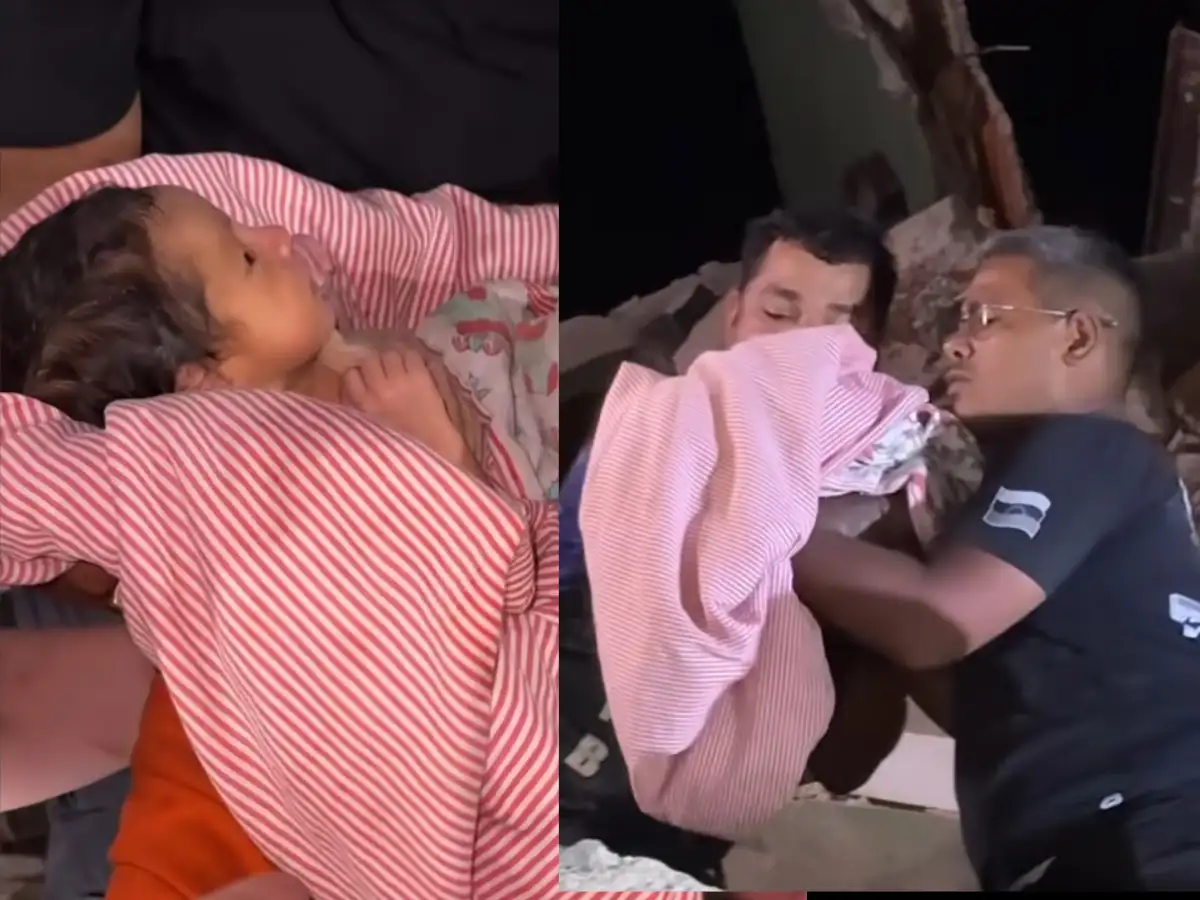
Thirty-two hours after catastrophic twin earthquakes reduced a Venezuelan coastal city to rubble, rescuers pulled a newborn baby alive from the wreckage of a collapsed building.
The rescue, captured on video and shared widely across social media by resident Andreina Quintero, showed rescue workers bathed in the harsh white glow of a floodlight, perched atop a mountain of shattered masonry.
One by one, they carefully passed the tiny bundle from hand to hand as onlookers broke into applause, a rare, electrifying sound in a city that has known little but sirens and weeping since Wednesday’s catastrophic double earthquake struck the Venezuelan coastline.
“The baby was just 18 days old,” Quintero wrote alongside the footage, which quickly spread across platforms, offering a fleeting but desperately needed sense of hope amid the scale of destruction gripping the country.
Remarkably, the infant appeared entirely unscathed. Rescuers gently cleaned the child with tissues, inspecting the baby with a careful tenderness that belied the chaos surrounding them. The mother, whose identity has not been publicly released, was pulled from the same debris approximately one hour later.
In a follow-up video posted by Quintero on Friday evening, the mother was seen lying in a hospital bed, visibly exhausted but alive. A medical worker, speaking directly to her, delivered the news every parent prays to hear: her newborn appeared to have sustained no injuries.
The medic then offered what may be the most profound detail in this story of survival: the baby had likely been shielded from the crushing collapse by the mother herself, who is believed to have instinctively covered her child with her body or another object as the building came down around them.
In the darkness and dust of a collapsed building, with no rescue in sight, a mother’s body became her newborn’s fortress.
The backdrop to this singular moment of joy is nothing short of devastating. La Guaira, a bustling coastal city situated just north of the capital Caracas along Venezuela’s Caribbean shoreline, has been effectively gutted.
Entire residential and commercial buildings have crumbled into themselves, leaving behind vast fields of rubble where streets and neighborhoods once stood.
The twin earthquakes measuring magnitudes 7.2 and 7.5 struck in rapid succession on Wednesday, June 24th, with a ferocity that seismologists say was exceptional even by regional standards.
Back-to-back tremors of such magnitude are exceptionally rare, and the compounding effect on infrastructure already weakened by years of economic hardship proved catastrophic.
As of Saturday, at least 920 people have been confirmed dead, though officials and aid organizations caution that the true toll is almost certainly far higher.
Thousands more remain injured, while a deeply troubling number, potentially in the tens of thousands, are still listed as missing, their fates uncertain beneath the rubble and the region’s damaged communication networks.
The scope of this disaster is only beginning to come into full focus, and the picture emerging from international agencies is staggering.
The United Nations on Saturday estimated that close to 6.76 million people may have been impacted by the twin earthquakes, a figure that underscores just how wide the disaster’s reach extends beyond the visible destruction in La Guaira.
The UN’s migration agency, the International Organisation for Migration (IOM), arrived at that number after analyzing available population data and damage assessments, and it issued a stark warning about what lies ahead.
“These projections highlight the potentially vast humanitarian impact of the disaster,” the IOM said in a formal statement, noting that up to two million people in Caracas alone may have been affected, a sobering reminder that while La Guaira absorbed the most visible devastation, the tremors rippled outward with enormous force.
Venezuela, a nation already contending with years of economic collapse, political instability, and deteriorating public infrastructure, now faces one of the most severe natural disasters in its modern history.
Humanitarian organizations are warning of urgent needs for shelter, clean water, medical supplies, and search-and-rescue capacity — needs that may outpace what the Venezuelan government can meet alone.
For the rescuers who work through the night, shifting rubble by hand and ear, listening for any sound of life beneath thousands of tons of broken concrete and steel, moments like Friday’s infant rescue are not merely symbolic. They are fuel.
Every survivor pulled alive from the wreckage, every baby handed gently from one pair of arms to the next, every mother reunited with her child in a hospital ward is proof that the effort is worth it. That beneath all of this devastation, life persists.
Venezuela is mourning. But on Friday night, under a single floodlight in La Guaira, it also held its breath and then, together, it exhaled.
WHAT YOU SHOULD KNOW
On June 24th, twin earthquakes of magnitudes 7.2 and 7.5 struck Venezuela’s coastal city of La Guaira, killing nearly 1,000 people, injuring thousands, and leaving up to 6.76 million people impacted.
Amid the devastation, one story pierced through the darkness: an 18-day-old infant was pulled alive from the rubble 32 hours after the disaster, shielded from death by her mother’s body. The child was uninjured. The mother survived, too.