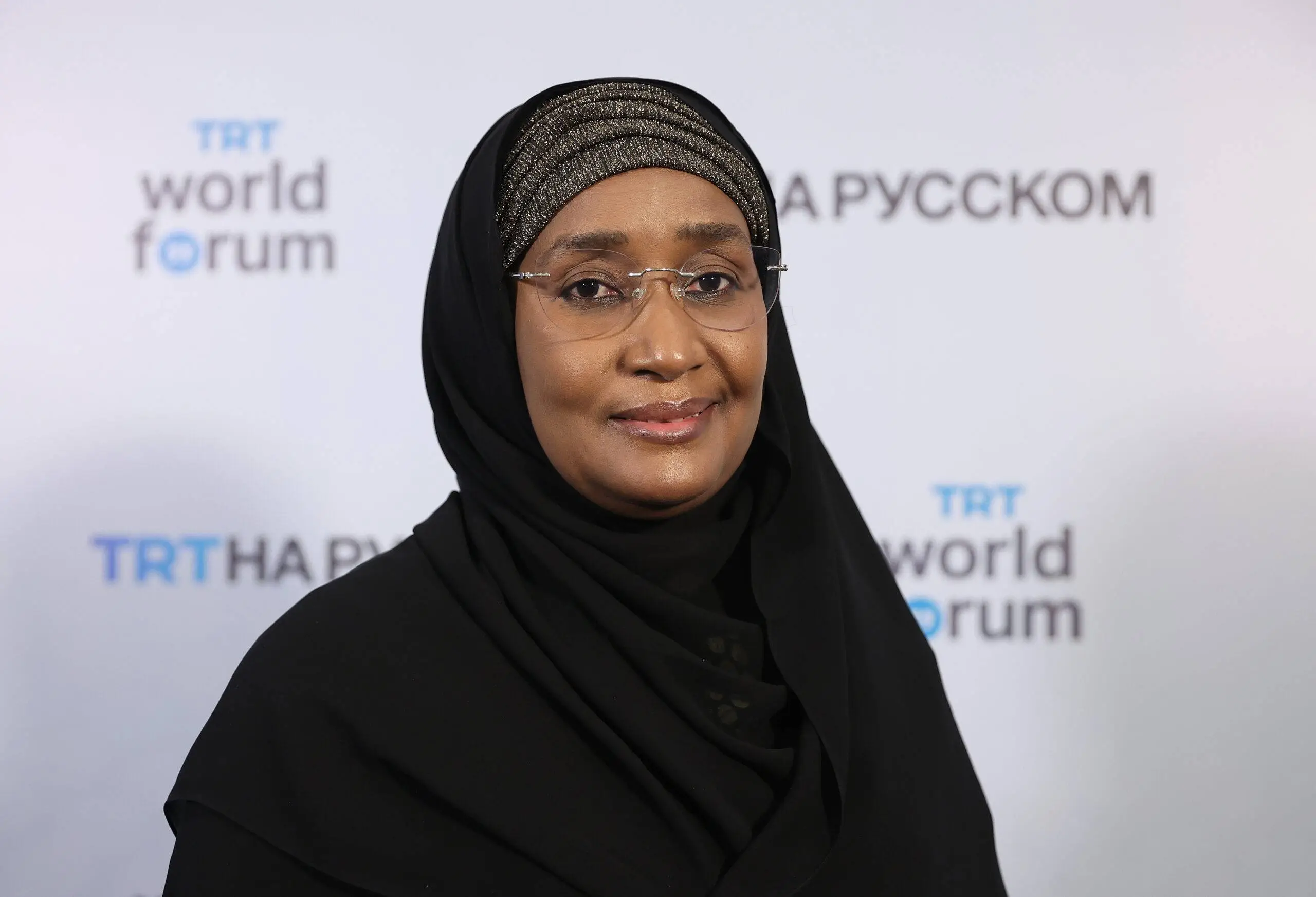
A Federal Capital Territory High Court sitting in Apo, Abuja, was thrown into fresh controversy on Monday as lawyers for former Minister of Humanitarian Affairs and Social Development, Sadiya Umar Farouq, told the court that their client was hospitalised in Egypt and medically incapable of standing trial.
The dramatic development unfolded at a resumed hearing before Justice Jude Onwuegbuzie, where proceedings had been scheduled for the formal arraignment of Farouq on a sweeping 21-count charge filed by the Economic and Financial Crimes Commission (EFCC).
The charges, which touch on breach of trust, abuse of office, and the alleged misappropriation of staggering sums of public money, have placed the former minister at the centre of one of the more high-profile corruption prosecutions to emerge from Nigeria’s anti-graft machinery in recent months.
The EFCC alleges that Farouq, alongside co-defendants Bashir Nura Alkali, a permanent secretary in the ministry and one Sani Mohammed, conspired to misappropriate approximately $1.3 million and ₦746.6 million in public funds, monies that were ostensibly meant to serve the welfare of Nigeria’s most vulnerable citizens.
When the case was called on Monday morning, it became immediately apparent that the first defendant was conspicuously absent from the dock. Her counsel, Oladipo Okpesheyi, rose to offer an explanation that was met with visible scepticism both from the bench and the prosecution.
“My lord, she is in Egypt,” Okpesheyi told the court. “I learnt that her doctor said she is not medically fit to appear today. There is a medical report I received on my phone last night that she is in the hospital on doctor’s advice in Egypt. She will need about two months to recover before she can come. We will be humbly asking for an adjournment.”
The submission, resting as it did on a medical report transmitted via a mobile phone the night before the hearing, drew immediate scrutiny. Notably absent was any formal, certified documentation presented before the court, raising questions about the verifiability of the claim.
Leading counsel for the EFCC, the formidable Rotimi Jacobs (SAN), was having none of it. Rising sharply in opposition, Jacobs reminded the court that this was not the first time the first defendant had failed to honour her legal obligations.
He noted that a second defendant, Alkali, had already surrendered himself to the court following an earlier bench warrant, a stark contrast to Farouq’s continued elusiveness.
Jacobs urged Justice Onwuegbuzie to sustain the existing arrest warrant against the former minister, arguing that the pattern of non-appearance could not be allowed to continue unchallenged.
The EFCC’s position was clear: the wheels of justice should not be indefinitely stalled by the absence of a defendant who, as yet, remains at large.
Justice Onwuegbuzie, clearly unimpressed by the defence’s submission, declined to discharge the bench warrant and issued a pointed warning against what he described as delay tactics.
In a firm address from the bench, the judge made it unmistakably clear that the court would not serve as an unwitting instrument for the prolonging of proceedings through convenient medical episodes and last-minute adjournment requests.
Nevertheless, in a measured exercise of judicial discretion, the court granted a short adjournment, pushing the arraignment to June 8, 2026, a concession that critics may view as yet another window of opportunity for the defence to manoeuvre.
The bench warrant against Farouq remains active.
The charges against Farouq carry significant public weight. As minister, she presided over a ministry whose mandate was the administration of social intervention programmes targeting millions of Nigerians living in poverty.
The allegation that funds from such a ministry were diverted for personal enrichment has fuelled public anger and underscored growing concerns about accountability within Nigeria’s social welfare architecture.
That the former minister is now reportedly recuperating in a hospital abroad while a Nigerian court awaits her presence will do little to quiet those concerns.
For many observers, the optics are damaging , an accused public official, facing charges of defrauding the poor, is receiving medical care in a foreign country while her co-defendant sits before the same court on Nigerian soil.
Whether Farouq returns to face the charges on June 8 remains to be seen. What is certain is that Justice Onwuegbuzie has signalled, in no uncertain terms, that the court’s patience is not without limits.
WHAT YOU SHOULD KNOW
Former Minister Sadiya Umar Farouq, charged alongside two others for allegedly misappropriating $1.3 million and ₦746.6 million in public funds, failed to appear in court for her arraignment, with her lawyer claiming she is hospitalised in Egypt for the next two months.
Despite a bench warrant already issued for her arrest, the court granted an adjournment to June 8, 2026. The judge warned against delay tactics and kept the warrant active.