Aliko Dangote has revealed that the NNPC was turned down in its bid to acquire a larger stake in his refinery, laying bare the power dynamics at the heart of Nigeria’s energy sector.
Speaking in a wide-ranging interview with Nicolai Tangen, chief executive officer of the Norwegian Sovereign Wealth Fund, Dangote confirmed that the decision to reject NNPC’s overtures was deliberate and strategic.
The group plans to open ownership of the refinery to everyday Nigerians through an initial public offering (IPO), and expanding NNPC’s foothold would have compromised that democratic vision.
“We are the ones that said no,” Dangote stated plainly. “We want to spread it and have everybody be part of it.”
The revelation adds fresh context to what has quietly been an uncomfortable chapter in the NNPC-Dangote relationship. NNPC had originally negotiated a 20 percent equity stake in the refinery, a significant position in what is now Africa’s largest single-train petroleum refinery.
However, the national oil company failed to meet its financial obligations, and its stake was progressively reduced to just 7.25 percent, acquired for $1 billion in 2021, with an option to purchase the remaining 12.75 percent by June 2024.
That option was never exercised. Instead, the NNPC, under former Group CEO Mele Kyari, opted to remain at its reduced holding, a decision the corporation’s then-spokesman, Olufemi Soneye, later attributed to a strategic pivot toward investing in compressed natural gas infrastructure.
Dangote, however, made clear that NNPC subsequently returned to the table seeking a larger share only to be turned away.
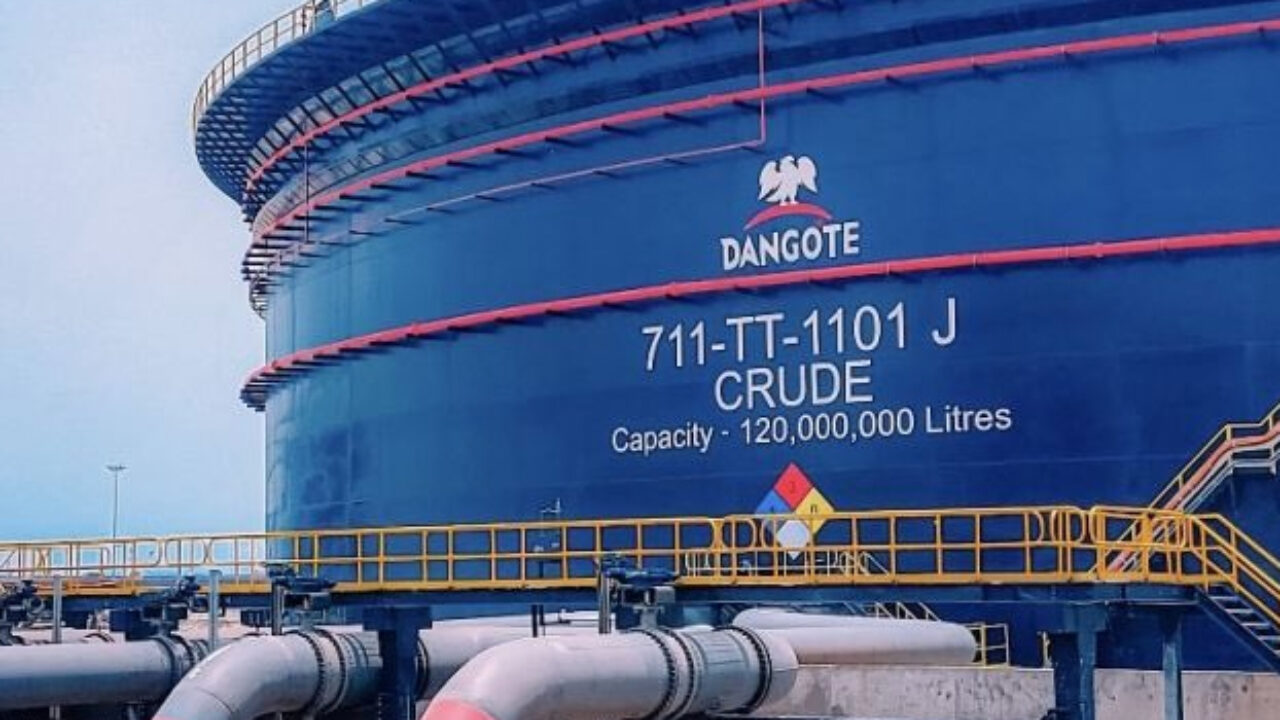
Beyond the ownership dispute, the interview offered a revealing look at the refinery’s operational performance. Dangote disclosed that the facility is now processing crude oil at 661,000 barrels per day, surpassing its nameplate capacity of 650,000 bpd.
The achievement, he argued, has fundamentally transformed the Dangote Group’s standing with global financial institutions.
“We have now processed even crude at 661,000 barrels a day,” he said. “A lot of financial institutions are saying, ‘Yes, if it is you doing this project, we are there to back you.'”
The refinery’s construction was itself a feat of financial improvisation. Dangote had originally intended to fund it largely from internally generated revenues. Still, successive naira devaluations forced the group to turn to a consortium of lenders, including Afreximbank, Africa Finance Corporation, Zenith Bank, Access Bank, UBA, Standard Bank of South Africa, and Standard Chartered Bank of the UK, to bridge the financing gap.
The Middle East crisis, far from being a threat, has proved a boon to Dangote’s operations. With global energy markets in turmoil, the refinery has found itself in the enviable position of being oversold.
Fertilizer prices have more than doubled, rising from roughly $400 per tonne to $850. Polypropylene, critical to Nigeria’s plastics industry, has surged from $900 to approximately $3,000 per tonne in the United Kingdom.
Dangote did not mince words about what that means for local manufacturers: without the polypropylene being produced at his plant, he argued, Nigeria’s entire plastics sector would have collapsed. Aviation fuel from the refinery, he added, is fully committed through mid-July, with daily jet fuel production running at 20 million liters.
Crude sourcing has also scaled dramatically. The refinery currently draws approximately 56 percent of its feedstock from Nigeria, supplemented by supplies from Angola, Libya, and the United States, requiring the procurement of 21 cargo shipments every single month.
Perhaps most provocatively, Dangote openly named the forces he believes have been working to destabilize his enterprise. He described a network of shippers, commodity traders, and local intermediaries, all of whom profited handsomely from Nigeria’s fuel subsidy regime, which he claims was costing the country nearly $10 billion annually, as the primary antagonists.
“These are the people that did not want us to settle down because they believed that we were coming here to displace them,” Dangote said. “And of course, that’s what we have done now.”
With that battle largely won, Dangote’s sights are now fixed firmly on the horizon. The group is targeting $100 billion in revenue by 2030, underpinned by a $45 billion capital injection to be raised through partial asset sales and new investor participation.
Cement production is earmarked to reach 100 million tonnes. The refinery itself is slated for a more than doubling of capacity, with plans to reach 1.4 million barrels per day within 30 months.
If achieved, the target EBITDA of over $30 billion, ten times last year’s figure of $3 billion, would vault the Dangote Group into the ranks of the world’s most profitable industrial conglomerates, with a market valuation the businessman himself projects could exceed $250 billion.
Amid the billion-dollar projections, Dangote offered a quietly personal aside that spoke to the singular focus driving his ambitions. Years ago, he sold his properties in both the United States and the United Kingdom, including two large homes in America and one in Britain, to plant himself fully in Nigeria.
“I wanted to really sit in Nigeria and concentrate,” he explained. “Now my life is very simple. Wherever I go, I use hotels; I pay. When I leave, nobody will call me and say I have a burst pipe.”
It is a posture that, taken together with everything else he revealed, speaks to a man who has made a calculated, total bet on Nigeria—and is, by most measurable indicators, winning it.
WHAT YOU SHOULD KNOW
Aliko Dangote’s refinery is no longer just a construction success story; it is a fully operational industrial powerhouse running beyond its own designed limits, and its owner has made clear he intends to keep it that way, on his own terms.
Dangote rejected NNPC’s bid for more shares because he wants ordinary Nigerians to own a piece of the refinery through a future IPO, a significant statement about who he believes this asset ultimately belongs to.