Mohammed Bello El-Rufai, son of former Kaduna Governor Nasir El-Rufai, has dumped the ruling APC for the ADC, the latest lawmaker to jump ship ahead of the 2027 elections.
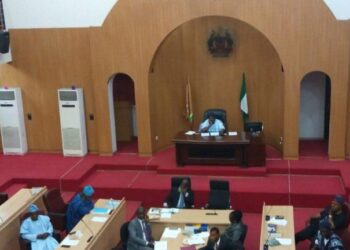
The announcement was made on the floor of the House of Representatives by Speaker Abbas Tajudeen during plenary, as four lawmakers across multiple parties simultaneously declared switches in their political allegiances, a development that underscores the deepening instability within Nigeria’s major parties.
Bello El-Rufai, who represents Kaduna North Federal Constituency in the House of Representatives, described his decision to leave the APC as difficult but necessary, saying he took the step after extensive consultations with his political mentors.
The defection carries particular symbolic weight. It comes months after his father, former Governor Nasir El-Rufai, a founding member of the APC who served as Governor of Kaduna State from 2015 to 2023, had himself defected from the ruling party, joining the ADC in November 2025 as part of a broad opposition coalition targeting President Bola Tinubu’s grip on power in 2027.
For a time, father and son had stood on opposing political sides; the elder El-Rufai had publicly acknowledged this divergence, saying of his son, “He is an adult of over 30 years; he can make his own choices.” Politics is about personal preference.” That divergence has now closed, with Bello crossing over to his father’s political home.
Speaker Tajudeen also announced that two Peoples Democratic Party (PDP) lawmakers from Kaduna State, Umar Ajilo and Suleiman Richifa, were joining the ADC alongside him.
Ajilo cited the prolonged leadership crisis in the PDP as a primary reason, saying it had made it difficult for him to effectively focus on representing his constituents. He added that after consultations with stakeholders in his constituency, he decided to join the ADC to pursue his political future.
On the other end of the political carousel, Speaker Tajudeen announced the defection of Kamilu Ado, a lawmaker from Kano State, from the ADC to the Nigeria Democratic Congress (NDC), as well as that of Joshua Obika, who represents the AMAC/Bwari Federal Constituency of the Federal Capital Territory, from the APC to the NDC.
The News Agency of Nigeria (NAN) reports that all the affected members cited internal crises and uncertainty within their former parties as justification for their moves.
Thursday’s defections do not occur in a vacuum. They are the latest chapter in a dramatic unravelling of Nigeria’s opposition alignment.
The ADC had, since early 2025, been the platform of a formidable coalition of opposition heavyweights, including former Vice President Atiku Abubakar, former Governor Peter Obi, former Senate President David Mark, Nasir El-Rufai, ex-Minister Rotimi Amaechi, and Rabiu Kwankwaso, who had plotted to unseat President Tinubu in 2027.
Just days ago, no fewer than 18 House of Representatives members and two senators defected from the ADC to the NDC, barely two days after former Anambra State Governor Peter Obi and former Kano State Governor Rabiu Kwankwaso quit the party. The defections have left the ADC with just six members in the House of Representatives.
With the 2027 elections drawing closer, the reshuffling of alliances shows no signs of slowing. For Bello El-Rufai, the move to the ADC aligns him not only with his father’s political camp but also with what remains of an opposition bloc still struggling to regroup.
Whether the ADC can consolidate what is left of its coalition and whether Thursday’s additions signal a stabilization or merely another ripple in an increasingly choppy political sea remains to be seen.
WHAT YOU SHOULD KNOW
Bello El-Rufai‘s defection from the APC to the ADC, now joining his father’s side, is a footnote in a much larger crisis: the ADC-anchored coalition that once threatened to unseat President Tinubu in 2027 is collapsing under the weight of its own leadership feuds and presidential ticket disputes.
With dozens of lawmakers abandoning the ADC in rapid succession and heavyweights like Peter Obi and Kwankwaso already gone, what was Nigeria’s most formidable opposition front has been reduced to a shell.
As 2027 approaches, the opposition remains dangerously fragmented — and that, more than any individual defection, is the headline.