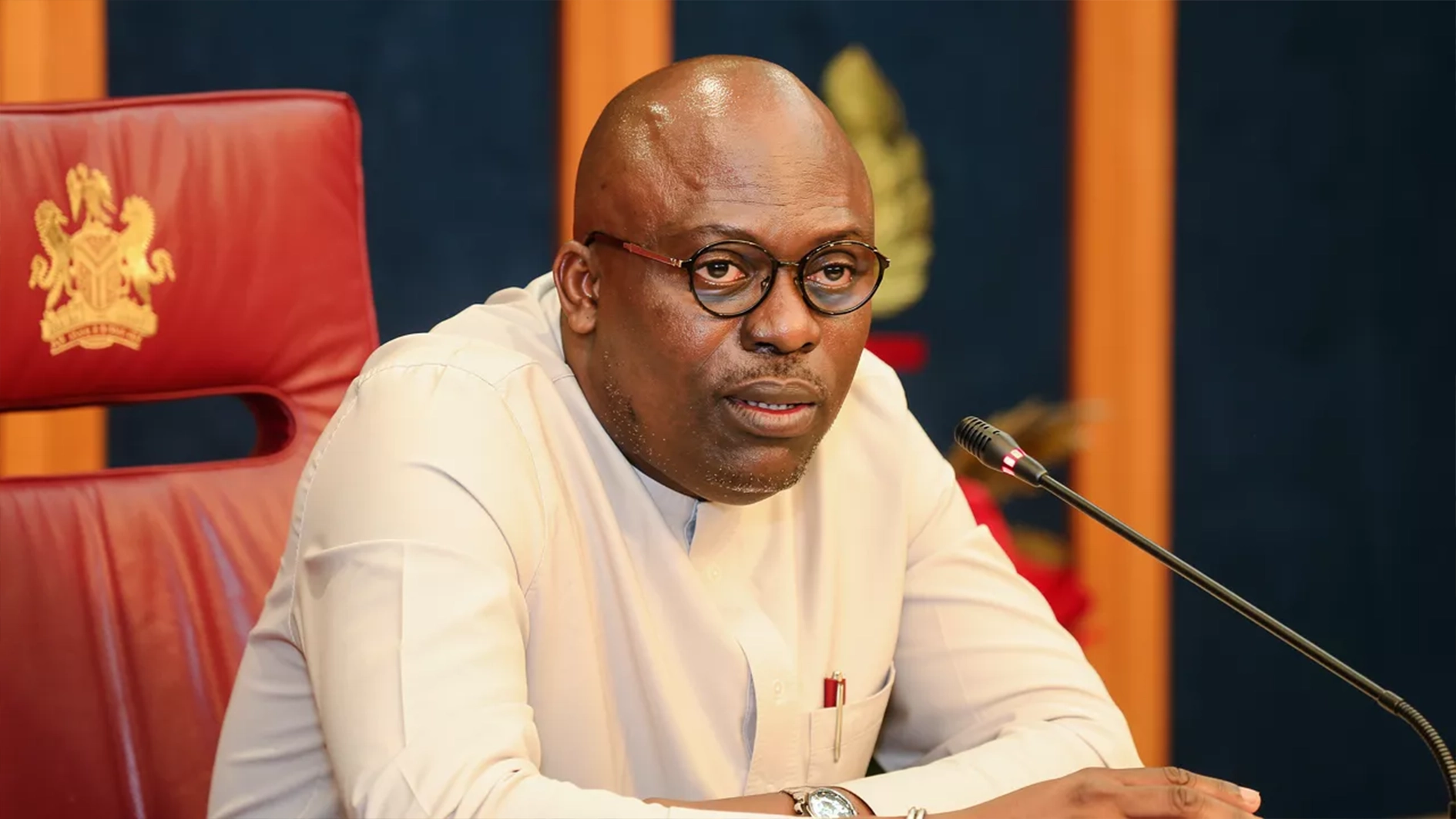
Rivers State Governor Siminalayi Fubara threw his full weight behind President Bola Tinubu’s re-election bid on Thursday, declaring before an assembly of some of the country’s most revered traditional rulers that Nigeria is in safe and capable hands.
Fubara made the declaration while formally opening the fourth meeting of the Southern Traditional Rulers Council in Port Harcourt, a high-profile gathering that drew monarchs from all 17 southern states to deliberate on pressing matters of unity, security, and economic development.
The choice of venue was itself a statement, with the governor describing Rivers State’s willingness to host the summit as evidence of its peaceful disposition and its readiness to be a stage for consequential national conversations.
“It is not ideal to change the goalposts in the middle of the game,” Fubara told the assembled monarchs, in remarks that were as much a political manifesto as they were an opening address.
The governor argued that the Tinubu administration, despite the well-documented hardships that have accompanied its sweeping economic reforms, is making measurable progress, pointing specifically to the revival of key infrastructure projects, including coastal road developments that have long been anticipated across the southern corridor.
His message was clear and deliberate: continuity, not disruption, is what Nigeria needs. For a governor who has himself navigated turbulent political waters in Rivers State, including a protracted and very public power struggle with his predecessor and political godfather, Nyesom Wike, the endorsement carries particular weight.
It is a signal to political watchers that Fubara is consolidating his position within the broader Tinubu political orbit, even as he works to stabilize governance at home.
The summit itself, chaired by the Ooni of Ife, Oba Adeyeye Enitan Ogunwusi, one of the most prominent and internationally recognized traditional rulers in Africa, was convened under the banner of peace, regional solidarity, and constructive engagement with federal governance.
Addressing delegates, the Ooni framed the council not merely as a ceremonial body but as a living institution that embodies the rich and complex tapestry of southern Nigerian identity.
He noted that more than 400 dialects are spoken across the southern states represented at the meeting, a figure that underscores both the extraordinary diversity and the remarkable cohesion that the council seeks to nurture.
“This is unity in diversity in its truest form,” the Ooni remarked, according to sources present at the session. He noted that the Port Harcourt meeting is the fourth in an ongoing series, following previous sessions held in Imo, Ogun, and Lagos states, a deliberate rotation that reinforces the council’s commitment to giving each subregion a voice and a stake in its proceedings.
Also present at the summit were the council’s co-chairman, the Obi of Obinugwu, Eze Cletus Illomuanya, and the Olubadan of Ibadan, Oba Senator Rashidi Adewolu Ladoja—whose combined influence spans the South-East and South-West, lending the gathering a broad and representative character that few forums in Nigeria can claim.
Beyond the political optics, the council’s agenda addressed issues of urgent and practical importance to millions of Nigerians in the south. The Ooni confirmed that traditional rulers would deliberate on strategies to support the federal government in tackling the twin crises of insecurity and economic instability, two challenges that have defined the Tinubu administration’s first term and that remain acutely felt across the southern states.
Notably, the Ooni was careful to characterize participation in the council as voluntary, a point that observers say is significant, given the delicate sensitivities around any body that could be perceived as a vehicle for political patronage or pressure. The emphasis on voluntary engagement, he suggested, is precisely what lends the forum its moral authority and its credibility as an independent voice for the South.
Governor Fubara echoed this spirit of collective ownership, urging stakeholders across the region to set aside parochial interests in pursuit of shared aspirations. His call for southern unity was pointed and purposeful, a recognition that a fragmented South carries less weight in the corridors of Abuja than a region that speaks with one voice.
With the 2027 general elections still on the horizon but increasingly in the calculations of Nigeria’s political class, these gatherings serve a dual purpose: they are platforms for genuine policy deliberation, but they are also, unmistakably, terrain on which political capital is built, and alliances are forged.
Whether the monarchs of the Southern Traditional Rulers Council will ultimately lend their collective moral weight to any electoral cause remains to be seen.
What Thursday’s meeting made plain, however, is that the south—diverse, dynamic, and fiercely proud of its identity- is already in conversation about the kind of Nigeria it wants to shape, and the kind of leadership it believes can deliver it.
WHAT YOU SHOULD KNOW
Governor Fubara’s public endorsement of President Tinubu’s re-election, delivered before an audience of the region’s most influential monarchs, was no coincidence.
With 2027 quietly ticking in the background, the Southern Traditional Rulers Council summit served as both a platform for genuine dialogue on unity, security, and development and a carefully staged political signal.
The south is organizing, alliances are being tested, and the battle for Nigeria’s next electoral chapter has, for all practical purposes, already begun.