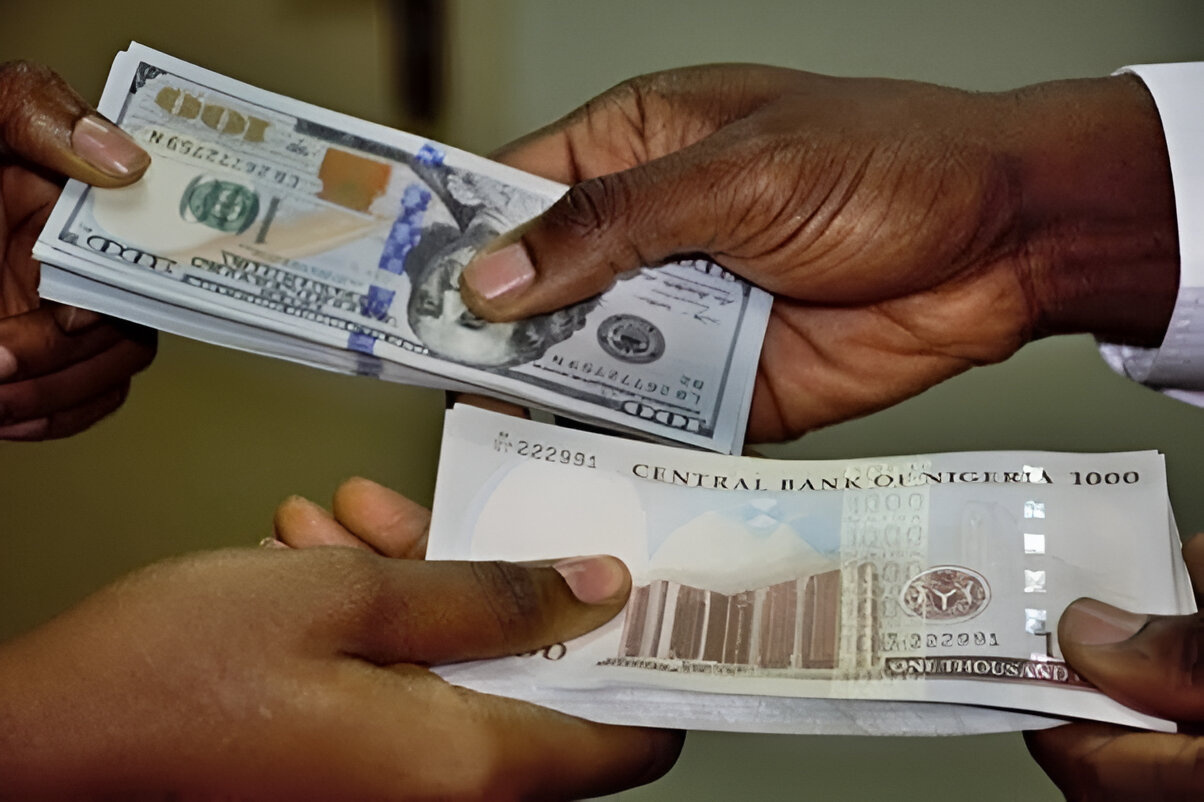
The naira slipped to N1,359 against the dollar on Tuesday as markets weighed the CBN’s latest monetary policy decision amid signs of improving macroeconomic conditions.
The slight depreciation from Monday’s close of N1,353.5/$ followed the conclusion of the 304th Monetary Policy Committee (MPC) meeting, at which the CBN’s rate-setting body voted to trim the benchmark Monetary Policy Rate by 50 basis points—from 27 percent to 26.5 percent.
It was a carefully telegraphed easing, one that analysts had largely anticipated, yet the naira’s muted negative response underscores just how sensitive Africa’s largest economy’s currency remains to any shift in the interest rate environment.
For context, higher interest rates typically attract foreign capital by offering better returns on naira-denominated assets, thereby supporting the currency. A rate cut, even a modest one, can unwind that calculus, prompting some investors to reassess their exposure. Tuesday’s marginal weakening appears to reflect precisely that kind of cautious repositioning—a market hedging, rather than panicking.
Yet to focus exclusively on the day’s currency movement would be to miss the more consequential headline to emerge from Abuja on Tuesday. CBN Governor Olayemi Cardoso, addressing journalists after the MPC’s deliberations, disclosed that Nigeria’s gross external reserves have climbed to $50.45 billion as of February 16—the highest level recorded in thirteen years, and a figure that would have seemed almost aspirational not long ago, given the acute foreign exchange crises that plagued the country through much of the early 2020s.
For a nation that has weathered severe dollar shortages, chronic currency instability, and the scars of multiple devaluation cycles, a reserve position above $50 billion represents something tangible: firepower.
It is the kind of buffer that gives a central bank the capacity to intervene in markets when volatility threatens to spiral, and it sends a signal to foreign investors that Nigeria’s external position is on firmer ground.
Cardoso was keen to emphasize that point. The MPC, he said, noted the “remarkable performance of Nigeria’s external sector,” crediting it with contributing to greater stability in the foreign exchange market and with bolstering investor confidence—a commodity the governor clearly regards as foundational to any durable exchange rate framework.
“Without market confidence, no matter what you do, you will significantly suboptimize,” Cardoso said—a pointed remark that speaks to the hard lessons of Nigeria’s recent currency management history, when policy uncertainty and opaque intervention practices eroded trust and fueled speculation.
Equally striking is the trajectory of Nigeria’s inflation, which declined for the eleventh consecutive month, falling to 15.1 percent in January 2026. That is a remarkable run by any standard, and it provided the MPC with the political and economic space to ease monetary policy without appearing reckless.
For much of 2024 and into 2025, the CBN held rates at punishing levels in a bid to tame inflation that had surged above 30 percent, squeezing households and businesses alike. The sustained downward trend now offers some relief—both to borrowers facing steep lending rates and to policymakers who have defended the tight stance with increasing strain.
The committee, however, was careful not to overplay its hand. Alongside the rate cut, the MPC left its other key policy parameters unchanged. The Cash Reserve Ratio remains at 45.0 percent for commercial banks and 16.0 percent for merchant banks—among the highest such requirements in the world, reflecting the CBN’s continued commitment to carefully manage system-wide liquidity.
The liquidity ratio holds at 30.0 percent, and the Standing Facilities Corridor remains set at +50 and -450 basis points around the MPR, maintaining the asymmetric structure designed to discourage excessive recourse to the central bank’s lending window.
Tuesday’s naira reaction also invites a broader reflection on how Nigeria’s currency has responded to successive MPC decisions—and the picture is far from straightforward.
After the 303rd MPC meeting, the naira actually appreciated, closing at N1,441 per $1. Ahead of that November gathering, it had already strengthened from N1,458/$ to N1,452/$, suggesting that pre-meeting expectations and post-decision relief can sometimes work in the currency’s favor.
Contrast that with the outcome following the 302nd MPC meeting, when the naira weakened from N1,491.49/$ to N1,493.2/$—a reminder that rate decisions alone do not determine currency direction.
What these divergent outcomes reveal is that the naira’s movement is rarely a simple function of interest rate arithmetic. Liquidity conditions in the interbank market, the volume of dollar inflows from oil revenues and diaspora remittances, the appetite of foreign portfolio investors, and the broader mood of global risk sentiment all feed into the exchange rate equation in ways that can overwhelm even a well-communicated policy decision.
For now, the CBN appears to be threading a deliberate needle—easing policy gradually enough to support economic activity without triggering a disorderly currency sell-off. Whether that balance holds will depend in large part on whether the reserve build-up continues, whether inflation sustains its downward trend, and whether the confidence that Governor Cardoso speaks of so earnestly translates into the kind of sustained foreign investment that can keep the naira from revisiting its darker chapters.
Tuesday’s slip of roughly six naira to the dollar is, in isolation, unremarkable. In context, it is a reminder that Nigeria’s currency story—for all its recent progress—remains unfinished, and that each MPC decision is as much a test of market psychology as it is of economic policy.
WHAT YOU SHOULD KNOW
The naira’s slight dip to N1,359/$ following the CBN’s 50 basis point rate cut is a minor blip in what is otherwise an encouraging economic story. The headline that truly matters is this: Nigeria’s foreign reserves have hit a 13-year high of $50.45 billion, inflation has fallen for eleven straight months, and the CBN is now confident enough in that progress to begin easing monetary policy.
The currency’s short-term wobble aside, the fundamentals are pointing in the right direction—and for a country that has endured years of foreign exchange turmoil, that is no small thing.