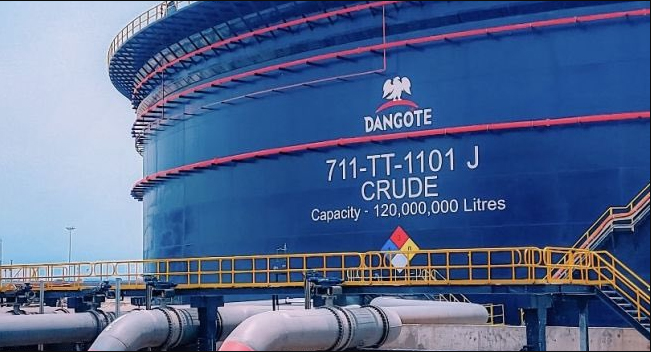
The Dangote Group has inked a landmark $400 million construction equipment agreement with Chinese machinery giant XCMG Construction Machinery, setting the stage for one of the most ambitious industrial expansion drives the continent has ever seen.
The deal, disclosed in an official statement by the company, will see heavy-duty construction equipment deployed in phases across multiple large-scale project sites over the next three years, anchored by a bold plan to nearly triple the output of the group’s flagship Dangote Petroleum Refinery & Petrochemicals complex in Lekki, on the outskirts of Lagos.
When the Dangote refinery first came online, it turned heads worldwide. Designed with an initial capacity of 650,000 barrels per day, it already ranked among the largest single-train refineries on the planet—a feat of engineering and capital mobilization that few thought possible on African soil.
Now, the group is doubling down. Under the new expansion blueprint, refining capacity is projected to surge to approximately 1.4 million barrels per day upon completion—a figure that would vault the Lekki facility into the upper echelon of the world’s largest refineries, rubbing shoulders with the behemoths of the Middle East and Asia.
That transformation, the group insists, will not happen by chance. The $400 million XCMG equipment package is the industrial backbone upon which that ambition rests, enabling faster civil works, more efficient logistics operations, and accelerated plant installations across multiple sites simultaneously.
The refinery headline figures tell only part of the story. The scale of Dangote’s broader industrial ambitions becomes starker when the full scope of the expansion is laid out.
Polypropylene output—a critical input for packaging, textiles, and consumer goods manufacturing—is projected to climb from 900,000 metric tons per annum to roughly 2.4 million metric tons, a near-tripling of capacity that could reshape supply dynamics for manufacturers across the continent.
In the fertilizer segment, the group plans to triple Nigeria’s urea production capacity from three million to nine million metric tons annually, a move with profound implications for African food security, where access to affordable fertilizer has long constrained agricultural productivity. The group’s Ethiopian fertilizer facility, meanwhile, will maintain its existing three million metric tons per year throughput as attention pivots to scaling operations elsewhere.
Perhaps most striking is the group’s quiet march toward continental dominance in linear alkyl benzene—the key raw material behind the detergent and cleaning products used in millions of African homes. Annual output of the compound is targeted to reach 400,000 metric tons, a level that would crown Dangote as the largest linear alkyl benzene producer on the African continent. New base oil production capacity is also on the drawing board as part of what the group describes as a broader industrial scale-up strategy.
The partnership with XCMG carries significance beyond the machinery itself. In announcing the deal, the Dangote Group did not shy away from the magnitude of its self-declared destination.
“The additional equipment we are acquiring under this partnership will significantly enhance execution across our projects,” the company stated. “With this investment, we are positioning ourselves to become the number one construction company in the world.”
It is a declaration that, from almost any other corporate boardroom, might invite skepticism. From Dangote, which has spent decades converting seemingly outsized ambitions into concrete reality, the statement arrives with a certain weight of precedent.
The newly acquired machines will complement an already substantial fleet of equipment deployed across the group’s refinery and industrial project sites—reinforcing, rather than replacing, an existing infrastructure base that has quietly grown into one of the most formidable construction and industrial platforms in Africa.
The deal arrives at a moment of heightened focus on African energy and industrial self-sufficiency. For decades, Nigeria—despite sitting atop some of the world’s most significant crude oil reserves—has been a net importer of refined petroleum products, a paradox that has drained foreign exchange, stoked inflation, and left consumers and businesses hostage to global price volatility.
The Dangote refinery was always conceived as the antidote to that contradiction. The latest expansion accelerates that corrective mission, with the group explicitly framing the scale-up as a mechanism to strengthen the domestic supply of refined petroleum products, petrochemicals, and fertilizer—while simultaneously building out export capacity to serve African and global markets.
The phased deployment of XCMG equipment over three years suggests a methodical, project-managed approach to an expansion that, in total scope, few construction programs anywhere in the world can currently match. For the African industry, the implications of success would be transformative. For global energy and petrochemical markets, it is a development that analysts and competitors alike can no longer afford to overlook.
WHAT YOU SHOULD KNOW
The Dangote Group’s $400 million equipment deal with XCMG is more than a procurement agreement—it is a declaration of industrial intent. With plans to nearly double refining capacity to 1.4 million barrels per day, triple urea output, and dominate African petrochemical markets, the group is systematically dismantling Africa’s dependence on imported industrial products. If executed as planned, this expansion will not just reshape Nigeria’s economy—it will redraw the industrial map of an entire continent.