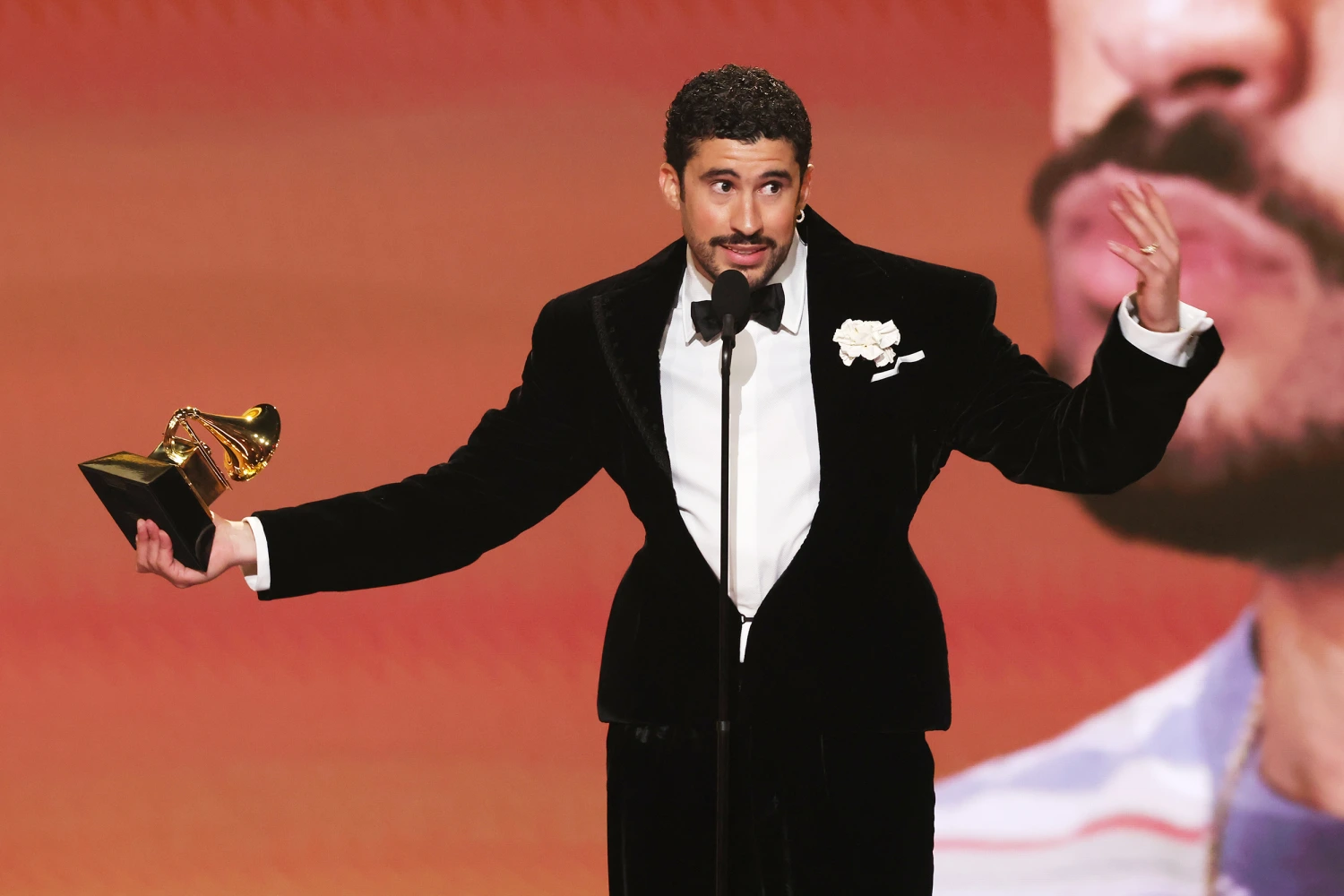
In a landmark moment for Latin music and the Recording Academy, Puerto Rican superstar Bad Bunny claimed the Grammy Awards’ most prestigious honor on Sunday night, as his album ‘Debí Tirar Más Fotos’ became the first Spanish-language record to win album of the year in the ceremony’s 68-year history.
The victory, announced at the Crypto.com Arena before a packed audience, marks a seismic shift in an awards show that has long been criticized for overlooking non-English language artists in its top categories. For Bad Bunny, born Benito Antonio Martínez Ocasio, the win represents both personal vindication and a breakthrough for Latin music on the global stage.
“This is not just my award—this is for everyone who has been told their language, their culture, wasn’t enough,” Bad Bunny said during his acceptance speech, delivered in Spanish with English subtitles displayed on screens throughout the arena.
In a poignant full-circle moment, it was Harry Styles who presented the golden gramophone to Bad Bunny. Three years ago, Styles’ “Harry’s House” defeated Bad Bunny’s Un Verano Sin Ti in this same category—the only other Spanish-language album previously nominated for album of the year. The British pop star embraced the reggaeton artist warmly before handing over the trophy, a gesture that wasn’t lost on observers who noted the symbolism of the torch being passed.
“Debí Tirar Más Fotos” swept multiple categories throughout the evening, also capturing best música urbana album, while the album’s track “EOO” earned the award for best global music performance. The album, whose title translates to “I Should Have Taken More Photos,” is an introspective meditation on memory, home, and Puerto Rican identity that resonated deeply with critics and fans alike.
Industry insiders and cultural commentators have noted that Bad Bunny’s victory arrives amid heightened political tensions. The win is being interpreted, at least in part, as a statement by Recording Academy voters against the anti-immigrant rhetoric that has characterized President Donald Trump‘s second term.
Though Bad Bunny, as a Puerto Rican, is an American citizen—a fact many in the general public don’t fully grasp—his outspoken advocacy for Latin American communities and his unapologetic embrace of his heritage have made him a cultural lightning rod.
The parallels to the 2007 Grammy Awards are hard to ignore. That year, country trio The Chicks (then known as the Dixie Chicks) swept the major categories in what was widely seen as the Academy’s endorsement of the group following their public criticism of President George W. Bush and the Iraq War. Similarly, Bad Bunny’s triumph is being read as the music industry taking a stand during another contentious political moment.
Behind the scenes, significant institutional changes may have paved the way for this historic outcome. Harvey Mason Jr., CEO of the Recording Academy, confirmed that the organization recently extended invitations to all voting members of the Latin Recording Academy to join the Grammy voting body. Nearly 1,000 were accepted, creating an infusion of new voices that better reflect the diversity of contemporary music.
This demographic shift in the voting membership appears to have had ripple effects beyond Bad Bunny’s victory. The Buena Vista Social Club’s win for best musical theater album over heavily favored productions like Maybe Happy Ending and Just in Time has been attributed to this same influx of Latin voters, who championed the celebration of Cuban musical heritage.
While Bad Bunny’s victory is being celebrated as a breakthrough for representation, it has also renewed conversations about another glaring omission in Grammy history. No rap album has won album of the year since OutKast’s “Speakerboxxx/ The Love Below” claimed the prize 22 years ago in 2004.
This year marked a milestone for hip-hop representation, with three rap albums nominated in the category for the first time—including Kendrick Lamar‘s critically acclaimed project. However, some analysts suggest this historic representation may have actually worked against the genre, splitting votes among the rap nominees and allowing Bad Bunny to consolidate support from a broad coalition of voters.
Bad Bunny’s Grammy triumph comes just one week before he takes center stage at what may be the year’s most-watched entertainment event: the Super Bowl LIX Halftime Show on February 8 in New Orleans. With his album of the year victory secured, he’s poised to join an exceptionally rare company.
According to Grammy historians, Bad Bunny will become only the second artist to win Album of the Year and perform the Super Bowl Halftime Show in the same calendar year. The first was Tony Bennett, who performed at Super Bowl XXVIII on January 29, 1994, alongside Patti LaBelle, Teddy Pendergrass, Arturo Sandoval, and Miami Sound Machine, then won album of the year for “MTV Unplugged” at the Grammys held on March 1 of that year.
The timing could hardly be more perfect for an artist at the peak of his cultural influence. Bad Bunny’s halftime performance is expected to draw one of the largest global audiences in television history, potentially reaching over 120 million viewers in the United States alone—many of whom will now be tuning in to see a newly minted Grammy champion.
As the confetti settled Sunday night and Bad Bunny held his Grammy aloft, the message was unmistakable: the sound of popular music has changed, and the industry’s highest honors are finally catching up.
WHAT YOU SHOULD KNOW
Bad Bunny’s Debí Tirar Más Fotos shattered a 68-year barrier as the first Spanish-language album to win a Grammy for Album of the Year—a historic breakthrough fueled by the Recording Academy’s decision to add nearly 1,000 Latin Recording Academy members to its voting body.
This institutional change, combined with Bad Bunny’s cultural resonance amid heightened political tensions around immigration, transformed what had seemed impossible into reality.
The win signals a fundamental shift in how the music industry recognizes non-English artistry, though it also underscores ongoing gaps: no rap album has won this category in 22 years, despite unprecedented hip-hop representation this year.
Bad Bunny will cement this watershed moment by performing at the Super Bowl Halftime Show next week, becoming only the second artist ever to achieve both honors in the same year.