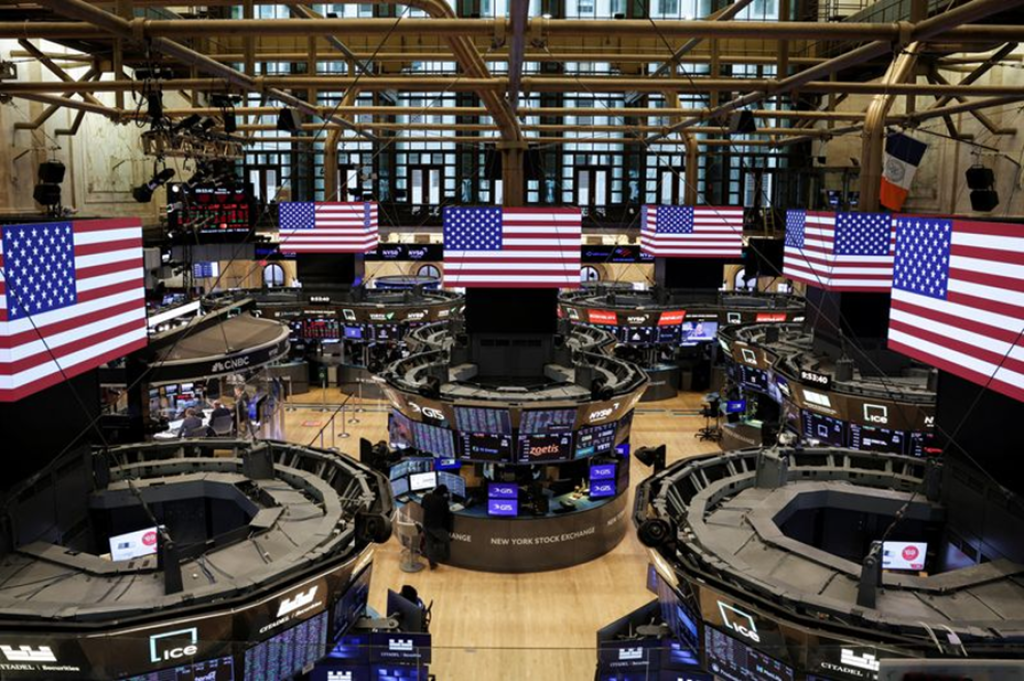
Wall Street maintained its perch near all-time highs on Friday in characteristically light post-Christmas trading, as investors found renewed confidence in artificial intelligence investments and economic resilience heading into the final days of what has been another banner year for equities.
The benchmark S&P 500 briefly touched a fresh intraday record before retreating modestly, while the Dow Jones Industrial Average hovered within half a percentage point of its December 12 peak. Trading volumes remained subdued as many market participants extended their holiday breaks, though the session’s calm belied the remarkable recovery stocks have staged in recent days.
The rebound comes on the heels of last week’s sharp sell-off, when technology and AI-related stocks faced intense scrutiny over stretched valuations and mounting concerns about the massive capital expenditures required to build out artificial intelligence infrastructure. Those investments, critics warned, could weigh on near-term profitability even as companies race to dominate the emerging AI landscape.
But sentiment has shifted dramatically as a confluence of factors reignited investor appetite. A steady stream of robust economic data has reinforced the narrative of American economic exceptionalism, while speculation about future Federal Reserve policy under potential new leadership next year has bolstered expectations for additional monetary easing. Most significantly, enthusiasm for AI stocks has roared back, propelling the market’s three major indexes toward their third consecutive year of double-digit gains.
“2026 is likely going to be a ‘prove-it’ year for markets,” cautioned Brian Jacobsen, chief economist at Annex Wealth Management. “Companies must deliver tangible productivity and margin gains from AI and other investments.” His comments underscore the mounting pressure on corporations to translate massive AI spending into bottom-line results.
Wall Street analysts are betting they will succeed. Profit forecasts for S&P 500 companies call for earnings growth of 15.5% in 2026, according to LSEG data, an acceleration from the 13.2% expansion expected for 2025. Those projections reflect growing confidence that AI investments will begin bearing fruit as the technology matures beyond its current experimental phase.
The S&P 500’s performance this year tells the story of a market in transition. The index has climbed more than 17% in 2025, initially powered almost exclusively by megacap technology giants. But the rally has broadened considerably in recent months, with investors rotating into economically sensitive sectors such as financials and materials, suggesting growing confidence in sustained economic expansion rather than narrow tech dominance.
Market watchers are now focused on whether the so-called “Santa Claus rally” will materialize. This seasonal pattern, identified by the Stock Trader’s Almanac, typically sees the S&P 500 post gains during the last five trading days of the year and the first two sessions of January. That seven-day window opened Wednesday and runs through January 5, offering a potential final boost to an already strong year.
By mid-morning Friday, the markets showed mixed results in sleepy trading. The Dow slipped 65 points, or 0.13%, to 48,666, while the S&P 500 was virtually unchanged at 6,931. The tech-heavy Nasdaq Composite edged up 0.05% to 23,625, buoyed by strength in semiconductor stocks.
Nvidia, the poster child for AI enthusiasm, gained 1.4% after announcing it would license chip technology from startup Groq and bring the company’s CEO onto its team, a move analysts viewed as strengthening the chipmaker’s already dominant position in AI computing.
Retailer Target climbed 1.7% following reports that activist hedge fund Toms Capital Investment Management has taken a substantial stake in the company and is pushing for changes. Such activist campaigns often unlock shareholder value through operational improvements or strategic shifts.
Precious metals miners were among the session’s standout performers, with shares of First Majestic, Coeur Mining, and Endeavour Silver rising between 0.3% and 2.2% as gold and silver prices surged to fresh record highs. The metals’ strength reflects persistent inflation concerns and geopolitical uncertainty that continue to drive safe-haven demand.
Beneath the surface, market breadth told a more cautious story. Declining stocks outnumbered advancing ones by a ratio of 1.37-to-1 on the New York Stock Exchange and 1.71-to-1 on the Nasdaq, suggesting the session’s modest gains were concentrated in a relatively small group of stocks. The S&P 500 notched 17 new 52-week highs against no new lows, while the Nasdaq recorded 33 new highs but also 126 new lows, highlighting the divergence in individual stock performance.
As the calendar year draws to a close, investors find themselves balancing optimism about AI’s transformative potential and economic strength against the very real need for companies to demonstrate that billions in technology investments will generate returns. The coming year will test whether market valuations can be justified by actual results or whether enthusiasm has once again outpaced reality.
WHAT YOU SHOULD KNOW
U.S. stocks are closing out 2025 near record highs, marking a third consecutive year of strong gains driven primarily by AI optimism and economic resilience. However, 2026 will be a critical “prove-it” year where companies must demonstrate that their massive AI investments can actually translate into tangible profits and productivity gains.
While the AI rally has rekindled after last week’s sell-off, investors are now demanding results over promises. With analysts expecting 15.5% profit growth in 2026, the pressure is on tech companies to show that billions in AI spending will pay off—or risk another valuation reckoning.