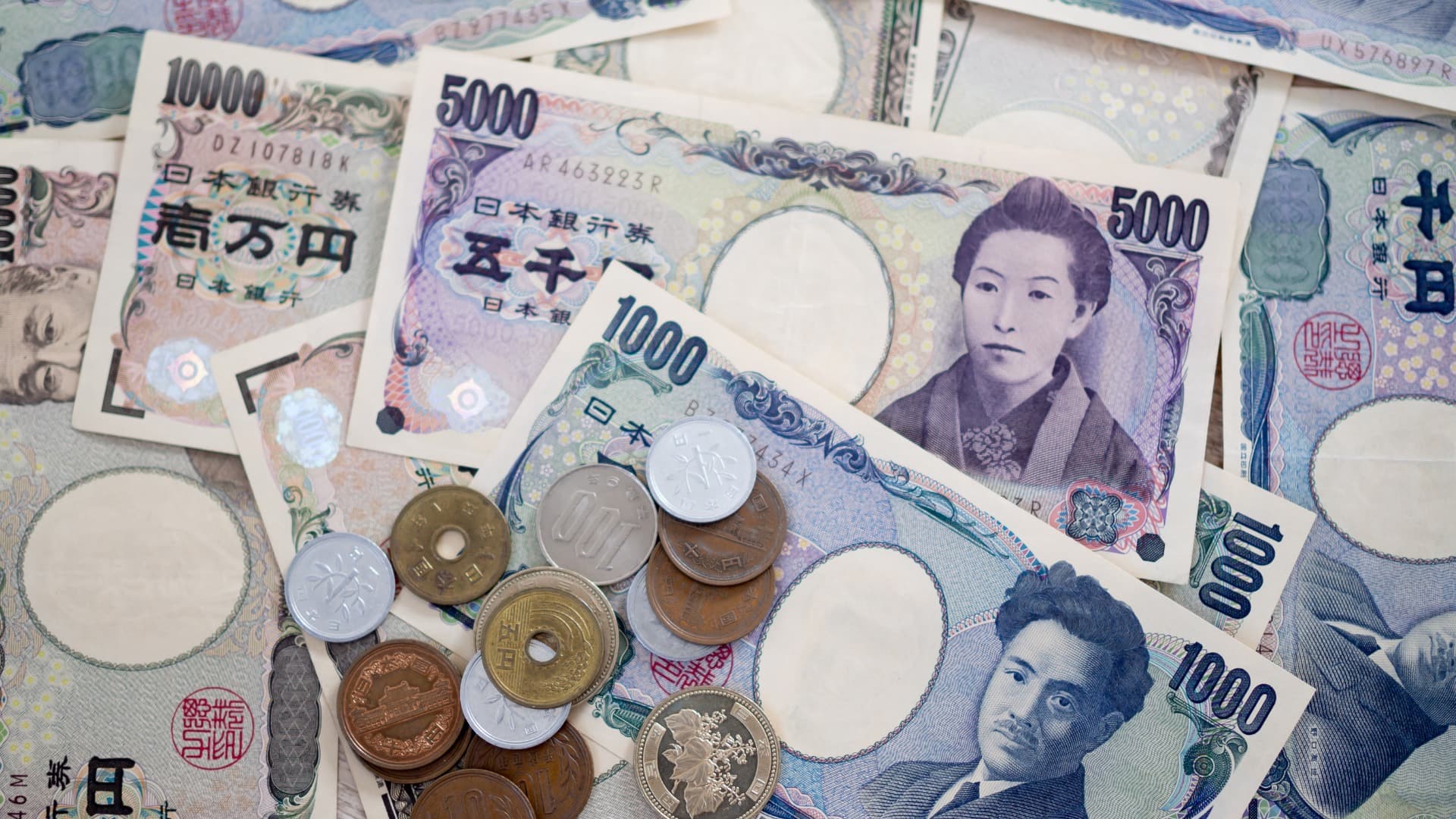
The Japanese yen tumbled to record lows against multiple major currencies on Monday, testing the resolve of government officials who issued their strongest warnings yet about potential market intervention, as traders interpreted the Bank of Japan’s latest policy moves as insufficiently aggressive to support the beleaguered currency.
The yen’s slide accelerated following Friday’s policy announcement, during which the BOJ raised its benchmark rate by 25 basis points to 0.75%—a three-decade high—but failed to deliver the hawkish rhetoric markets had anticipated. Governor Kazuo Ueda’s characteristically measured press conference comments disappointed investors hoping for stronger signals about the pace of future rate increases, triggering a broad-based sell-off that sent the yen careening lower across the board.
By Monday morning in Tokyo, the currency was testing critical psychological levels: hovering near an 11-month low against the U.S. dollar at 157.37 yen, approaching a 17-year trough versus the Australian dollar at 104.16 yen, and reaching unprecedented weakness against both the euro and Swiss franc. The euro briefly touched a record 184.75 yen Friday before settling around 184.42, while the Swiss franc climbed as high as 198.22 yen—another all-time peak.
Government Issues Stern Warnings
The currency’s persistent weakness prompted unusually direct language from Japanese authorities Monday morning. Chief currency diplomat Atsushi Mimura and top government spokesperson Minoru Kihara both expressed deep concern about what they termed “one-sided and sharp” movements in the foreign exchange market. Their use of the phrase “appropriate actions”—widely understood in diplomatic circles as code for potential currency intervention—marked the government’s most explicit threat yet to enter markets.
The warnings come as Japan faces a delicate balancing act: supporting a weakening currency that drives up import costs and inflation while avoiding the substantial financial expense and international criticism that typically accompanies unilateral currency intervention.
The BOJ’s Tightrope Walk
Friday’s rate increase, while clearly telegraphed to markets in advance, came with language suggesting the central bank remains prepared to continue its tightening cycle. The policy statement notably characterized real interest rates as remaining “significantly low”—a potential signal that further hikes lie ahead. However, Governor Ueda’s subsequent press conference offered little concrete guidance on timing or magnitude, maintaining his trademark data-dependent approach that has frustrated traders seeking clearer forward guidance.
“The absence of clearer guidance on the pace of future hikes disappointed markets, triggering yen selling,” wrote Tony Sycamore, an analyst at IG, in a Monday client note.
The market reaction extended beyond currency trading. Japanese government bonds experienced a sharp sell-off on Friday, pushing the benchmark 10-year yield above the psychologically significant 2% threshold for the first time since 1999. Bond yields, which move inversely to prices, surged as investors recalibrated their expectations for Japan’s interest rate trajectory.
Growing Rate Differentials Drive Weakness
The yen’s struggles reflect a fundamental challenge: even after Friday’s increase, Japan’s interest rates remain far below those of other major economies. The widening gap between Japanese yields and those in the United States, Australia, and Europe makes yen-denominated assets less attractive to international investors, who can earn substantially higher returns elsewhere.
This dynamic is particularly pronounced in the Australian dollar-yen cross, where Commonwealth Bank of Australia analysts forecast further gains to 109 yen per Australian dollar by March. The pair, they noted, “still has fundamental support from solid risk sentiment and, more recently, by wider interest rate differentials between Australian and Japanese ten-year government bond yields.”
Currency strategists are now watching the 158 yen-per-dollar level closely. A decisive break above that threshold would clear the path toward this year’s January high near 158.87, potentially accelerating the yen’s decline and forcing authorities’ hand on intervention.
What’s Next
Markets will get another opportunity to parse BOJ policy intentions on Wednesday, when Governor Ueda is scheduled to address Japan’s influential Keidanren business lobby on Christmas Day. Traders will scrutinize his remarks for any hints about the central bank’s evolving thinking on inflation, economic growth, and the appropriate pace of monetary normalization.
For now, the yen remains caught between a central bank moving too slowly for currency bulls and a government increasingly vocal about exchange rate concerns—but thus far unwilling to back up its warnings with concrete action. How long this standoff can continue without triggering actual intervention remains one of the most pressing questions facing Asian currency markets as the year draws to a close.
WHAT YOU SHOULD KNOW
The Japanese yen has plunged to historic lows against major currencies after the Bank of Japan raised interest rates but failed to signal aggressive future tightening. Despite the BOJ hiking rates to a 30-year high of 0.75%, Governor Ueda’s cautious messaging disappointed markets expecting stronger action. This has triggered sharp yen selling and forced Japanese officials to issue their strongest intervention warnings yet.
The core issue: Japan’s interest rates remain far below other major economies, making the yen increasingly unattractive to investors who can earn better returns elsewhere—a gap the BOJ seems unwilling to close quickly enough to stabilize its currency.