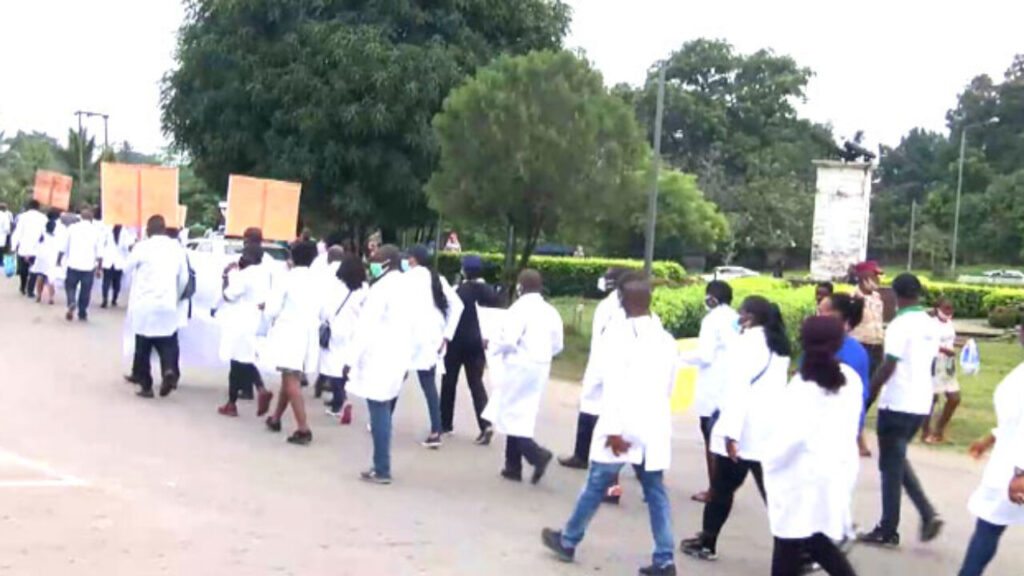
The Nigerian Association of Resident Doctors (NARD) has declared an indefinite nationwide strike set to begin on November 1, 2025, following the Federal Government’s failure to address long-standing issues affecting its members.
In a statement issued on Sunday, NARD President, Mohammad Suleiman, said the strike decision followed the expiration of a 30-day ultimatum previously given to the government. The announcement came after a five-hour emergency meeting of the association’s National Executive Council (NEC) held on Saturday.

According to Suleiman, “The NEC has marshalled out minimum demands, strike monitoring directives, and ‘no work, no pay/no pay, no work’ resolutions needed for a successful execution of this action.” He confirmed that after the exhaustive meeting, members of the NEC unanimously resolved to embark on a “total, comprehensive, and indefinite strike action” beginning on Friday, October 31, 2025, at 11:59 p.m.
He explained that the National Officers Committee (NOC) has been tasked with ensuring full compliance and monitoring of the strike across all centres. “We have reported to NEC and NEC has decided. The NOC will carry out this directive to its latter and in full compliance,” Suleiman added.
The NARD president further directed all centre presidents and general secretaries to convene emergency congress meetings to brief members on the details of the resolutions and prepare for total compliance. He also accused some government and non-government actors of “evil and exploitative plans” against resident doctors, warning that the union would “collectively resist” any attempts to undermine its members’ welfare.
Suleiman urged doctors to use the days leading up to the strike to hand over patients, engage with community and religious leaders, and enlighten the public on the reasons behind the action.
The impending industrial action is expected to paralyse medical services across hospitals nationwide, as resident doctors form the backbone of clinical operations in Nigeria’s healthcare system.
On September 26, NARD had issued a one-month ultimatum to the Federal Government to resolve issues concerning the welfare and training of resident doctors and medical officers. Among the grievances raised were excessive work hours, unpaid arrears from the 25 and 35 percent upward review of the Consolidated Medical Salary Structure (CONMESS), and the unjust dismissal of five resident doctors from the Federal Teaching Hospital, Lokoja.
The association also condemned the government’s failure to pay promotion arrears to medical officers in several federal tertiary hospitals, as well as the non-payment of the 2024 accoutrement allowance despite assurances from the Ministry of Health.
NARD further criticised bureaucratic delays in upgrading resident doctors’ ranks after the completion of postgraduate examinations, which has resulted in unpaid salary arrears and delayed implementation of new pay scales. The group also faulted their exclusion from the specialist allowance, despite their critical contribution to specialist care in the nation’s health sector.
Additionally, the association rejected the exclusion of medical and dental house officers from the civil service scheme, describing it as a discriminatory policy that deprives them of due salaries, recognition, and career progression. They also protested the downgrading of newly employed resident doctors from CONMESS 3 Step 3 to CONMESS 2 Step 2, a move that has led to reduced pay and unpaid arrears across several federal hospitals.
What You Should Know
The Nigerian Association of Resident Doctors’ indefinite strike, beginning November 1, 2025, highlights deep-rooted grievances over welfare, salary arrears, and working conditions.
The association accuses the Federal Government of neglecting repeated appeals for fair treatment, payment of outstanding allowances, and reversal of unfair demotions. Resident doctors, who are pivotal to Nigeria’s healthcare delivery, say they have been left with no choice but to down tools after failed negotiations.
With hospitals relying heavily on resident doctors, the strike threatens to severely disrupt medical services nationwide and intensify pressure on the already strained health system.