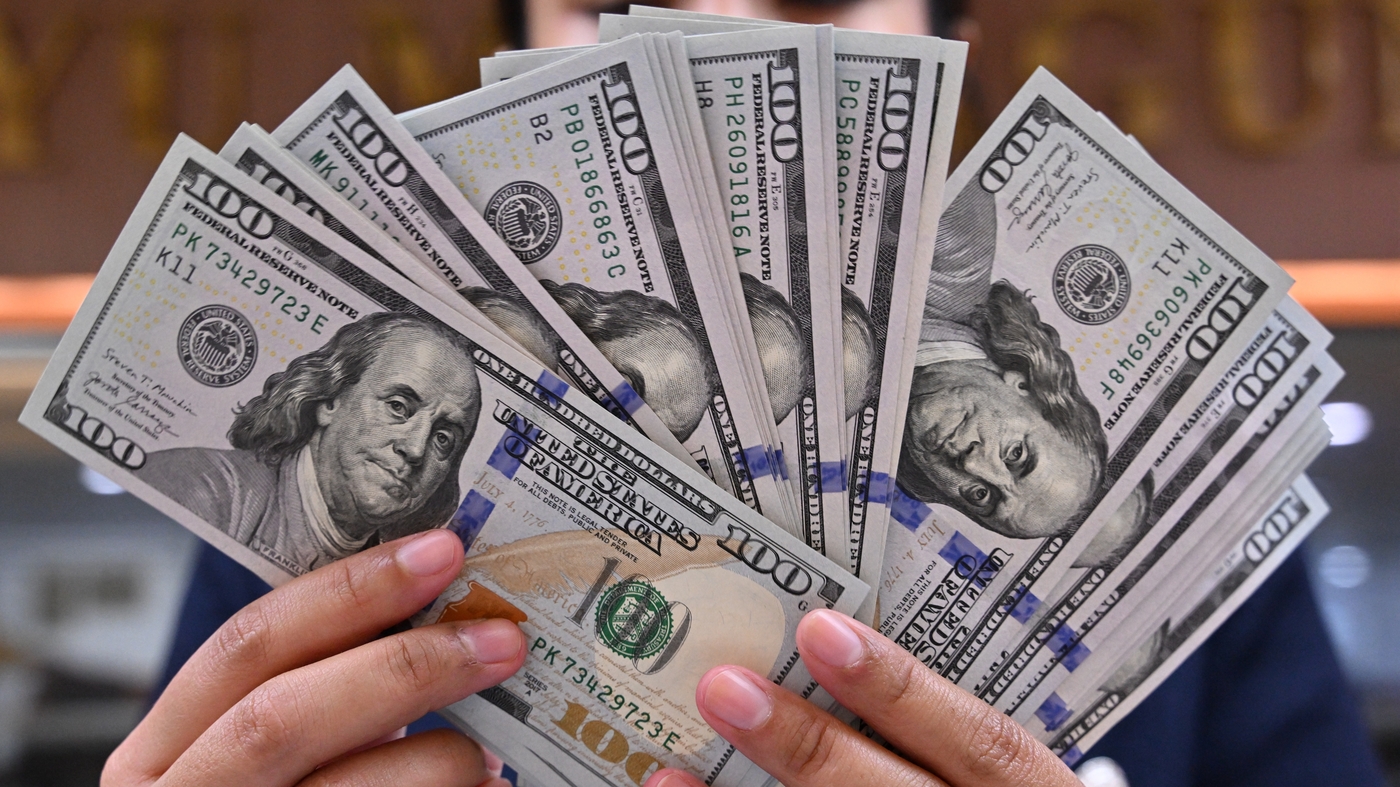
The U.S. dollar traded lower on Monday as global investors sought signs of reconciliation between Washington and Beijing, hoping the latest tariff confrontation might ease after President Donald Trump’s weekend comments appeared to soften his stance on China.
The dollar index, a key barometer measuring the greenback against six major currencies, slipped 0.1% to 98.908 in early trading, struggling to sustain its brief recovery from Friday’s sharp decline that followed Trump’s bombshell announcement of 100% tariffs on Chinese goods.
Friday’s tariff declaration sent shockwaves through global markets, drawing uncomfortable parallels to Trump’s “Liberation Day” in April, when sweeping tariffs triggered widespread turmoil across equities and digital assets. Stock markets tumbled and cryptocurrencies plunged as traders scrambled to assess the implications of what appeared to be a dramatic escalation in the U.S.-China trade war.
“Certainly it’s pretty nervous out there,” said Tim Kelleher, head of institutional foreign exchange sales at Commonwealth Bank in Auckland. Kelleher invoked a familiar Wall Street maxim: “If you look at the U.S. and China stuff, it looks like Trump has done a bit of a TACO again and softened his tone,” he said, referring to the trading adage that “Trump always chickens out.”
The market’s tentative optimism stems from Trump’s Sunday post on Truth Social, where the president struck a markedly different tone from his Friday announcement. “Don’t worry about China; it will all be fine! Highly respected President Xi just had a bad moment,” Trump wrote. “He doesn’t want depression for his country, and neither do I. The U.S.A. wants to help China, not hurt it!!!”
The conciliatory message suggested Washington might be pulling back from the brink, though analysts remained cautious about reading too much into social media pronouncements.
While the dollar retreated, both the euro and yen faced headwinds from domestic political developments.
The euro held steady at $1.1622 during Asian trading hours after France’s presidency unveiled Prime Minister Sebastien Lecornu’s new cabinet lineup Sunday evening. President Emmanuel Macron moved to shore up economic continuity by reappointing Roland Lescure, a close ally, as finance minister.
The Japanese yen weakened 0.5% against the dollar, trading at 151.89, as markets digested political upheaval in Tokyo. Komeito’s withdrawal from the ruling coalition on Friday dealt a significant blow to Liberal Democratic Party leader Sanae Takaichi’s ambitions to become Japan’s first female prime minister. Monday’s Health and Sports Day holiday in Japan limited trading activity in the world’s fourth-largest economy.
The offshore yuan strengthened 0.2% to 7.1357 per dollar during Asian trade, buoyed by data showing China’s export growth accelerated in September, suggesting the world’s second-largest economy maintains momentum despite trade tensions.
“What China does in response to Trump’s latest tariff announcement will also affect how markets will respond in the coming days,” said Vasu Menon, managing director for investment strategy at OCBC in Singapore. “Both the U.S. and China know that they cannot afford to ratchet up tensions too much, especially after having accomplished so much in trade talks in recent months.”
Menon expressed cautious optimism that pragmatism would ultimately prevail: “Ultimately, confrontation between the two superpowers could give way to reason, and the two leaders could prioritize their economies over their egos.”
Cryptocurrency markets remained volatile, with Bitcoin down 0.2% at $114,849.14 after Friday’s sharp sell-off, as digital assets continued to trade in tandem with risk sentiment in traditional markets.
Gold surged to a fresh record high of $4,068 per ounce, advancing 1.2% as investors sought safe-haven assets amid geopolitical uncertainty.
Commonwealth currencies outperformed, with the Australian dollar climbing 0.8% to $0.6525 and the New Zealand dollar gaining 0.3% to $0.5735 in early trading. Sterling edged up 0.1% to $1.3347.
Trading volumes were expected to remain subdued on Monday due to Columbus Day and Indigenous Peoples’ Day observances across parts of the United States, though major stock exchanges remained open.
As Asian markets closed and European trading approached, investors remained focused on any further signals from Washington or Beijing that might clarify the trajectory of the trade dispute that continues to cast a shadow over global economic prospects.
WHAT YOU SHOULD KNOW
Markets are cautiously optimistic that Trump will back down from his 100% China tariffs after he posted conciliatory messages over the weekend, softening Friday’s aggressive stance. Traders are betting on the familiar pattern of “Trump always chickens out,” where initial tariff threats are later moderated.
However, uncertainty remains high as investors await concrete actions from both Washington and Beijing. The dollar weakened while safe-haven gold hit record highs, signaling continued nervousness despite hopes that economic pragmatism will ultimately prevail over escalating trade confrontation between the world’s two largest economies.