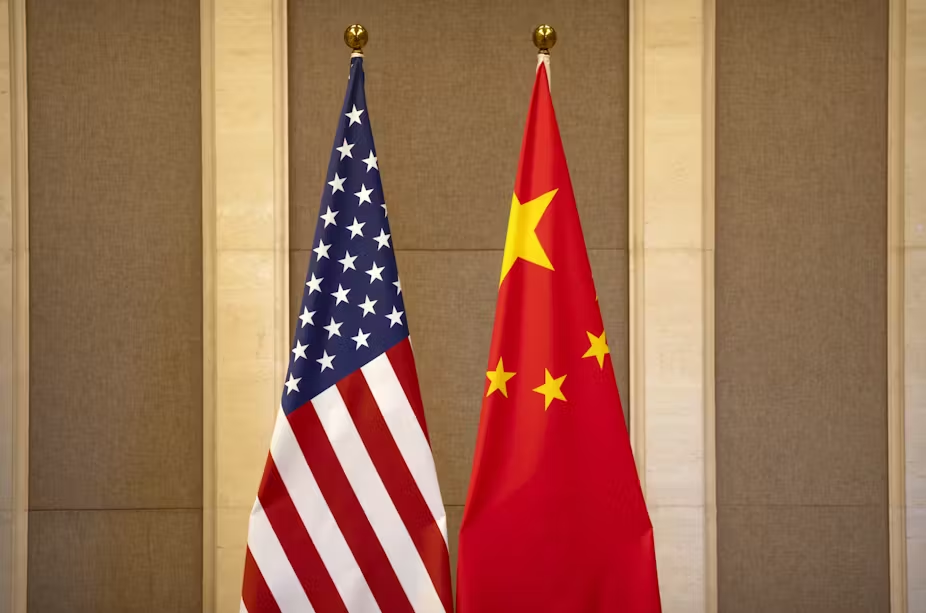
China fired back forcefully on Sunday at President Donald Trump’s announcement of punishing new tariffs, accusing the United States of wielding “double standards” and employing threats rather than diplomacy to resolve the escalating trade conflict between the world’s two largest economies.
“The relevant US statement is a typical example of ‘double standards,'” a Ministry of Commerce spokesperson declared in a strongly worded statement, marking Beijing’s sharpest rebuke yet of the Trump administration’s latest trade offensive.
The Chinese response came two days after Trump announced his intention to slap an additional 100 percent tariff on Chinese goods, a move set to take effect on November 1. The dramatic escalation—which would effectively double the cost of affected imports—was justified by the White House as retaliation for what Trump called “extraordinarily aggressive” new Chinese export restrictions on rare-earth minerals.
But Beijing rejected Washington’s characterization entirely, instead painting the United States as the aggressor in a systematic campaign of economic pressure that has intensified since September. “These actions… have severely harmed China’s interests and seriously undermined the atmosphere of the economic and trade talks between the two sides,” the commerce ministry said, suggesting that American tactics are poisoning any chance of productive negotiation.
The statement marked a clear shift in tone from Beijing, which has previously maintained a more measured public posture even as trade tensions mounted. Chinese officials now appear willing to directly challenge what they view as Washington’s hypocritical approach—condemning Chinese trade practices while imposing its own protectionist measures.
“Threatening high tariffs at every turn is not the right approach to engaging with China,” the ministry added, in what amounted to a lecture on diplomatic protocol aimed squarely at the Trump administration’s confrontational strategy.
The rare-earth dispute that triggered Trump’s tariff threat centers on minerals critical to modern technology and defense systems—materials for which China controls roughly 70 percent of global production. Trump has also threatened to cancel a planned meeting with Chinese President Xi Jinping later this month, further jeopardizing diplomatic channels.
Chinese officials made clear Sunday that they view the tariff threats as part of a broader pattern of American economic coercion rather than isolated responses to specific Chinese actions. By accusing Washington of “double standards,” Beijing is essentially arguing that the United States demands free trade principles from others while abandoning them itself when convenient.
The escalating war of words raises serious questions about whether the two nations can find common ground before the November 1 deadline, or whether this latest exchange signals a point of no return in their increasingly hostile economic relationship. With billions of dollars in trade hanging in the balance and global markets watching nervously, the stakes could hardly be higher.
As the diplomatic temperature rises, the world is left to wonder whether reason will prevail or whether both sides are prepared to inflict significant economic pain on each other and the global economy in pursuit of their competing visions of fair trade.
WHAT YOU SHOULD KNOW
China has publicly accused the United States of hypocrisy in its trade policy, rejecting Trump’s justification for imposing an unprecedented 100 percent tariff on Chinese goods. Beijing’s core message is clear: Washington cannot credibly demand fair trade while simultaneously weaponizing tariffs as threats.
The real concern is that both nations are now prioritizing confrontation over negotiation, with the November 1 tariff deadline and a potentially cancelled Xi-Trump summit signaling that this trade war may be entering its most dangerous phase yet—one where diplomatic off-ramps are rapidly disappearing.