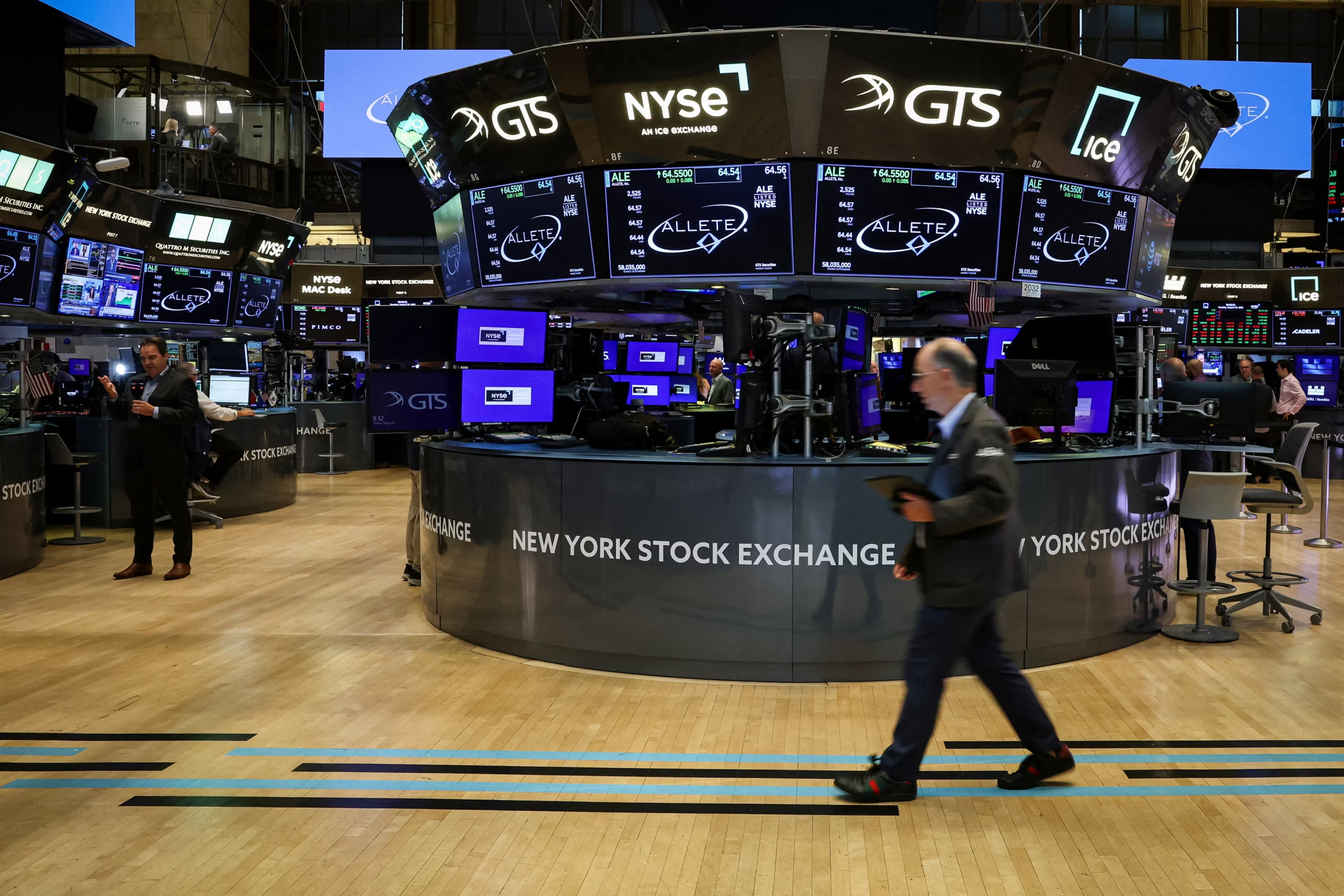
Wall Street’s major indexes scaled fresh intraday peaks Friday, capping a tumultuous week marked by government dysfunction with a display of resilience that underscored investors’ unwavering focus on Federal Reserve policy and artificial intelligence momentum.
The Dow Jones Industrial Average climbed 274.53 points, or 0.59%, to 46,794.89 by mid-morning trading, while the S&P 500 advanced 12.09 points, or 0.18%, to 6,727.44. The tech-heavy Nasdaq Composite edged down slightly, losing 7.27 points, or 0.03%, to 22,836.64, as losses in megacap technology names offset gains elsewhere.
The rally comes despite extraordinary circumstances: a federal government shutdown now in its third day has thrown sand in the gears of economic data collection, including the postponement of Friday’s closely watched nonfarm payrolls report—a cornerstone of the Fed’s decision-making process.
Yet rather than retreating in the face of this uncertainty, investors appear emboldened by the very absence of potentially disappointing employment data, allowing alternative indicators pointing to labor market softening to fuel speculation that the Federal Reserve will accelerate its rate-cutting timeline.
Fed Rate Cut Bets Drive Market Psychology
“The market’s focused on a couple of different things instead of the shutdown,” explained Veronica Willis, global investment strategist at Wells Fargo Investment Institute. “One is the AI optimism that we’ve seen over recent days, and then the data that came out this week is pretty supportive of the Fed being able to cut rates.”
That sentiment received institutional validation Friday when BofA Global Research revised its forecast, now predicting the Fed would deliver its next interest-rate reduction in October rather than the previously anticipated December timeline. The call reflects mounting evidence of labor market cooling—precisely the conditions that would give policymakers confidence to ease monetary policy.
However, Federal Reserve officials themselves remain divided. Chicago Fed President Austan Goolsbee injected a note of caution into the proceedings, expressing reluctance to commit to a sustained easing cycle given that inflation continues running above the central bank’s 2% target. His comments serve as a reminder that the path toward rate cuts remains conditional and data-dependent.
New York Fed President John Williams, speaking separately, emphasized the need for central banks to maintain flexibility in the face of unpredictable economic shifts—a comment that takes on added resonance given the current political dysfunction in Washington.
Sector Rotation Reflects Shifting Sentiment
Beneath the headline index moves, Friday’s trading revealed a complex pattern of sector rotation. Healthcare stocks emerged as the session’s standout performers, with the S&P 500 healthcare sector surging 1.3% to build on the week’s gains. Managed care giant Humana led the charge with a 5.6% gain, while life sciences conglomerate Danaher added 4.2%, ranking among the benchmark index’s top performers.
The technology sector, which has powered much of this year’s market advance on artificial intelligence enthusiasm, posted a modest 0.2% gain. But weakness in communication services stocks—down 0.9%—weighed on the Nasdaq. Meta Platforms and Alphabet, two of the market’s most influential names, declined 1.2% and 1.4%, respectively, their losses sufficient to keep the Nasdaq in marginally negative territory despite broader market strength.
Financial stocks provided crucial support to the Dow, with banking giants Goldman Sachs and JPMorgan Chase rising 0.5% and 1%, respectively, as investors positioned for an economic environment where interest rate cuts might stimulate lending activity.
Economic Data Disappoints, But Context Matters
The session’s economic data provided a mixed picture. The Institute for Supply Management reported that non-manufacturing activity—encompassing the vast services sector—registered at 50 last month, below the 51.7 consensus estimate and barely above the threshold separating expansion from contraction. The softer-than-expected reading tempered some of the morning’s early enthusiasm but ultimately failed to derail the rally.
The services sector data joins other recent indicators suggesting economic momentum may be moderating—precisely the combination that historically has prompted the Federal Reserve to shift toward a more accommodative stance.
Corporate News and Market Breadth
In individual stock action, Applied Materials tumbled 2.9% after the semiconductor equipment manufacturer warned that broader export restrictions on chip-making technology would cost it approximately $600 million in fiscal 2026 revenue. The forecast highlights ongoing geopolitical tensions affecting the technology supply chain and serves as a reminder that not all corners of the market are participating in the AI-driven euphoria.
On the other end of the spectrum, USA Rare Earth shares rocketed 19.6% higher after CEO Barbara Humpton disclosed that the company maintains close communication with the White House—a comment that sparked speculation about potential strategic importance or government support for domestic rare earth production.
Market breadth told a decidedly positive story, with advancing issues outnumbering decliners by a 2.59-to-1 ratio on the New York Stock Exchange and by a 2.43-to-1 ratio on the Nasdaq. The S&P 500 recorded 31 new 52-week highs against just one new low, while the Nasdaq Composite notched 110 new highs versus 17 new lows—metrics that suggest broad-based participation in the advance rather than narrow leadership.
The Week Ahead: Navigating Information Vacuum
With all three major indexes on track for weekly gains if current levels hold, investors have demonstrated a remarkable ability to compartmentalize political dysfunction from market dynamics. Yet the continuation of the government shutdown poses challenges for the week ahead, as the absence of official economic data will force market participants to rely on alternative indicators and corporate earnings reports for direction.
Later Friday, investors were scheduled to parse additional commentary from Dallas Fed President Lorie Logan and Fed Vice Chair Philip Jefferson, seeking further clues about the central bank’s policy trajectory.
The market’s resilience in the face of government paralysis suggests that, for now at least, investors believe the Federal Reserve’s monetary policy toolkit matters far more to asset prices than Washington’s fiscal dysfunction. Whether that confidence proves justified may depend on how quickly normal government operations—and the economic data flow that accompanies them—can resume.
WHAT YOU SHOULD KNOW
Wall Street hit record highs Friday despite a three-day government shutdown that postponed crucial jobs data. Investors are betting the Federal Reserve will cut interest rates as soon as October, fueled by signs of a cooling labor market and sustained AI-sector optimism.
Markets are shrugging off political dysfunction in Washington, choosing instead to focus on the prospect of cheaper money from the Fed. BofA now predicts rate cuts two months earlier than expected, though Fed officials remain cautious about committing to aggressive easing while inflation stays above the 2% target.