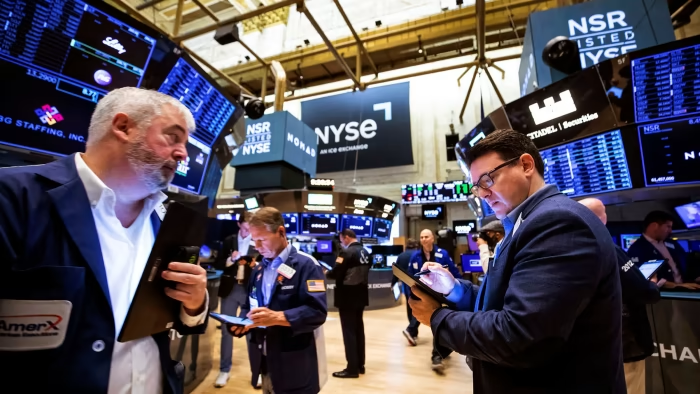
Wall Street opened Thursday on an optimistic note, with stock index futures climbing sharply as investors welcomed news that President Donald Trump’s aggressive new semiconductor tariffs would exempt companies with domestic manufacturing operations—a move that appears to shield major technology giants from the trade policy’s harshest impacts.
The rally was led by Apple, whose shares surged 3.2% in premarket trading following the company’s announcement of an additional $100 billion investment in U.S. operations. This commitment brings Apple’s total domestic investment pledge to $600 billion over the next four years, underscoring the iPhone maker’s strategy to align with the administration’s “America First” manufacturing agenda.
Trump’s newly announced 100% tariff on semiconductor imports represents a doubling down on his protectionist trade policies, but the critical exemption for companies manufacturing domestically appears to have calmed investor nerves. Major chipmakers responded positively to the news, with Nvidia advancing 2.5%, Advanced Micro Devices climbing 1.8%, and Intel rising 1.2% in premarket action.
The broader market reflected this technology-driven optimism, with S&P 500 E-minis up 0.84%, Nasdaq 100 E-minis gaining 0.84%, and Dow E-minis advancing 0.62% as of 6:16 a.m. ET. These gains come even as Trump’s broader tariff package—imposing duties of 10% to 50% on dozens of trading partners—officially took effect Thursday.
The market’s resilience near record highs reflects a confluence of supportive factors beyond the selective tariff approach. Investors remain buoyed by expectations of Federal Reserve policy easing, driven largely by disappointing economic data, including July’s weak payrolls report. According to the CME Group’s FedWatch tool, traders have nearly fully priced in a 25-basis-point rate cut in September and anticipate at least two cuts before year-end.
Thursday’s weekly jobless claims data, scheduled for release at 8:30 a.m. ET could provide crucial insights into labor market health and potentially shift these rate cut expectations. The data comes as investors also await Trump’s interim replacement for Fed Governor Adriana Kugler, with market participants expecting a more dovish nominee who would favor lower interest rates.
Kugler’s resignation creates an opening on the seven-member Fed Board currently led by Jerome Powell, whose tenure expires in May 2025. Trump has been a persistent critic of Powell’s monetary policy stance, particularly regarding the pace of rate cuts.
The earnings season continues to provide mixed signals for individual stocks. DoorDash shares jumped 8.6% after the food delivery company exceeded revenue expectations and issued stronger-than-anticipated guidance for gross merchandise value in the current quarter. Conversely, Lyft fell 2.3% despite providing an upbeat gross bookings forecast for the September quarter, as investors focused on the ride-hailing company’s revenue miss.
The market’s ability to maintain momentum near historic highs while navigating complex trade policy dynamics and mixed economic signals demonstrates the ongoing influence of both artificial intelligence investment optimism and dovish Federal Reserve expectations in driving investor sentiment.
As the trading session progresses, market participants will be closely monitoring how the semiconductor sector responds to the nuanced tariff policy and whether the broader technology rally can sustain its momentum amid these evolving policy crosscurrents.
WHAT YOU SHOULD KNOW
U.S. markets surged on Thursday as President Trump’s new 100% tariff on semiconductor imports includes a crucial exemption for companies manufacturing domestically. Apple led the rally with a $100 billion additional U.S. investment commitment, while major chipmakers gained 1-2.5% on the exemption news.
The selective tariff approach, combined with expectations of Federal Reserve rate cuts due to weak economic data, is keeping markets near record highs despite broader trade tensions.