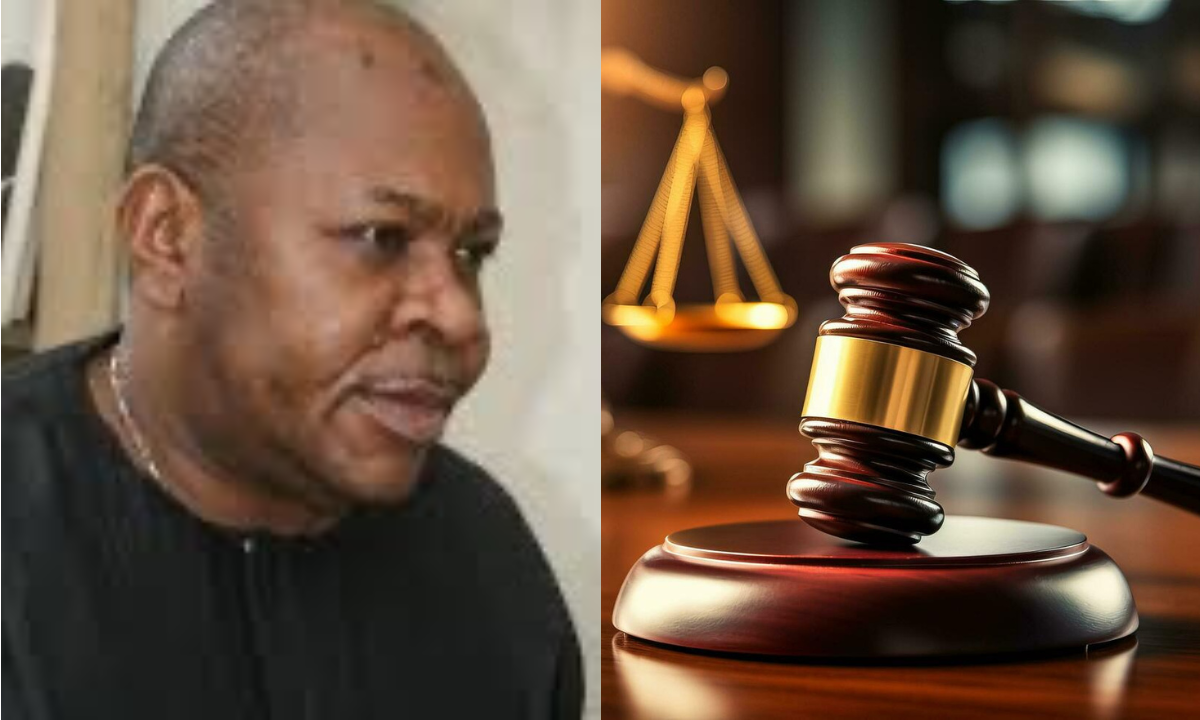
The Special Offences Division of the Lagos State High Court, sitting in Ikeja, has rejected a renewed application for bail filed by Nigerian businessman Fred Ajudua.
Through his lead counsel, Olalekan Ojo (SAN), Ajudua petitioned the court, presided over by Justice Mojisola Dada, to release him on bail pending the conclusion of his trial. Ojo informed the court that Ajudua, who appeared in court accompanied by medical personnel from the Lagos University Teaching Hospital (LUTH), was suffering from a chronic kidney ailment.
He implored the court to grant the defendant temporary freedom to allow him to receive proper medical attention, emphasizing that “only the living can face trial.”
However, counsel for the Economic and Financial Crimes Commission (EFCC), Seidu Atteh, opposed the bail request. Atteh argued that Ajudua currently has pending matters before the Supreme Court and that his application should have been addressed to that court instead. He urged Justice Dada not to entertain the request.
Responding to this argument, Ojo contended that the issue before the Supreme Court was not related to bail and therefore should not obstruct the current bail application. He clarified that the application pending before the apex court aimed to set aside its judgment delivered on May 9, which had no bearing on the present plea for bail.
In her ruling, Justice Dada stated she would refrain from deciding on the matter until the Supreme Court had delivered its verdict.
“In view of the applications filed at the Supreme Court, I am constrained to make any decision with respect to this instant application filed by the defence counsel. I will abide by the decisions of the Supreme Court,” the judge ruled.
She consequently adjourned the case to October 10, October 31, and November 20, 2025, for further trial proceedings.
Ajudua is being prosecuted for allegedly defrauding a Palestinian businessman, Zad Abu Zalaf, of the sum of $1,043,000 (One Million, Forty-Three Thousand U.S. Dollars) under false pretences.
Prior to ruling on the bail request, the court took the testimony of the third prosecution witness, Afanda Bashir Emmanuel, an investigator with the EFCC.
The witness recounted how he met the defendant in 2005, shortly after the EFCC was established, and that the case file was handed over to the Advance Fee Fraud Section of the Commission by the Special Fraud Unit (SFU) of the Nigerian Police Force.
He further disclosed that in the course of the investigation, the EFCC sought documentation from the Nigerian Police Force, the Central Bank of Nigeria (CBN), the Nigerian National Petroleum Company Limited (NNPCL), and the EFCC’s forensic laboratory to aid their inquiries.
During the session, the EFCC attempted to tender these documents as exhibits. However, the defence counsel raised objections, arguing that the documents were inadmissible on the grounds that they were neither original documents nor certified true copies. Additionally, he stated that the EFCC counsel was not the author of the documents and had failed to establish a foundation for presenting photocopies as evidence.
After hearing arguments from both sides, Justice Dada ruled to reject two of the documents and admitted the remaining two into evidence as exhibits.
The case was then adjourned to allow the defence team time to prepare for the cross-examination of the prosecution witness.
The legal battle, which started in 2005 before Justice Morenike Obadina at the Lagos State High Court in Ikeja, has faced multiple setbacks due to what observers have described as delay tactics deployed by the defendant.
Over the years, the matter has been transferred among several judges, including Justice Josephine Oyefeso and eventually Justice Mojisola Dada, under whom Ajudua was arraigned on June 4, 2018.
Following the denial of bail by Justice Dada, Ajudua proceeded to the Lagos Division of the Court of Appeal, where he was granted bail on September 10, 2018. Dissatisfied with that decision, the EFCC appealed to the Supreme Court.
The EFCC also challenged a ruling by the appellate court ordering that the case be reassigned from Justice Dada to another judge to begin afresh (de novo).
In a landmark judgment, the Supreme Court ruled in favor of the EFCC, instructing that Justice Dada should continue with the trial.
What You Should Know
Fred Ajudua is a well-known figure in Nigeria’s legal history, primarily due to a string of fraud allegations dating back to the early 2000s.
His current case involves accusations of defrauding a Palestinian businessman of over $1 million in a classic 419-style scheme.
Although Ajudua claims to be suffering from a chronic kidney condition, the court has declined to grant him bail, citing ongoing proceedings at the Supreme Court.
The case, which has experienced repeated delays and judicial transfers, serves as a glaring example of how legal complexities and appeals can extend trials for years, often without resolution.