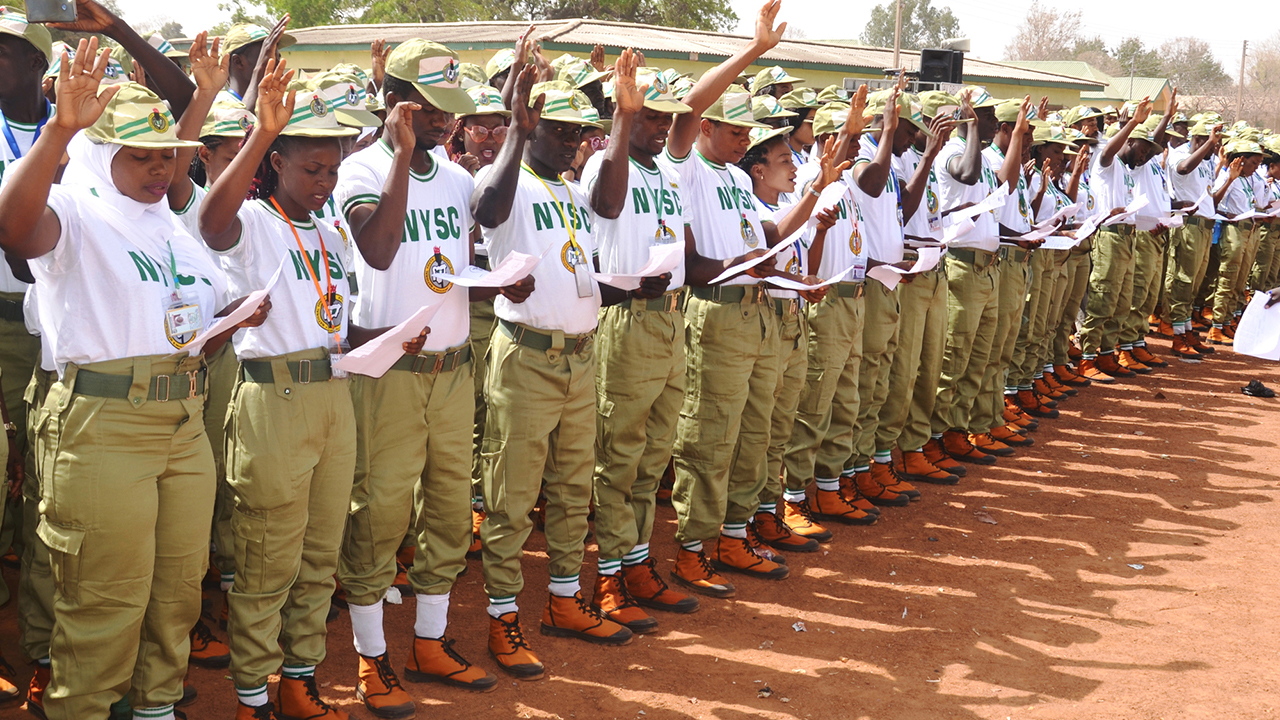
A recent court ruling permitting female members of the National Youth Service Corps (NYSC) to wear skirts on religious grounds has ignited widespread debate, drawing both praise and criticism across the country.
The Federal High Court in Abuja ruled on June 13 that the NYSC’s policy mandating trousers for all female corps members violated constitutional rights, particularly those relating to religious freedom and human dignity.
Justice Hauwa Yilwa, in delivering the judgment, held that the NYSC’s enforcement of trousers-only uniforms contravened Section 38(1) of the 1999 Constitution (as amended), which guarantees the right to freedom of religion.
The court also found the policy to be demeaning and discriminatory, especially when enforced against individuals whose religious beliefs sincerely prohibit women from wearing trousers.
The legal victory was the result of two separate but related lawsuits filed by former corps members Miss Blessing Ogunjobi and Miss Vivian Ayuba. The cases, marked FHC/ABJ/CS/989/2020 and FHC/ABJ/CS/988/2020 respectively, were consolidated due to their similar nature. Both applicants argued that being compelled to wear trousers during their NYSC service contradicted their Christian beliefs, particularly referencing Deuteronomy 22:5, which they interpret as prohibiting women from wearing clothing associated with men.
Justice Yilwa declared that the NYSC’s refusal to permit the wearing of skirts on religious grounds was unconstitutional and amounted to an infringement of the applicants’ right to freely express and manifest their faith. She also criticized the treatment the plaintiffs received, describing it as humiliating and degrading. As part of her ruling, the court awarded ₦500,000 in damages to each applicant—less than the ₦10 million they requested but considered reasonable by the court.
The court ordered the NYSC to recognize skirts as an acceptable alternative for female corps members with genuine religious objections. Furthermore, it directed the recall of the affected applicants and mandated that their certificates of national service be issued accordingly.
The ruling has triggered mixed reactions among Nigerians, with some celebrating it as a milestone for religious liberty, and others warning it could erode the institutional integrity of the NYSC’s paramilitary framework.
Juliet Ogunsaya, a former corps member, praised the plaintiffs for their courage and welcomed the judgment as a step forward for personal rights. However, she noted concerns over how the new policy might be implemented in a paramilitary context. “Personally, I believe that the NYSC has outlived its original objective, and should no longer be mandatory.
But given its paramilitary nature, uniforms should be regulated to preserve discipline and coherence,” she stated. She humorously questioned how physical activities like rope climbing would be handled if participants wore skirts.
On the other hand, StellaMaris Akubuike raised constitutional and operational concerns. “The NYSC is backed by an Act and has specific dress codes. Allowing variations will lead to chaos and defeats the paramilitary essence of the program,” she said. Akubuike further argued that by choosing to participate in NYSC, one should expect to follow its rules, adding that the humiliation suffered was unfortunate but avoidable.
Mr. Monday Ijeh echoed similar sentiments, asserting that it would be impractical and unsafe to conduct physically demanding tasks while wearing skirts. He emphasized that the paramilitary framework necessitates a standard, functional uniform for all.
Mr. Dominic Bassey warned that the judgment could open the door to future confusion. “If skirts are allowed today, what if another group insists on wearing traditional wrappers tomorrow? That will undermine the NYSC’s uniform policy. The problem isn’t the trousers—it’s the outdated structure of the scheme itself,” he argued.
The judgment has also drawn legal and institutional attention. The News Agency of Nigeria (NAN) noted that the applicants sought relief under the 1999 Constitution and the African Charter on Human and Peoples’ Rights. They requested a court declaration that the NYSC’s dress code policy violated their religious rights and amounted to degrading treatment. The NYSC and its Director-General were listed as respondents in the suits.
The court emphasized that the denial of the right to serve based on clothing choices rooted in religious belief constituted discrimination. In addition to ordering compensation, the judge condemned the emotional trauma caused by the NYSC’s actions, which she labeled as unconstitutional.
Legal observers describe the judgment as a landmark ruling that redefines the balance between institutional policy and individual religious rights in public service programs. Yet many await how the NYSC will respond, particularly whether it will challenge the ruling or revise its uniform policy.
What You Should Know
A Federal High Court judgment delivered on June 13 ruled in favor of two former female corps members, permitting them to wear skirts during their NYSC service on religious grounds.
The court found that forcing women to wear trousers violated their constitutional rights to freedom of religion and dignity.
While the ruling has been hailed as a win for religious freedom, critics argue it could undermine the uniformity and paramilitary nature of the NYSC scheme.
The decision orders the NYSC to accommodate such religious attire and pay damages to the affected individuals. The ruling may set a precedent for religious expression in other institutions.