The World Bank Group has pledged full support for Nigeria’s ambitious plan to lay a 90,000-kilometre national fibre-optic backbone—one of the most expansive digital infrastructure projects globally.
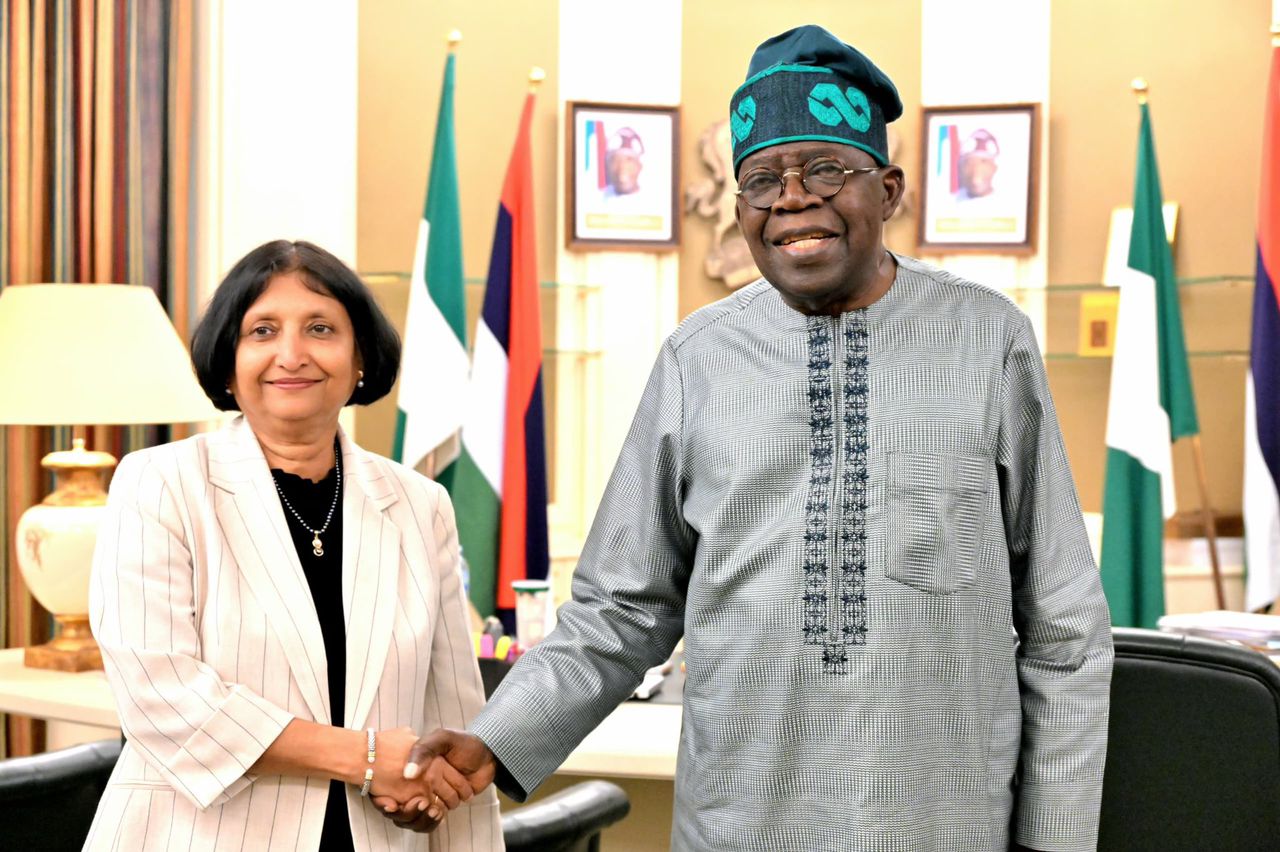
This assurance came from Anshula Kant, the World Bank’s Managing Director and Chief Financial Officer, during her visit to President Bola Tinubu at the Aso Rock Presidential Villa on Wednesday.
Following the meeting, Kant praised Tinubu’s “ambitious macro-economic reforms,” describing Nigeria as a crucial development partner for the World Bank. “We are working very, very closely together with this,” she said while addressing journalists.
Accompanied by the World Bank’s Country Manager, Taimur Samad, Kant outlined several ongoing and upcoming collaborations between the bank and Nigeria. “We have a very large programme with Nigeria and, like the Minister (of Communications, Innovation and Digital Economy) was saying, one of the biggest upcoming, forthcoming projects will be in the digital space, providing digital, you know, broadband access across the country,” she noted.
She further disclosed that the World Bank’s engagement with Nigeria also spans agriculture, energy, education, health, and social protection sectors.
Congratulating the Tinubu administration for what she called courageous reform policies, Kant said: “They are not easy to do, but already you can see the big improvements and forward momentum that is taking place in Nigeria.”
According to her, the World Bank’s current mission focuses on poverty eradication and environmental sustainability. This includes advancing economic growth and fostering job creation, especially among young people.
She explained that shared goals with Nigeria include digital access, energy availability, improved agricultural productivity, and quality health and education services.
This visit marks Kant’s first to Nigeria since President Tinubu assumed office in May 2023. Her trip comes amid efforts by the Nigerian government to stabilise the national currency, reduce inflation, and boost foreign investment. These efforts follow the removal of fuel subsidies and the adoption of a unified exchange rate regime.
At present, the World Bank is managing a $9 billion portfolio in Nigeria, which cuts across multiple sectors including power, agriculture, and social protection.
Nigeria’s Finance Minister and Coordinating Minister of the Economy, Wale Edun, who was part of the high-level talks, said the World Bank team held discussions around “the overall partnership,” with special emphasis on the digital infrastructure project.
He explained that the broadband expansion project will increase Nigeria’s fibre-optic coverage from the existing 35,000km to 125,000km. It will be structured as a self-financing special-purpose vehicle (SPV).
“It is geared at the sector which will make use of the facility, pay for it and therefore make the project highly viable,” Edun told the press.
Minister of Communications, Innovation and Digital Economy, Bosun Tijani, described the project as a “once-and-for-all” infrastructure investment that will connect all six geopolitical zones and extend fibre-optic cables to homes, schools, and healthcare facilities.
He said the government will retain a minority share in the SPV, while private sector stakeholders will provide 51 percent of the required funding. The World Bank and other global development partners are expected to contribute at least $500 million.
“We can’t become smarter with agriculture, scale education or deliver modern healthcare without good connectivity,” Tijani stated, highlighting the transformational potential of high-quality broadband.
Citing international benchmarks, the minister noted that a 10 percent increase in broadband quality can contribute up to 1.35 percentage points to a nation’s Gross Domestic Product (GDP).
Tijani revealed that construction of the fibre network could commence before the end of 2025, following the publication of detailed route maps. Presidential endorsement and Federal Executive Council approval have already been secured for the initiative.
He stressed that while Nigerians often complain of poor connectivity, the problem lies in the lack of adequate foundational infrastructure. The project, he assured, is designed to address that deficit permanently.
The network will be designed in a ring format, covering each state and geopolitical zone, thereby ensuring fibre-optic links reach even the most remote areas.
The SPV, which will be independently managed, is expected to recover investment costs through user fees, making it a self-sustaining model as opposed to one reliant on government loans.
Tijani asserted that the investment would have long-term economic benefits, as robust connectivity supports vital sectors such as agriculture, education, health, and the creative economy.
With the design phase already completed and route maps set for release within two months, the project is well on track for implementation before the end of the year.
Meanwhile, Kant noted that the World Bank’s existing programme in Nigeria includes $1.5 billion for power-sector recovery, $700 million for adolescent girls’ education, and $500 million for rural road infrastructure.
Future collaborations, she revealed, would focus on renewable energy, agribusiness value chains, and broadband expansion.
The bank is also reportedly working with Nigerian authorities to develop a concessional financing mechanism tailored for small and medium-sized enterprises (SMEs).
What you should know
Anshula Kant is the Managing Director and Chief Financial Officer of the World Bank Group. A highly respected economist and former executive of the State Bank of India, she plays a key role in shaping global financial partnerships.
Her visit to Nigeria reinforces the World Bank’s strong interest in supporting the country’s digital transformation, economic stability, and inclusive development.