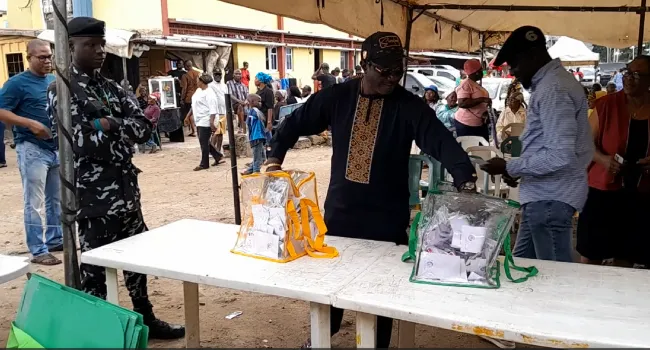
Bamidele Yusuf, Chairman of Surulere Local Government Area and candidate of the All Progressives Congress (APC) in Saturday’s local government elections, has expressed disappointment over what he described as consistent low participation of elite voters in electoral processes.
Yusuf made the remarks after casting his vote, as residents of Lagos State trooped to the polls to elect chairmen and councillors across the state’s 20 Local Government Areas (LGAs) and 37 Local Council Development Areas (LCDAs).
According to the Lagos State Independent Electoral Commission (LASIEC), fifteen political parties are participating in the elections, vying for chairmanship, vice chairmanship, and councillorship positions.
While many polling units recorded moderate voter engagement, turnout was especially poor in elite-dominated areas, such as the Alhaji Marshal Small London axis of Surulere. At Polling Unit 34 in the area, which has 172 registered voters, only a few showed up to cast their ballots.
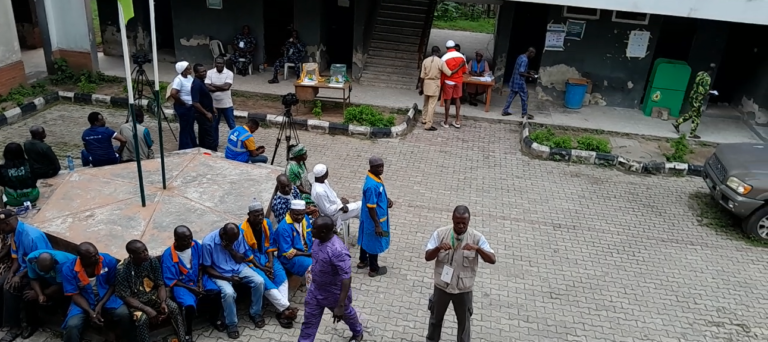
Speaking on the issue, Yusuf said that although logistics and early arrival of electoral officers ensured a smooth start in most areas, certain polling units did not meet expected turnout levels. He attributed this trend to elite voter apathy.
“The electoral officers came early and people have cast their votes as early as 8 in the morning. It is peaceful, and we normally have a large turnout of voters because those who have left normally come around to vote. The logistics are perfect, and materials were distributed early,” Yusuf noted.
“Although we have a large turnout in some areas, there are also places where voters did not turn out as expected, especially where we have the elites. This is not supposed to be so because we are supposed to learn from the elites. But what we see here is that the elites sit at home during elections. The media needs to enlighten the elites so that they can come out and vote in the coming elections.”
He specifically cited the Adeniran Ogunsanya area of Surulere as one of the places affected by low elite participation.
“When you get to Adeniran Ogunsanya, the number of people that come out to cast their votes is too small,” he said.
An on-site correspondent confirmed Yusuf’s concerns, reporting that by midday, only 60 of the 669 registered voters had turned out to vote at Polling Unit 014, located at Elizabeth Fowler Memorial High School in Surulere’s Adeniran Ogunsanya area. Voting at the polling unit is scheduled to end by 3:00 p.m.
Among those expected to vote at the same polling unit is Femi Gbajabiamila, Chief of Staff to President Bola Tinubu and former Speaker of the House of Representatives.
In contrast to the elite districts, voter activity appeared higher at Polling Unit 17, where scores of mostly female voters queued in an orderly fashion beneath a canopy to cast their ballots.
The LASIEC Chairman, Justice Bola Okikiolu-Ighile (retd.), earlier confirmed during an interview that all necessary arrangements had been finalized to ensure smooth conduct of the election. She also reiterated the participation of 15 political parties across the state.
Despite the general peace recorded at polling units and the smooth rollout of logistics, low turnout in highbrow areas has triggered fresh discussions about civic responsibility among the educated and urban elite.
Observers have long noted that local elections in Nigeria often struggle with voter apathy, especially in urban centres, despite being the closest tier of government to the people and having direct impact on basic amenities such as local roads, sanitation, healthcare, and education.
As the elections progress, candidates and election officials are urging better civic education and media advocacy to reverse the trend in future polls.
What You Should Know
Surulere LG Chairman Bamidele Yusuf has called out elite voters for poor participation in the local government elections, especially in upscale areas like Adeniran Ogunsanya. While logistics were smooth and some polling units recorded fair turnouts, others—particularly those in elite neighborhoods—saw dismal voter response.