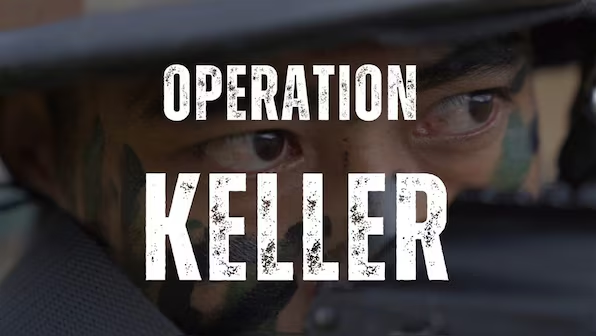
Operation Keller, a counter-terrorism mission launched by the Indian Army in Jammu and Kashmir’s Shopian district, is currently trending on Google Trends in India. The operation, which resulted in the elimination of three Lashkar-e-Taiba (LeT) terrorists on May 13, 2025, has captured national attention due to its strategic significance, the high-profile nature of the targets, and its timing amid heightened India-Pakistan tensions. Here’s why Operation Keller is dominating conversations across the country.
A Decisive Strike Against Terrorism
On the morning of May 13, 2025, the Indian Army’s Rashtriya Rifles unit, acting on precise intelligence, initiated Operation Keller in the Shoekal Keller area of Shopian, South Kashmir. The mission began as a cordon-and-search operation in the Shukroo Keller forest, following reports of terrorist activity that originated in the neighboring Kulgam district. As security forces, including the Army, Jammu and Kashmir Police, and CRPF, closed in, the terrorists opened heavy fire, triggering a fierce firefight. The Indian Army’s swift response neutralized three LeT operatives, identified as high-priority threats. The operation’s success, described as a “major anti-terror breakthrough” by The Times of India, has been widely celebrated, fueling its trending status.
High-Profile Targets Eliminated
The operation gained significant traction due to the identities of the slain terrorists, particularly Shahid Kuttay, a top LeT commander and mastermind of the April 22, 2025, Pahalgam attack that killed 26 civilians. Kuttay, a Category-A terrorist who joined LeT in March 2023, was linked to multiple high-profile attacks, including the killing of a BJP sarpanch in Heerpora and a firing incident at Danish Resort that injured German tourists. The second terrorist, Adnan Shafi Dar, a Category-C LeT operative, was involved in the killing of a non-local laborer in October 2024. The elimination of such notorious figures, especially Kuttay, described as a “significant blow” to LeT’s proxy, The Resistance Front (TRF), has amplified public and media interest, driving the operation’s prominence on social media and news platforms.
Context of India-Pakistan Tensions
Operation Keller’s timing, just days after a fragile ceasefire with Pakistan, has added to its significance. The operation follows Operation Sindoor, a May 7, 2025, airstrike targeting terror camps in Pakistan and Pakistan-occupied Kashmir, which India launched in response to the Pahalgam attack. The airstrike, which reportedly killed over 100 terrorists, escalated tensions, with Pakistan retaliating through shelling that claimed civilian lives in Jammu and Kashmir. India’s declaration that future terror acts will be treated as “acts of war” underscores the government’s zero-tolerance policy, making Operation Keller a symbol of its resolve. Social media posts on X, including from the Indian Army’s official handle, have highlighted the operation’s success, with users praising the forces and linking it to India’s broader anti-terror strategy, further boosting its trending status.
Public and Political Reactions
The operation has sparked widespread reactions across India. Prime Minister Narendra Modi, addressing the nation on May 12, praised the armed forces’ “swift and bold action” in counter-terrorism efforts, a sentiment echoed in his visit to Adampur Air Base, where he emphasized destroying Pakistan’s “audacity.” Locally, residents of Shopian, long plagued by militancy, have welcomed the operation, though concerns about retaliatory attacks persist. On X, hashtags like #OperationKeller and posts from outlets like @latestly have fueled discussions, with users debating the operation’s tactical and psychological impact. The Jammu and Kashmir Police’s initiative to post rewards for information on terrorists involved in the Pahalgam attack has also kept the region’s security situation in the public eye, contributing to the operation’s visibility.
Why It Matters
Operation Keller is trending because it represents a critical moment in India’s fight against terrorism in Jammu and Kashmir. The elimination of three LeT terrorists, including a key orchestrator of civilian attacks, underscores the Indian Army’s operational precision and commitment to national security. Amid ongoing regional tensions and a recent ceasefire, the operation reinforces India’s stance against cross-border terrorism, resonating with a public eager for decisive action. As the Army continues to sanitize the area for additional threats, Operation Keller remains a focal point of pride, debate, and hope for a terror-free Kashmir, ensuring its place at the top of India’s trending topics.