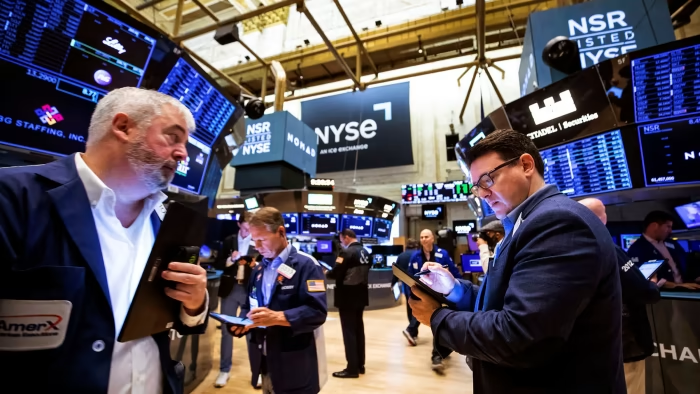
Wall Street’s major indices fell on Thursday as investors adopted a cautious stance ahead of Federal Reserve Chair Jerome Powell’s highly anticipated speech at the Jackson Hole Economic Symposium, while disappointing quarterly results from retail giant Walmart added to the day’s pessimistic tone.
The Dow Jones Industrial Average dropped 119 points, or 0.27%, to 44,817.87, while the S&P 500 declined 0.22% to 6,381.80 and the tech-heavy Nasdaq Composite fell 0.23% to 21,124.77 as of 10:04 a.m. ET.
Walmart’s Mixed Results Highlight Consumer Spending Concerns
Walmart, the world’s largest retailer, delivered a sobering reminder of the challenges facing American businesses despite raising its full-year sales and profit forecasts. The Bentonville-based company reported strong demand across all income demographics but fell short of quarterly profit expectations while warning of higher costs stemming from tariff pressures.
The retailer’s stock tumbled 4.3%, dragging down the broader consumer staples sector by 0.9%. The results underscored the complex economic environment retailers are navigating, where robust consumer demand is being offset by rising operational costs.
“The results were pretty good,” noted Art Hogan, chief market strategist at B. Riley Wealth. “I just think they’re landing in a market that has taken on a risk-off tone this week.”
Retail Sector Shows Divergent Performance
Walmart’s mixed performance follows similarly varied results from other major retailers this week. Target and Home Depot reported earnings that painted an inconsistent picture of consumer health, adding to investor uncertainty about the strength of the American consumer, long considered the backbone of the U.S. economy.
The retail sector’s struggles were compounded by sharp declines in major technology stocks, including Meta, Amazon, and Advanced Micro Devices, reflecting broader concerns about overvaluation in high-growth equities that have surged since April lows.
Powell Speech Takes Center Stage
Market attention has now shifted decisively to Jackson Hole, Wyoming, where Fed Chair Powell is scheduled to address the central bank’s annual economic symposium on Friday at 10 a.m. ET. Investors are desperately seeking signals about the likelihood of interest rate cuts following recent signs of labor market weakness.
“Investors are looking for assurance from Powell that a rate cut is likely at the September meeting to help prevent any further weakening of the labor market,” explained Rick Gardner, chief investment officer at RGA Investments.
Fed Rate Cut Expectations Waver
The probability of a 25-basis-point rate reduction in September has fallen dramatically to 79% from nearly 100% just last week, according to LSEG data. This shift reflects growing uncertainty about the Fed’s next moves amid conflicting economic signals.
Thursday’s economic data added to the complex picture, with reports showing continued labor market concerns alongside improved business activity in August, creating a challenging environment for monetary policymakers.
Minutes from the Fed’s July meeting revealed a cautious tone among officials, who indicated they plan to carefully assess the impact of trade uncertainty before making significant policy changes.
Broader Market Weakness Emerges
Beyond individual company results, the market selloff reflects deeper concerns about equity valuations and regulatory pressures, particularly in the technology sector. Some analysts point to seasonal factors, noting that this period has historically been challenging for stocks.
Beauty products maker Coty exemplified broader concerns, plummeting 20% after forecasting declining current-quarter sales due to weak U.S. consumer spending.
Market breadth remained negative, with declining issues outnumbering advancing stocks by a 1.85-to-1 ratio on the New York Stock Exchange and 1.69-to-1 on the Nasdaq.
Looking Ahead
As investors await Powell’s remarks, the focus remains on whether the Fed will provide the monetary accommodation markets are seeking. With the September Federal Open Market Committee meeting approaching, Friday’s speech could prove pivotal in determining the trajectory of both monetary policy and market sentiment in the weeks ahead.
The combination of mixed corporate earnings, labor market concerns, and policy uncertainty has created a perfect storm of investor anxiety, making Powell’s words more crucial than ever for market direction.
WHAT YOU SHOULD KNOW
Wall Street fell on Thursday as investors awaited Fed Chair Jerome Powell’s critical speech at Jackson Hole on Friday, with markets pricing in only a 79% chance of September rate cuts (down from 99.9% last week).
Walmart’s mixed earnings—strong sales but missed profit expectations due to tariff costs—epitomized broader economic uncertainty. The market’s cautious tone reflects concerns about overvalued tech stocks, inconsistent retail performance, and conflicting economic signals that leave the Fed’s next policy move unclear.
Powell’s Friday address will likely determine whether markets get the dovish signals they’re seeking for September rate relief.