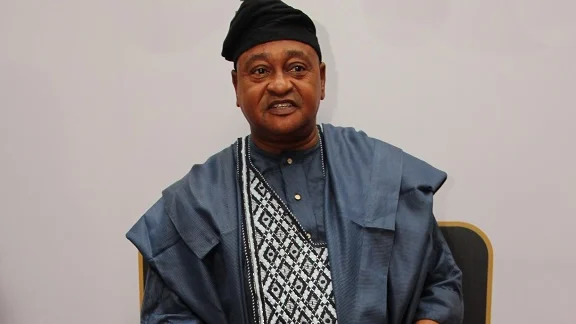
Nollywood icon Jide Kosoko has been formally presented as the Oloja of Lagos-elect, assuming a traditional title that carries deep cultural significance in Nigeria’s commercial capital, seven years after the stool became vacant.
The 72-year-old actor, whose career has spanned decades in Nigeria’s film industry, received the prestigious appointment during a ceremony held January 24 at the palace of the Elereko of Lagos. The selection marks a notable intersection of entertainment and traditional governance in contemporary Nigerian society.
“This is a solemn call to service that comes with significant cultural and communal responsibilities,” Kosoko told journalists Friday, acknowledging the weight of the position. While expressing satisfaction at being chosen for the role, the veteran performer described the appointment as “well-deserved” but remained noncommittal about how the traditional duties might affect his acting commitments going forward.
The Oloja of Lagos position had remained unfilled since 2017, following the death of Chief Adebola Ige. The lengthy vacancy underscores the careful deliberation typically involved in selecting occupants for such culturally important stools in Yoruba tradition.
Mrs. Mutiat Ali-Balogun, Olori Ebi General of the King Kosoko Royal Family, formally announced and presented the actor-elect during the ceremony. In keeping with tradition, she raised Kosoko’s hand before assembled royal family members and guests while traditional rites and prayers were conducted. She was accompanied by Deputy Olori Ebi General Oyindamola Ayepola, who also leads the Meshimo Ruling House.
The selection has drawn praise from within the entertainment industry. Fellow Nollywood actor and theater practitioner Bolaji Amusan, widely known as Mr. Latin, congratulated Kosoko and framed the appointment as a validation of the film industry’s broader contributions to Nigerian society.
“Jide is not the only prince in Lagos or in the Kosoko family, but because of his intelligence and respect in the community, he was chosen as Oloja of Lagos,” Amusan noted, emphasizing that the choice reflected Kosoko’s personal qualities and standing beyond his celebrity status. He described the appointment as “further proof that practitioners in the film industry are disciplined, responsible, and relevant contributors to society.”
Kosoko’s emergence continues a growing trend of Nigerian entertainers assuming traditional leadership roles. Last year, comedian and actor Okey Bakassi was coronated as a monarch in his Imo State community, demonstrating how cultural institutions are increasingly recognizing individuals who have achieved prominence through creative industries.
The convergence of entertainment and traditional governance reflects evolving dynamics in Nigerian society, where success in modern professions is increasingly seen as compatible with—rather than divorced from—traditional responsibilities. For Kosoko, the transition from screen to palace represents not an ending but an expansion of his public service, one that will now require him to balance the demands of artistry with the expectations of custodianship over cultural heritage.
As preparations continue toward his formal installation, the Nollywood community and Lagos traditional establishment alike will be watching to see how one of Nigeria’s most recognizable actors navigates this new chapter of leadership and cultural stewardship.
WHAT YOU SHOULD KNOW
Veteran Nollywood actor Jide Kosoko, 72, has been selected as the Oloja of Lagos-elect, filling a traditional leadership position vacant since 2017. His appointment demonstrates that excellence in Nigeria’s entertainment industry is increasingly recognized as compatible with traditional governance.
Chosen not simply for his fame but for his intelligence and community respect among other eligible princes in the Kosoko family, his selection validates the discipline and societal relevance of creative professionals.
Nigerian cultural institutions are evolving to embrace accomplished individuals from modern professions, recognizing that traditional leadership and contemporary achievement can coexist meaningfully.