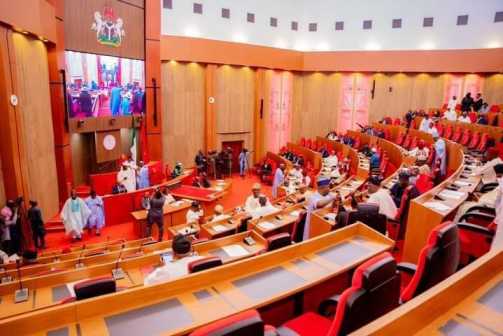
The Senate has urged a comprehensive upgrade of joint security operations between Niger and Kwara states as part of renewed efforts to address escalating insecurity in parts of the country.
Lawmakers mandated the Committees on Defence, Army, Air Force, Police Affairs, and National Security and Intelligence to undertake a coordinated assessment of the security situation across the North-Central region.
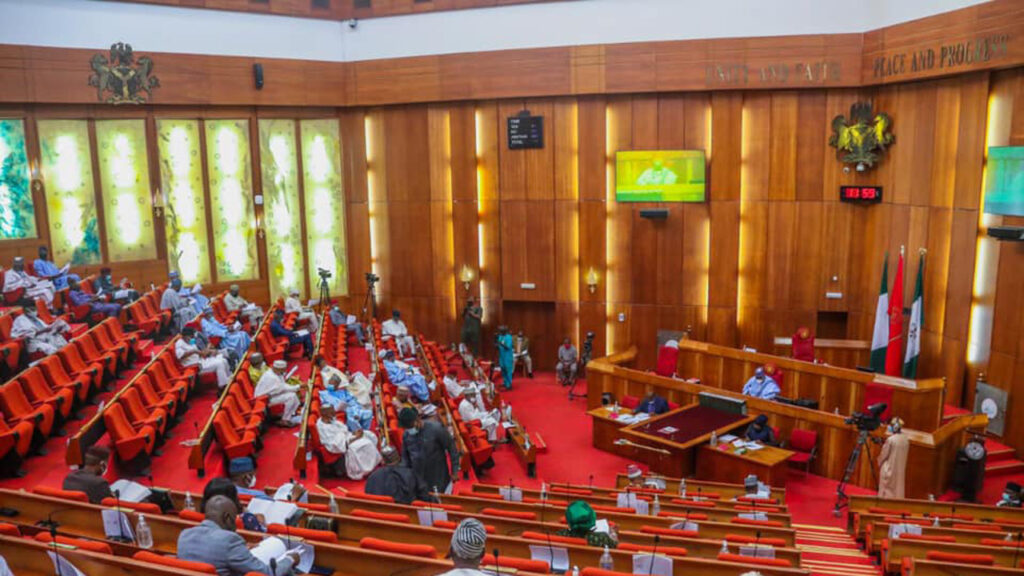
The committees are expected to present detailed recommendations within four weeks.
The resolution followed a motion moved by Sani Musa (APC/Niger East) in response to the killing of more than 50 people and the abduction of several women and children in Konkoso District, Borgu Local Government Area of Niger State.
While presenting his motion, Musa lamented that the North-Central zone has witnessed a steady rise in organised assaults targeting rural communities, agricultural lands, and settlements. He warned that the pattern of violence poses a serious threat to food production and national stability.
Other senators echoed concerns about recurring attacks on remote communities, pointing to what they described as weaknesses in intelligence sharing and coordination among security agencies. They also highlighted the worsening humanitarian crisis in affected areas.
The chamber observed a minute of silence in honour of the victims and called for stronger collaboration between security forces in Niger and Kwara states to dismantle cross-border terrorist networks operating in the region.
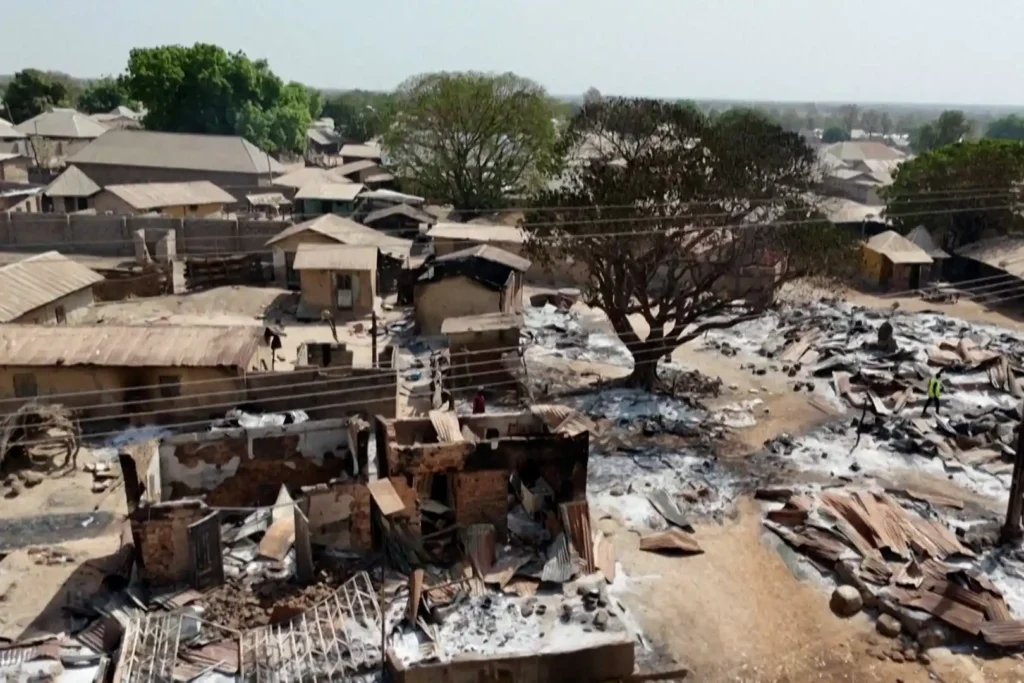
The renewed legislative attention comes in the wake of fresh violence that has drawn national and international scrutiny. Last Saturday, armed men riding motorcycles stormed three villages in Nigeria’s central region, killing at least 46 people through shootings and throat-slitting attacks.
According to a security report seen by AFP, the attackers reportedly arrived on 41 motorcycles, with each bike carrying two or three men. The villages attacked are located in Borgu, Niger State, near the boundary with Kwara State. The area has recently experienced similar deadly incidents, including an earlier attack this month that left more than 160 people dead.
The deadliest assault occurred in Konkoso village, where at least 38 residents were reportedly shot or killed with bladed weapons. A humanitarian source who spoke anonymously said most houses in the community were set ablaze and additional bodies were still being recovered.
A resident of Konkoso told AFP that the attackers initially struck the nearby village of Tungar Makeri before proceeding to his community.
A spokesperson for the Niger State Police Command confirmed that six people were killed in Tungan Makeri when gunmen overran the village at approximately 6:00 am.
He added that several homes were torched and an unspecified number of residents were abducted. Security operatives are still gathering information regarding the scale of the attacks in the other affected villages.
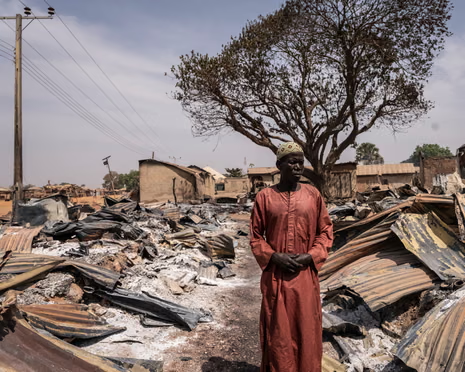
The Konkoso resident disclosed that his nephew was among those killed. He said many homes were destroyed, and four women were taken away by the attackers. After leaving Konkoso, the gunmen reportedly moved to Pissa, where they burned down a police station and killed one person. Several residents remain unaccounted for.
The border area between Kwara and Niger states encompasses the Kainji Forest, long regarded as a sanctuary for armed groups including bandits and jihadist elements.
Nigeria has been battling a jihadist insurgency in the northeast for more than 16 years. At the same time, the country continues to confront farmer-herder clashes in the North-Central region, separatist unrest in the southeast, and widespread kidnappings for ransom in the northwest.
Militant Islamist factions have also extended their activities into the northwest and west-central regions, taking advantage of rising instability in neighbouring countries such as Niger and Burkina Faso.
In addition, criminal gangs commonly referred to as bandits have intensified attacks on rural communities, looting properties, killing residents, and abducting victims for ransom.
Earlier in February, jihadist fighters killed more than 160 people in Woro village in Kwara State. The al-Qaeda-linked Group for the Support of Islam and Muslims (JNIM) previously claimed responsibility for its first attack on Nigerian territory near Woro last October.
Religious and community leaders from the Borgu axis recently appealed to President Bola Tinubu to establish a military base in the area to curb the recurring violence.
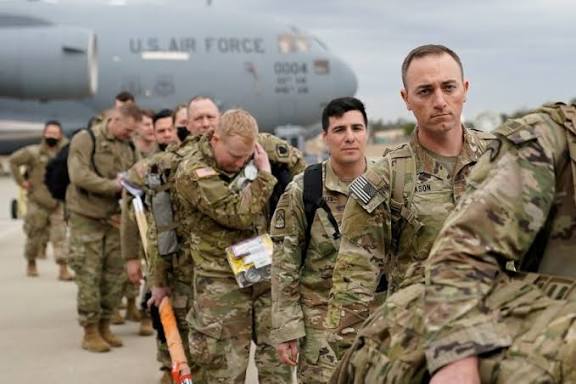
In December, the United States military collaborated with Nigerian authorities to conduct airstrikes in Sokoto State targeting what Washington described as Islamic State jihadists.
The deteriorating security situation has also attracted political commentary abroad. US President Donald Trump alleged that Christians in Nigeria are being persecuted and described the violence as a “genocide” carried out by terrorists.
However, the administration of President Bola Tinubu rejected that characterization, maintaining that the attacks are indiscriminate and affect both Christians and Muslims.
What you should know
The Senate has now formally directed a multi-committee security review of the North-Central region and is seeking stronger inter-state coordination between Niger and Kwara.
Lawmakers are concerned about the humanitarian toll, threats to food security, and the broader implications for national stability as armed groups continue to exploit forested border areas.
The proposed assessment and recommendations are expected within four weeks and could shape future security deployments in the region.