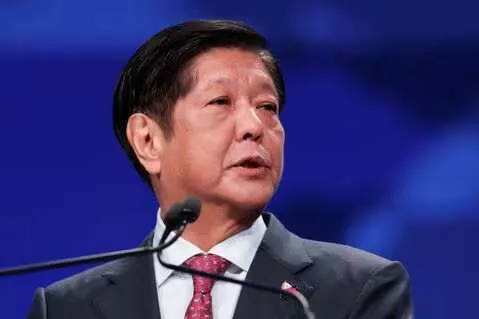
Philippine President Ferdinand Marcos Jr. will travel to Washington next week for a pivotal meeting with President Donald Trump, marking the first visit by a Southeast Asian leader since Trump’s return to office in January.
The trip comes at a critical juncture as both nations navigate escalating trade disputes while deepening their strategic partnership against China’s growing assertiveness in the South China Sea.
The visit underscores the delicate balancing act facing the Philippines as it seeks to maintain its economic relationship with the United States while strengthening military ties that have increasingly angered Beijing. Marcos will arrive in Washington carrying a pointed message: that the Philippines must achieve greater economic strength to serve as a truly effective partner in the region.
Trade Tensions Take Center Stage
Central to the discussions will be the mounting trade friction between the two allies. Trump’s administration has raised reciprocal tariffs on Philippine exports to 20% this month, up from the 17% threatened in April. The escalation has prompted urgent diplomatic efforts, with Philippine trade officials currently engaged in ongoing negotiations with their U.S. counterparts in Washington.
“The President’s official visit also aims to address the U.S. tariff proposed to be levied on Philippine exports,” Department of Foreign Affairs Assistant Secretary Raquel Solano told reporters during a media briefing Friday. She emphasized that both sides are working toward a “mutually acceptable and mutually beneficial” agreement.
The tariff dispute threatens to undermine what has otherwise been a strengthening relationship between Manila and Washington. For the Philippines, which relies heavily on exports to fuel its economy, the higher tariffs could significantly impact key industries and overall economic growth.
Security Alliance Deepens Amid China Tensions
Beyond trade, the visit will reinforce the military partnership that has become increasingly vital to both nations’ strategic interests. Relations between Manila and Beijing have deteriorated markedly under Marcos, who has pivoted decisively toward the United States in response to what both countries characterize as China’s aggressive behavior in the South China Sea and toward Taiwan.
The Philippine leader has granted the U.S. expanded access to military bases across the archipelago, a move that has facilitated increased joint exercises and training operations. These activities have included work with advanced U.S. weapons systems, including the Typhon missile system and the more recent NMESIS anti-ship missile system—developments that have drawn sharp criticism from Beijing.
“The purpose of this visit is to further strengthen the Philippines-United States Alliance, to proactively engage the U.S. in all aspects of the relations, and to seize opportunities for greater security and economic cooperation,” Solano stated.
The timing of the visit is particularly significant given the series of maritime confrontations between Philippine and Chinese vessels in the disputed waters of the South China Sea. These incidents have tested the seven-decade-old mutual defense treaty between the United States and the Philippines, with Washington repeatedly affirming its commitment to defending its ally.
Broader Diplomatic Engagement
Marcos’s itinerary reflects the comprehensive nature of the relationship that both countries seek to build. Beyond his meeting with Trump, the Philippine president will hold separate discussions with Secretary of State Marco Rubio and Defense Secretary Pete Hegseth, indicating the high-level attention the visit is receiving across the U.S. government.
The economic dimension of the relationship will also feature prominently, with Marcos scheduled to meet with U.S. business leaders who are investing in the Philippines. These meetings underscore Manila’s broader strategy of leveraging its strategic importance to attract greater American investment and economic partnership.
The visit represents a crucial test of how the Trump administration will balance its “America First” trade policies with the need to maintain strong alliances in the Indo-Pacific region. For Marcos, the challenge will be securing economic concessions while demonstrating that the Philippines remains a reliable partner in containing China’s regional ambitions.
As the first ASEAN leader to meet with Trump since his inauguration, Marcos’s visit may well set the tone for how the new administration approaches its relationships with Southeast Asian allies caught between great power competition and their own economic development needs.
WHAT YOU SHOULD KNOW
Philippine President Marcos Jr.’s visit to Washington next week represents a critical test of the U.S.-Philippines alliance as both nations grapple with competing priorities. While Trump has raised tariffs on Philippine exports to 20%, both countries are simultaneously deepening military cooperation to counter China’s aggression in the South China Sea.
This visit could determine whether the U.S. can maintain crucial regional partnerships while pursuing aggressive trade policies or if economic disputes will undermine the very alliances needed to contain China’s regional ambitions.