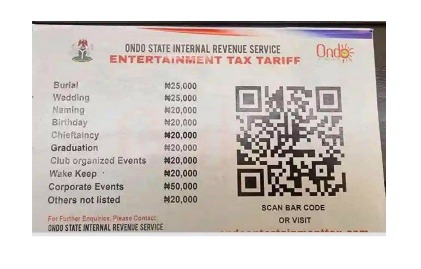
A purported tariff schedule from the Ondo State Internal Revenue Service (ODIRS) has exploded across social media, claiming to slap fresh levies on some of the most sacred and celebratory moments in Yoruba life: weddings, burials, naming ceremonies, and birthdays.
According to the widely circulated document, event organizers would cough out between ₦20,000 and ₦25,000 for personal ceremonies such as burials (₦25,000), weddings (₦25,000), naming ceremonies, and birthdays (₦20,000 each). Corporate events, meanwhile, would attract a steeper ₦50,000 fee.
The list reportedly extends to chieftaincy installations, graduations, club parties, and even wake-keeps, all under the banner of a new “Entertainment Tax.”
Neither Governor Lucky Aiyedatiwa’s office nor ODIRS had issued an official confirmation or denial.
The document surfaced without any accompanying government press release, website posting, or revenue code, the usual hallmarks of authentic state levies. Yet its rapid spread has turned Ondo into the unintended epicenter of a nationwide conversation: Should the government tax grief, joy, and family tradition?
Social media users across Instagram, Facebook, and X (formerly Twitter) have unleashed a torrent of memes, sarcasm, and outright fury. “If you want to bury your Papa, you have to pay #25,000 as tax,” one viral post quipped, attaching the tariff image.
Another asked pointedly, “Burial tax? So person don die, family dey cry, then govt POS machine go show face?” Others wondered aloud whether quiet backyard ceremonies or Zoom namings might soon become the only tax-free options.
The outrage is rooted in something deeper than naira and kobo. In Ondo and across Yorubaland, these events are not mere parties; they are communal rituals. Weddings bind families and display aso-ebi solidarity. Burials honor ancestors with drumming, dancing, and lavish feeding of mourners. Naming ceremonies welcome new life with prayers and gifts.
Taxing them, critics argue, feels less like prudent revenue generation and more like an intrusion into the very fabric of cultural survival.
Yet the timing is no coincidence. Nigeria’s federal tax reform push under President Bola Tinubu has urged states to widen their internally generated revenue (IGR) nets and phase out multiple, opaque levies.
ODIRS itself recently briefed residents on aligning with the new Nigeria Tax Laws 2025. Oil-producing Ondo, long criticized for modest infrastructure gains relative to its resources, has been under pressure to diversify its coffers.
Proponents of the alleged policy—the few who have dared to defend it—argue that high-end “owambe” culture among the elite could comfortably absorb the fees, while the state gains funds for roads, hospitals, and schools.
But many residents are unconvinced. “A government that doesn’t provide education or good hospitals but taxes citizens for providing their own?” One X user posted alongside the flyer. Another sardonic voice noted, “Ondo people, una go survive this one? Or na time to start doing quiet burials for backyard?”
This is not the first time such a document has gone viral. Last year, an identically styled flyer targeting weddings and burials in Oyo State was swiftly debunked by the government as “fake and mischievous.” Ondo authorities have similarly slapped down previous viral claims about inflated IGR figures.
The absence of any immediate clarification from Revenue House in Akure has only amplified suspicions that this latest list may be another hoax designed to stoke public anger or test the waters.
Still, the episode has laid bare a genuine tension. Nigeria’s economy remains under strain from inflation, naira volatility, and widespread hardship. Families already stretch budgets to host events that affirm dignity and community.
Adding another mandatory fee—even if modest by Lagos standards—risks pushing ordinary citizens further into survival mode.
As the dust settles and social media continues to buzz, Ondo residents and observers nationwide are watching closely for an official word.
WHAT YOU SHOULD KNOW
The viral “entertainment tax” list claiming Ondo State now levies ₦20,000–₦50,000 on weddings, burials, naming ceremonies, birthdays, and other social events remains unconfirmed by the Ondo State government or ODIRS as of now.