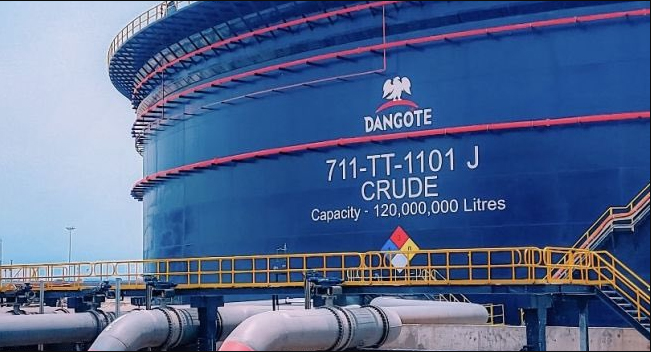
Nigeria’s petroleum marketers, who spent most of 2025 fighting Dangote’s market dominance, are now welcoming it with open arms.
The shift reflects the sobering reality of an oil market turned upside down by an escalating conflict in the Middle East, one that has sent Brent crude prices soaring past the $100-per-barrel mark before a partial correction brought the benchmark down to approximately $88 per barrel mid-week.
For a country that has historically relied heavily on imported petroleum products, the crisis has exposed the fragility of that arrangement and, in doing so, has cast the Lekki-based refinery in an entirely new light.
The volatility was felt sharply at the pump. The Dangote Refinery, citing the spike in global crude prices, raised its gantry price to ₦1,175 per litre last week, a move that cascaded quickly through the retail supply chain.
Filling stations across the country responded by adjusting pump prices to between ₦1,200 and ₦1,300 per liter, with some outlets in less accessible areas pushing the figure even higher.
However, in a development that offered brief relief to consumers and marketers alike, the refinery slashed its gantry price by ₦100 on Tuesday, bringing it down to ₦1,075 per liter. Coastal distribution prices were revised downward from ₦1,150 to ₦1,028 per liter, a ₦122 reduction. The price of diesel was also cut significantly, falling ₦190 from ₦1,620 to ₦1,430 per liter.
Anthony Chiejina, Group Chief Communications Officer of the Dangote Group, confirmed the revised pricing structure in a telephone interview with Channels Television, describing it as a direct reflection of prevailing global oil market conditions.
Perhaps the most telling sign of how dramatically the landscape has shifted came from the nation’s leading petrol retailers’ association. Dr. Billy Gillis-Harry, National President of the Petroleum Products Retail Outlets Owners Association of Nigeria (PETROAN), appeared on Channels Television’s The Morning Brief on Wednesday did not mince words.
“Let us be grateful first to God and Dangote for taking the investment foresight by establishing the Dangote Refinery,” he said, describing the facility as “our salvation” in light of the worsening regional conflict. “Going by the war, I don’t know what we would be doing today in Nigeria if we did not have that facility in place.”
The admission carries considerable weight. For much of last year, PETROAN and other stakeholders within the downstream sector had raised alarms about market concentration, warning that granting the Dangote Refinery undue dominance over local supply would be anti-competitive and potentially harmful to consumers.
Those concerns have not entirely disappeared, but they have been overtaken by a more immediate reality: with imports effectively made impossible by the conflict, the refinery is the only viable game in town.
“Right now, marketers source all of our products from Dangote Refinery,” Dr. Gillis-Harry acknowledged. “If Dangote has to have 100 percent of the domestic retail outlets, it is only for the benefit of Nigeria.”
He added that while higher prices were unwelcome, scarcity would be far worse, and that consumers and retailers must accept that fuel pricing would remain fluid in the near term—moving up or down in tandem with global market developments.
To understand what is driving these price swings, one must look beyond the headlines and into the mechanics of crude sourcing and maritime logistics. Kelvin Emmanuel, an economist and oil and gas expert who also appeared on The Morning Brief, provided a detailed breakdown of the pressures bearing down on the refinery’s cost structure.
According to Emmanuel, the Dangote Refinery draws less than half of its crude oil from domestic Nigerian sources, relying significantly on supplies from the United States, Brazil, and, to a lesser extent, Senegal and Iran. For March alone, he noted that the Nigerian National Petroleum Company (NNPC) had allocated approximately 5.7 million barrels spread across six cargo consignments and benchmarked in US dollars for delivery to the refinery.
The war, however, has dramatically inflated the cost of moving those cargoes. Shipping rates for Panama-class vessels capable of carrying roughly one million barrels across the Atlantic routes, such as those from Brazil, have reportedly doubled, jumping from approximately $40,000 to $80,000 per day. That figure does not account for fees payable to the Nigerian Maritime Administration and Safety Agency (NIMASA) and the Nigerian Ports Authority (NPA), nor for the sharp increases in war risk insurance and Protection and Indemnity (P&I) cover that underwriters are now demanding.
The cumulative effect of these added costs feeds directly into the refinery’s margins and ultimately into the price at the pump.
Emmanuel also pointed to a structural issue that has long plagued the refinery’s ability to source Nigerian crude competitively. Under the Petroleum Industry Act (PIA), crude oil is meant to be sold directly by operators. In practice, however, Emmanuel says the Dangote Refinery is often compelled to purchase Nigerian crude through third-party intermediaries—an arrangement that not only adds cost but may itself constitute a violation of the law.
Furthermore, he noted that the crude sourced locally is priced at a benchmark denominated in US dollars and subject to an additional premium, costs that are not taxed by the Federal Government. This means that in some scenarios, importing crude from overseas markets may actually be more cost-effective for the refinery than purchasing it domestically, an irony that underscores the need for urgent policy reform.
Emmanuel called on the Federal Government to engage directly with these issues: clarifying whether the refinery is being supplied with crude in naira or dollars and addressing the premium and third-party structures that inflate the cost of local crude supply.
“If he buys in Nigeria and pays at a benchmark, pays in dollars, and pays an extra premium that he doesn’t pay when he sources from abroad, it affects petrol price,” Emmanuel said, noting that despite the recent increases, Nigeria’s petrol price at approximately 182 cents per liter remains considerably lower than counterparts in some West African states, where consumers pay upward of $1.37 per liter.
What is emerging from this crisis is a broader reckoning with Nigeria’s energy security architecture. For decades, the country exported crude oil and imported refined products—a paradox that left it perpetually vulnerable to disruptions in global supply chains. The Dangote Refinery, with its nameplate capacity of 650,000 barrels per day, was designed to break that cycle.
Whether it ultimately succeeds in doing so will depend not only on global oil prices and geopolitical developments beyond Nigeria’s control but also on whether the Federal Government is willing to confront the domestic policy distortions in crude supply, pricing, and distribution that continue to undermine the refinery’s ability to operate at full efficiency and pass genuine savings on to Nigerian consumers.
For now, with import routes effectively closed and fuel queues looming as a constant threat, the country finds itself holding its breath—and its fortunes more tightly than ever to one refinery on the Lagos coastline.
WHAT YOU SHOULD KNOW
Nigeria’s fuel marketers have done a remarkable U-turn. The same industry voices that spent much of 2025 resisting Dangote’s growing grip on the domestic petrol market are now not only accepting it, but they are actively welcoming it.
The Middle East conflict, which has made imports virtually impossible, left them with little choice, and what was once a monopoly concern has quickly become a matter of national necessity.