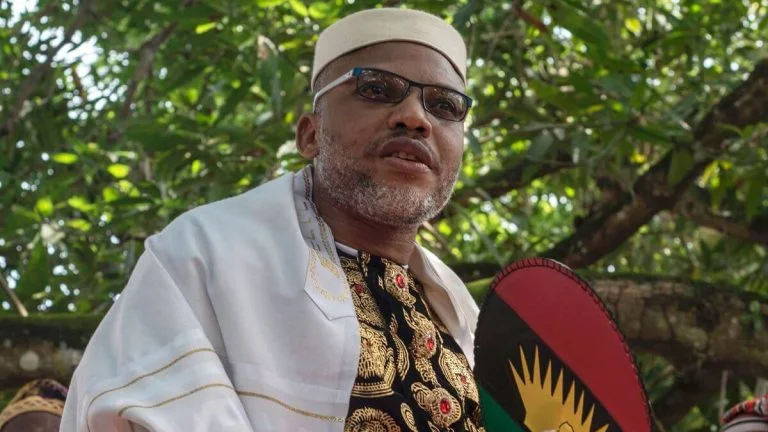
The detained leader of the Indigenous People of Biafra (IPOB), Nnamdi Kanu, has appealed to the Federal High Court in Abuja to suspend its planned judgment on the terrorism charges brought against him by the Federal Government.
In a motion he personally signed, Kanu requested that the court halt its November 20, 2025, judgment date, arguing that the proceedings were conducted under a repealed law and in defiance of a Supreme Court directive.
He specifically sought “an order arresting the delivery of judgment in Charge No: FHC/ABJ/CR/383/2015, scheduled for the 20th day of November 2025, on the ground that the proceedings were conducted under a repealed and non-existent statute and in disobedience to the Supreme Court’s directive contrary to Section 287(1) CFRN 1999.”
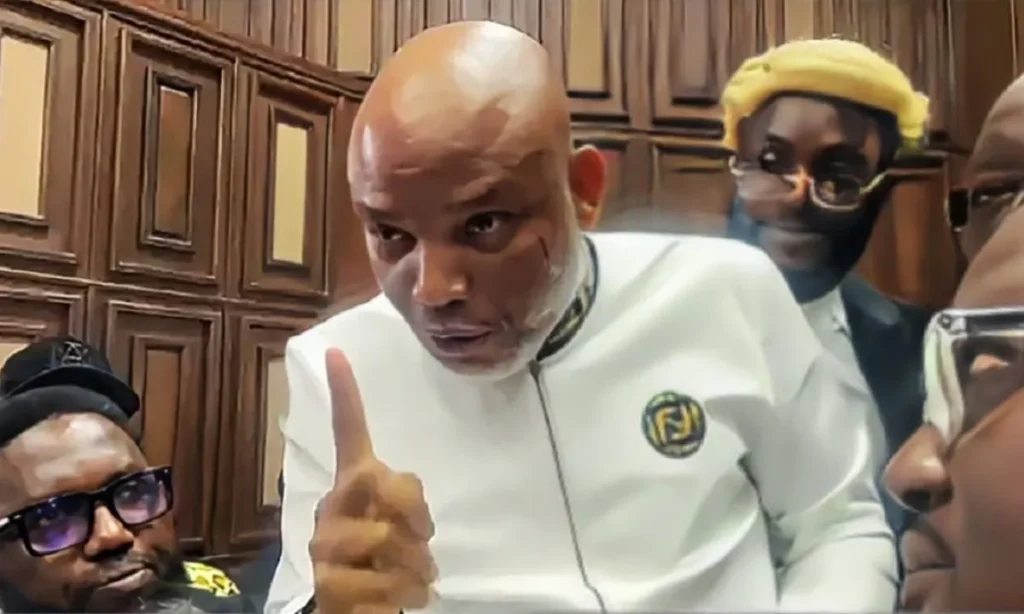
Kanu also sought a declaration that, based on Section 287(1) of the 1999 Constitution, the trial court was obligated to uphold the Supreme Court’s finding that Count 15 (now Count 7) “does not exist in law.” He argued that the court’s failure to do so rendered subsequent proceedings null and void.
Additionally, he maintained that the trial court’s refusal to acknowledge the repeal of the 2013 Terrorism Act, as required by Section 122 of the Evidence Act 2011, invalidated all related judicial steps. Kanu further contended that, in line with Section 76(1)(a)(iii) of the Terrorism (Prevention and Prohibition) Act 2022, the Federal High Court lacked jurisdiction to try him without proof that his alleged actions constituted an offence under Kenyan law or had been validated by a Kenyan court.
He also sought a ruling that the plea he entered on March 29, 2028, was void, claiming it was taken under a repealed statute and violated Section 220 of the Administration of Criminal Justice Act, 2015. According to him, “forged materials amount to constructive denial of fair hearing under Section 36(6) CFRN.”
The motion also requested “an order setting aside all proceedings and orders made by Hon. Justice Omotosho in Charge No. FEC/ABJ/CR/383/2015, for want of jurisdiction and violation of constitutional supremacy.”
Kanu, who is now representing himself after dismissing his legal team, argued that he was misled into entering a plea under a non-existent law. He insisted that halting the judgment was necessary “in the interest of justice.”
Reports indicate that Kanu plans to ensure the motion is heard before the set judgment date.
It will be recalled that Justice James Omotosho had, on November 7, reserved judgment in the case after the court closed Kanu’s defence, following the expiration of the six days given to him to present it.
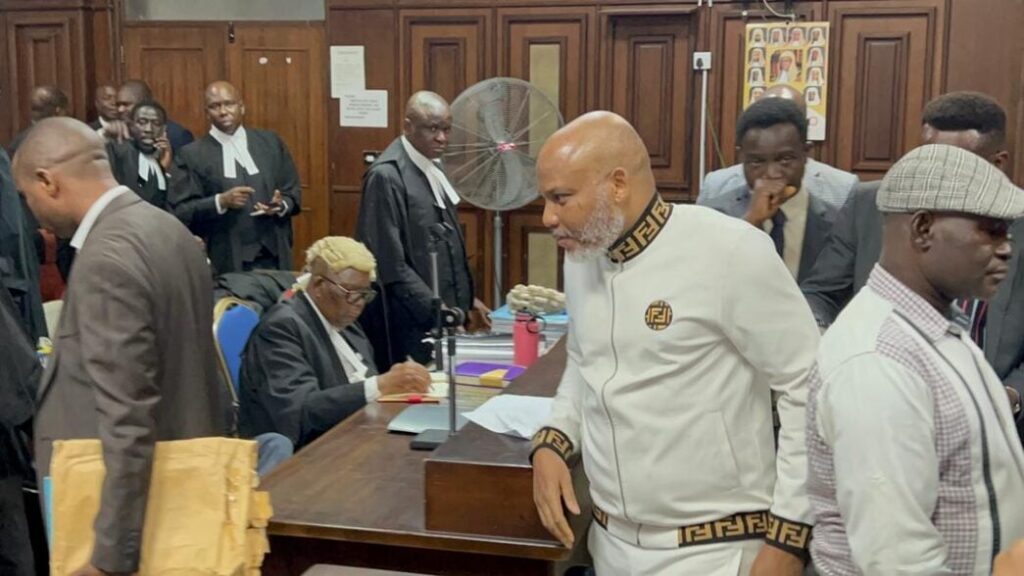
The Federal Government has accused Kanu, who has been in the custody of the Department of State Services (DSS) since 2021, of leading a separatist movement seeking to break away the South East, parts of the South South, and certain communities in Kogi and Benue states from Nigeria.
The government also alleged that Kanu used his broadcasts to incite violence and killings across the country and that he illegally imported a radio transmitter.
Kanu, however, pleaded not guilty to all charges. While the prosecution concluded its case after calling five witnesses, Kanu—who had initially listed 23 individuals, including serving governors, ministers, and former security chiefs, as potential witnesses—later withdrew his decision, stating he would not defend what he described as an “invalid charge containing offences unknown to the law.”
What you should know
Nnamdi Kanu, leader of the Indigenous People of Biafra (IPOB), has been in detention since 2021 over charges bordering on terrorism and secession.
He maintains that his trial is unconstitutional and based on repealed laws. His latest motion seeks to halt judgment scheduled for November 20, 2025, arguing that the court lacks jurisdiction and that his rights under the Nigerian Constitution have been violated.