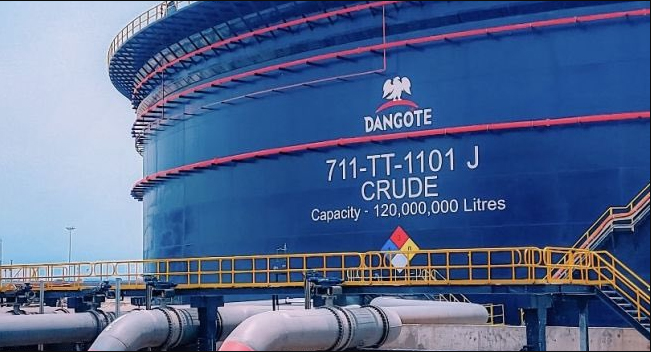
In a stark warning that has sent ripples through Nigeria’s petroleum sector, Dangote Petroleum Refinery has cautioned that the nation’s continued dependence on coastal shipping for fuel distribution could drive petrol prices to an eye-watering N1,000 per liter, effectively wiping out the price relief brought by domestic refining.
The alarm, raised in a detailed statement issued on Thursday, marks a critical juncture in Nigeria’s energy transition as the country grapples with the unintended consequences of inefficient distribution infrastructure despite achieving a long-sought breakthrough in local refining capacity.
According to the refinery’s analysis, coastal logistics—the practice of transporting petroleum products by sea along Nigeria’s coastline rather than through pipelines or direct truck loading—adds approximately N75 per liter to the cost of petrol. This seemingly modest surcharge carries devastating implications when viewed against the country’s massive fuel consumption patterns.
With Nigeria consuming an average of 50 million liters of petrol and 14 million liters of diesel daily, the mathematical reality is sobering: reliance on coastal logistics could impose an additional annual burden of roughly N1.752 trillion on the economy. This staggering sum would ultimately fall on either producers, who would see their margins evaporate, or consumers, who would face crushing fuel costs.
“The issue has broader implications for fuel affordability, consumer welfare, and Nigeria’s energy cost structure,” the refinery stated, underlining the systemic nature of the challenge beyond mere transportation logistics.
The timing of this warning is particularly significant. Just as Nigeria appeared to be turning a corner in its decades-long struggle with fuel supply, a new threat has emerged from an unexpected quarter: not production capacity, but distribution infrastructure.
The Dangote Refinery’s commencement of operations represented a watershed moment for Africa’s largest economy, ending years of dependence on imported refined products that had exposed the nation to foreign exchange volatility and global price fluctuations. The initial results were impressive: diesel prices plummeted from approximately N1,700 to between N980 and N990 per liter, while petrol declined from around N1,250 to a range of N839 to N900 per liter.
These gains have already delivered tangible benefits beyond the pump. Reduced fuel imports have eased pressure on foreign exchange reserves, contributing to a stronger naira now trading at approximately N1,385 to the dollar—a marked improvement in the country’s currency stability.
Yet the refinery warns that these hard-won achievements could be reversed by what it describes as “inefficient evacuation choices.”
At the heart of the controversy is the method by which petroleum marketers choose to transport fuel from the refinery to distribution points nationwide. Coastal logistics involves loading petroleum products onto vessels that then sail along Nigeria’s extensive coastline to various ports, where the fuel is offloaded and distributed.
While this method offers flexibility and may seem practical given Nigeria’s geography, Dangote Refinery argues it introduces a cascade of “avoidable costs” that provide no direct benefit to consumers. These include port charges, maritime levies, vessel-related expenses, and a host of other fees that compound with each stage of the journey.
In contrast, the refinery champions its gantry-based truck loading system as the most cost-efficient alternative. The facility, which features 91 loading bays capable of dispatching up to 2,900 tankers daily, eliminates several layers of logistics expenses inherent in marine transportation by allowing marketers to load directly and transport fuel overland to their destinations.
“Our gantry infrastructure has been designed to support cost-efficient fuel distribution across the country,” the company emphasized, noting its substantial investment in this transportation alternative.
Beyond its immediate business interests, Dangote Refinery is positioning this as a national policy issue, urging both petroleum marketers and government policymakers to “prioritize logistics solutions that support price stability and protect end users.”
The refinery has renewed its call for coordinated nationwide investment in pipeline infrastructure—traditionally the most cost-effective method for transporting petroleum products in high-volume markets. Such infrastructure would fundamentally reshape Nigeria’s distribution landscape, potentially offering even greater efficiencies than the current gantry system.
Nigeria’s relationship with fuel pricing has long been fraught. For years, the country’s refineries operated far below capacity or stood idle altogether, forcing the nation to import the vast majority of its refined petroleum despite being one of Africa’s largest crude oil producers. This paradox subjected ordinary Nigerians to the whims of international markets and currency fluctuations, with fuel subsidies becoming a politically charged and economically draining stopgap measure.
The Dangote Refinery, with its 650,000 barrels-per-day capacity, was heralded as the solution to this chronic problem. Its successful operation has indeed delivered on the promise of reduced imports and greater price stability. But as this latest development demonstrates, achieving energy security requires more than just refining capacity—it demands an entire ecosystem of supporting infrastructure.
The refinery’s warning places the ball squarely in the court of petroleum marketers and government regulators. Marketers, while free to choose their evacuation methods, now face a stark choice: absorb the higher costs of coastal logistics and squeeze their profit margins, or pass them on to consumers and risk public backlash.
For policymakers, the challenge is to create incentives or regulations that steer the industry toward more efficient distribution methods without appearing heavy-handed or stifling market competition.
The stakes extend beyond economics. With fuel prices affecting everything from transportation costs to food prices, the distribution debate has direct implications for Nigeria’s inflation rate, cost of living, and social stability.
It appears that Nigeria has solved the refining problem, only to discover we have a distribution problem. The question now is whether Nigeria will learn from this and build the infrastructure needed to fully realize the benefits of local refining, or whether short-term convenience will undermine long-term gains.
For millions of Nigerians who have watched fuel prices yo-yo for years, the answer to that question will determine whether the promise of the Dangote Refinery translates into lasting relief at the pump—or becomes another missed opportunity in the nation’s complex energy narrative.
WHAT YOU SHOULD KNOW
Despite Nigeria’s breakthrough in local refining through the Dangote Refinery—which has already slashed petrol prices from N1,250 to N839-900 per liter—the country now faces a critical distribution crisis.
Using coastal shipping to transport fuel instead of direct truck loading adds N75 per liter in unnecessary costs, potentially driving pump prices to N1,000 per liter and imposing an extra N1.752 trillion annual burden on the economy.
Nigeria has solved its refining problem but risks losing all those gains through inefficient logistics. How fuel is transported from the refinery matters just as much as producing it locally, and choosing the wrong method could make petrol more expensive than when it was imported.