The remains of Nigeria’s former President, Muhammadu Buhari, arrived in Daura, Katsina State, on Tuesday for interment, as the country came together in solemn mourning to honor the late leader.
The body was brought back to his homeland following his death on Sunday, July 13, 2025, in a London hospital. He was 82.
Earlier in the day, Buhari’s casket departed the United Kingdom and landed at the Umaru Musa Yar’Adua International Airport in Katsina. A visibly somber President Bola Tinubu was on hand to receive the body, having arrived at the airport from Abuja at 1:42 p.m., just minutes before the Nigerian Air Force jet transporting Buhari’s remains touched down at exactly 1:51 p.m.
The late president’s wife, Aisha Buhari, was part of the delegation that accompanied the body to Nigeria. Also present was Vice President Kashim Shettima, Chief of Staff to the President Femi Gbajabiamila, and other close family members and associates. A distinguished line-up of dignitaries, including President Umaro Sissoco Embaló of Guinea-Bissau, Niger’s Prime Minister Ali Lamine Zeine, former President of Niger Issoufou Mahamadou, and Nigeria’s former Vice President Yemi Osinbajo, joined in the reception.
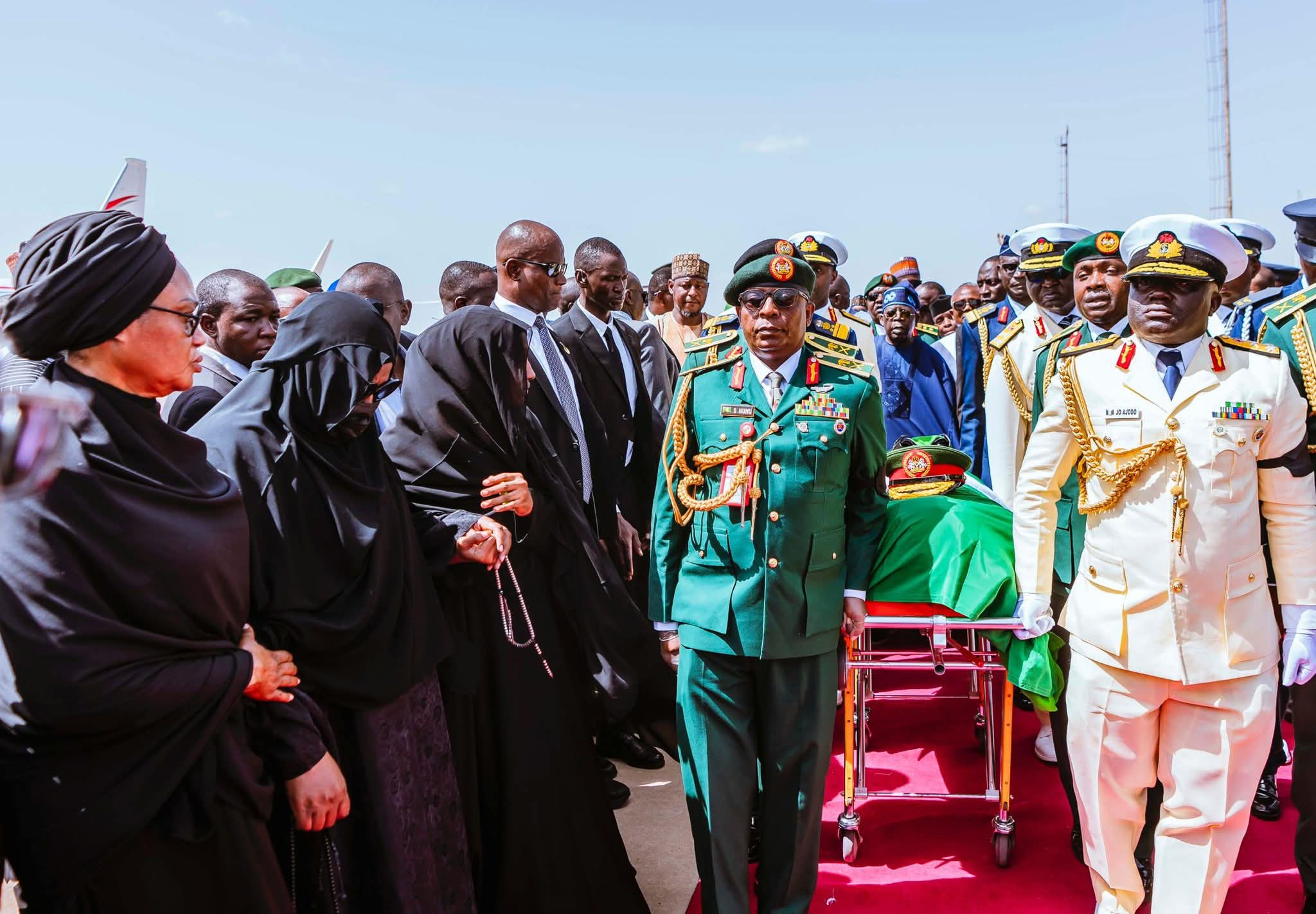
Upon arrival, a ceremonial welcome was performed by the military in Buhari’s honor. The casket, adorned in the national colors, was wheeled onto a military trolley by a group of senior officers drawn from the Nigerian Armed Forces. These included top-ranking officials from the Army, Navy, and Air Force. Major General Mike Alechenu supervised the coordination of this joint effort, ensuring precision and respect in every movement.
The slow march of the pallbearers was accompanied by the hymn, “God Be With You Till We Meet Again,” as the casket passed through a ceremonial military line-up of six officers and 96 soldiers, assembled to mark the final farewell. The somber procession moved with dignity and reverence as the dignitaries, led by President Tinubu and Vice President Shettima, followed silently behind the casket.
Once the ceremony concluded at the airport, the body was transferred to a military hearse for the journey to Daura, where preparations had been underway since morning. A sea of mourners had gathered near Buhari’s residence, many of whom had arrived before dawn to secure a place to bid their final goodbyes to a man they regarded as a leader of integrity and a champion of the ordinary Nigerian.
On arrival in Daura, the casket was met with an even larger crowd. Residents of the town and visitors from across the country flooded the area, chanting prayers and words of remembrance. Buhari, known for his reserved lifestyle and unwavering dedication to public service, was deeply respected in this close-knit community, where his connection to the people remained strong long after leaving office.
Religious rites were led by the Chief Imam of Katsina State, who presided over the prayer session in accordance with Islamic traditions. The funeral ceremony was marked by a reflective atmosphere as both national and international guests paid homage to the late statesman.
The event also featured a 21-gun salute, a traditional military honor reserved for heads of state. It served as a fitting final tribute to a man who served Nigeria as both a military leader and elected president. The full military honors demonstrated the state’s appreciation for Buhari’s lifelong commitment to national service.
The government of Nigeria had earlier declared Tuesday, July 15, a national public holiday in Buhari’s honor. The symbolic gesture was accompanied by an order for flags to be flown at half-mast across the country to signify the collective grief of a mourning nation.
As the body of the late leader was laid to rest in Daura, tributes continued to pour in from across Nigeria and beyond. For many, the final rites offered not just closure but a moment to reflect on the legacy of a man who, for better or worse, shaped Nigeria’s modern political history.
What you should know
Former President Muhammadu Buhari, who led Nigeria as both a military ruler and a democratically elected leader, was buried in his hometown of Daura with full state honors.
His remains were flown in from London and received by President Tinubu and a host of dignitaries, including African leaders and members of his family. The burial was marked by military ceremony, national mourning, and public affection from those who regarded him as a symbol of discipline and simplicity.