Operatives of the National Drug Law Enforcement Agency have apprehended a Nigerian businessman based in Brazil at the Murtala Muhammed International Airport in Ikeja, Lagos, over allegations of smuggling cocaine by hiding it on his body and inside his footwear.
The arrest was confirmed in a statement released on Sunday by the NDLEA’s Director of Media and Advocacy, Femi Babafemi.
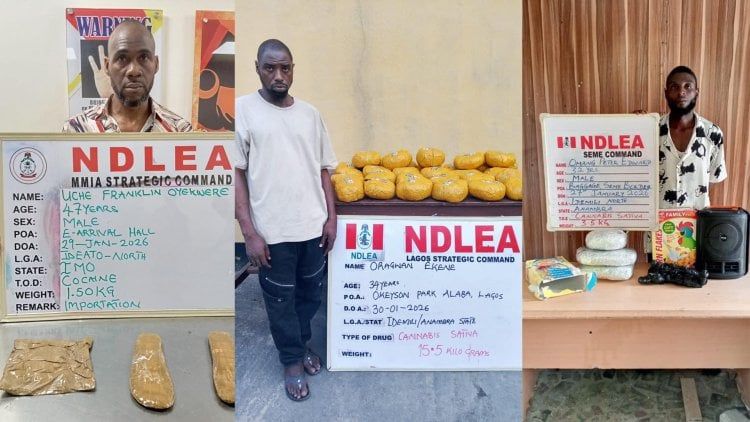
According to the agency, the suspect was taken into custody on Thursday, January 29, 2026, at the airport’s arrival hall while passengers were being cleared from a South African Airways flight that originated from Brazil and transited through Johannesburg. The arrest followed intelligence reports that had flagged the suspect.
Babafemi explained that a body scan carried out on the suspect revealed suspicious substances, which prompted officers to conduct a strip search.
“A Brazil-based Nigerian businessman, Uche Franklin Onyekwere, has been arrested by operatives of the National Drug Law Enforcement Agency (NDLEA) at the arrival hall of the Murtala Muhammed International Airport (MMIA), Ikeja-Lagos, for concealing parcels of cocaine in his private part and soles of his footwear,” the statement read.
“Onyekwere was arrested on Thursday, 29th January 2026, during the inward clearance of South African Airways flight passengers arriving from Brazil via Johannesburg, following processed intelligence. When the 47-year-old suspect was taken for a full body scan, the result confirmed illicit drug concealment.
“As a result, he was subjected to a strip search, during which a big parcel of white powdery substance, which later tested positive for cocaine, was discovered wrapped around his right thigh.”
The NDLEA spokesperson further disclosed that officers recovered three wraps of cocaine from the suspect, with a combined weight of 1.60 kilograms.
“A further search revealed two additional wraps of the same substance concealed in the sole of a pair of flat shoes worn by the suspect. In all, three large wraps of cocaine, with a gross weight of 1.60 kilograms, were recovered from his body and footwear.”
During initial questioning, the suspect reportedly admitted that he bought the cocaine in Brazil with plans to sell it in Nigeria. He told investigators that the proceeds were meant to support his business and cover expenses for the naming ceremony of his newborn child.
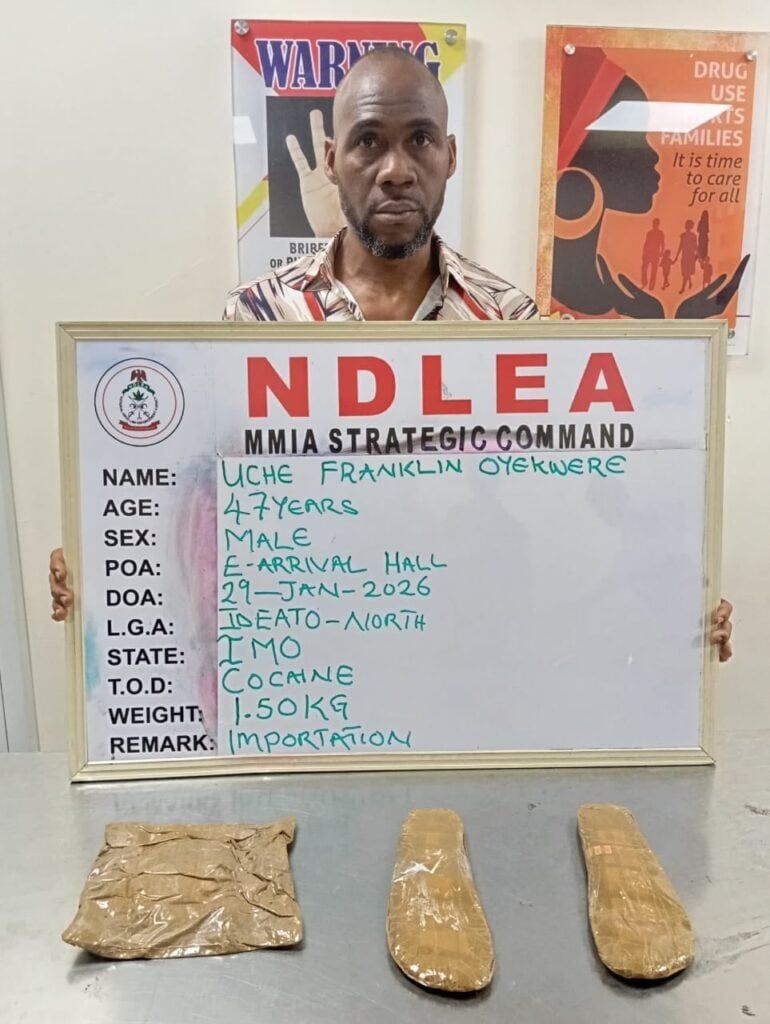
“During a preliminary interview, the suspect revealed he purchased the illicit drug consignment in Brazil with the intention to resell the cocaine in Nigeria in order to raise capital to boost his business and also finance the naming ceremony of his newly born child.
“The suspect who lives in Rua Ever, Mulariuha, São Paulo, claimed that he has been living in Brazil since 2008, while he has been operating a toy business for about nine years.”
In a separate operation, NDLEA officers at the Tincan Seaport in Lagos intercepted a massive consignment of cannabis. Authorities discovered 55 jumbo bags of Canadian Loud, a highly potent cannabis strain, weighing a total of 1,183 kilograms.
The agency stated that the drugs, which were imported from Montreal, Canada, were found on Wednesday, January 28, during a joint examination of a container by NDLEA officers, Customs officials, and other security agencies. The illicit items were concealed inside two vehicles—a Hyundai SUV and a Toyota Matrix.
The statement also revealed that NDLEA operatives in Niger State stopped a truck carrying 176 bags of skunk weighing 2,735 kilograms, along with one kilogram of Colorado, a synthetic cannabis, leading to the arrest of three suspects identified as Andy Chidogu, 49; Kenneth Ogene, 45; and Sadiq Olanrewaju, 27.
What you should know
The NDLEA has intensified its crackdown on drug trafficking networks operating through Nigerian borders, particularly airports and seaports.
This arrest highlights the agency’s reliance on intelligence-led operations and advanced screening methods to intercept illicit drugs. Cocaine trafficking routes from South America remain a major concern, while the seizure of large quantities of cannabis at seaports and highways shows the scale of domestic and international drug smuggling.
The agency continues to collaborate with Customs and other security bodies to disrupt supply chains and prosecute offenders.