The Nigerian Association of Resident Doctors (NARD) has refuted statements by the Federal Ministry of Labour claiming significant progress in addressing the union’s demands, describing the assertions as misleading and inaccurate.
In a statement released on Thursday, NARD expressed profound disappointment over the ministry’s November 19 press release, which suggested that a “high percentage” of the doctors’ grievances had been resolved. The association argued that the statement did not reflect the reality of ongoing negotiations or the conditions prompting the nationwide strike.
During its Extraordinary National Executive Council (NEC) meeting on November 17, NARD reviewed its demands and concluded that “not a single one” of its 19 core demands had been fully addressed, contrary to government claims. The union stressed that what the ministry described as progress largely consisted of promises, pending approvals, or newly formed committees—measures previously characterised by delays and non-implementation.
NARD also challenged the ministry’s assertion that payments of the 25%/35% CONMESS review and 2024 accoutrement allowances had commenced. The association stated that none of its members nationwide had received these payments, while claims about reconciling omissions only confirmed unresolved issues. “An announcement of intent is not a substitute for a credited salary,” the statement read.
The union criticised the government for merely “compiling” lists of specialist allowances and arrears for doctors in federal institutions, including Federal Teaching Hospital Lokoja, FMC Owo, and University of Ilorin Teaching Hospital. NARD described the practice as unacceptable, noting that years of dialogue have failed to yield tangible results.
On welfare issues, the association condemned committees set up to address manpower shortages, casualisation, and disengagement of doctors at FTH Lokoja, calling such committees bureaucratic tools that delay concrete action. NARD reiterated its demand for the immediate reinstatement of disengaged doctors and the full implementation of a one-for-one replacement policy to mitigate shortages and burnout.
The union also explained its refusal to sign a proposed Memorandum of Understanding (MoU), citing the lack of clear timelines and enforceable guarantees. “We refuse to sign any MoU built on unfulfilled promises,” NARD stated.
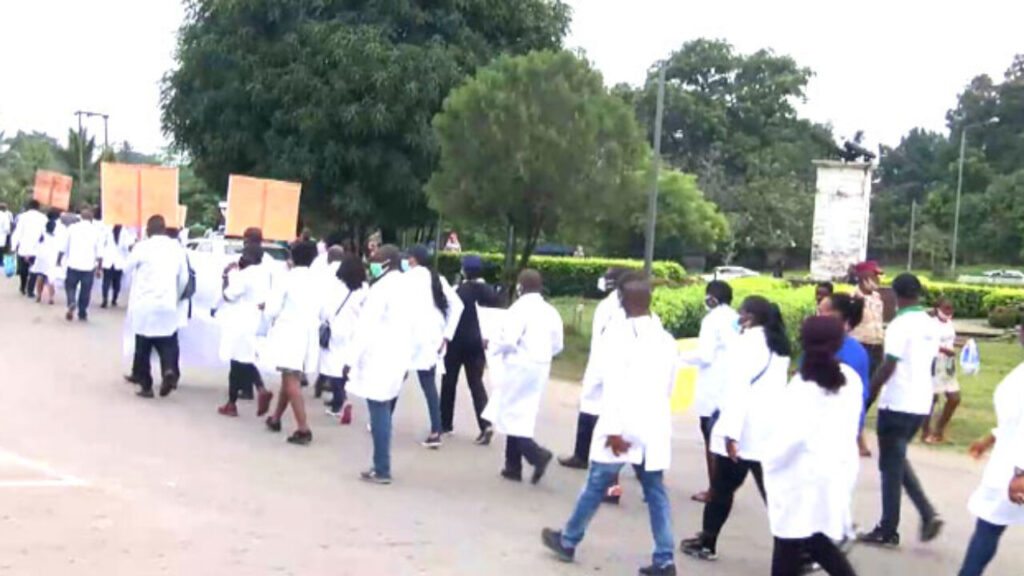
NARD affirmed that the nationwide, total, and indefinite strike, which began on November 1, would continue until minimum demands are met. These include reinstatement of the five doctors at FTH Lokoja with full compensation, immediate payment of reviewed allowances and arrears, full execution of the one-for-one replacement policy, payment of specialist allowances, and resolution of other outstanding issues previously communicated to the government.
The association expressed irony that the ministry accused NARD of failing to respect labour laws, pointing instead to repeated violations by the government. While reaffirming willingness to engage meaningfully, NARD urged the government to prioritise concrete action over “misleading press statements.”
“The health of our nation is in the balance. The responsibility to restore stability lies squarely with the government,” the statement concluded.
The communique was signed by NARD President Dr. Mohammad Usman Suleiman, Secretary-General Dr. Shuaibu Ibrahim, and Publicity and Social Secretary Dr. Abdulmajid Yahya Ibrahim.
What you should know
The Nigerian Association of Resident Doctors (NARD) has rejected the Federal Ministry of Labour’s claims of progress in resolving their grievances, asserting that none of their 19 core demands has been fully met.
The nationwide strike, which began on November 1, remains in effect. NARD criticised promises, committees, and partial payments as insufficient, demanding immediate action on arrears, allowances, specialist pay, and reinstatement of disengaged doctors.
The union refused to sign any Memorandum of Understanding lacking enforceable timelines. NARD called on the government to prioritise tangible solutions over press statements, stressing that public health stability depends on resolving the ongoing crisis.