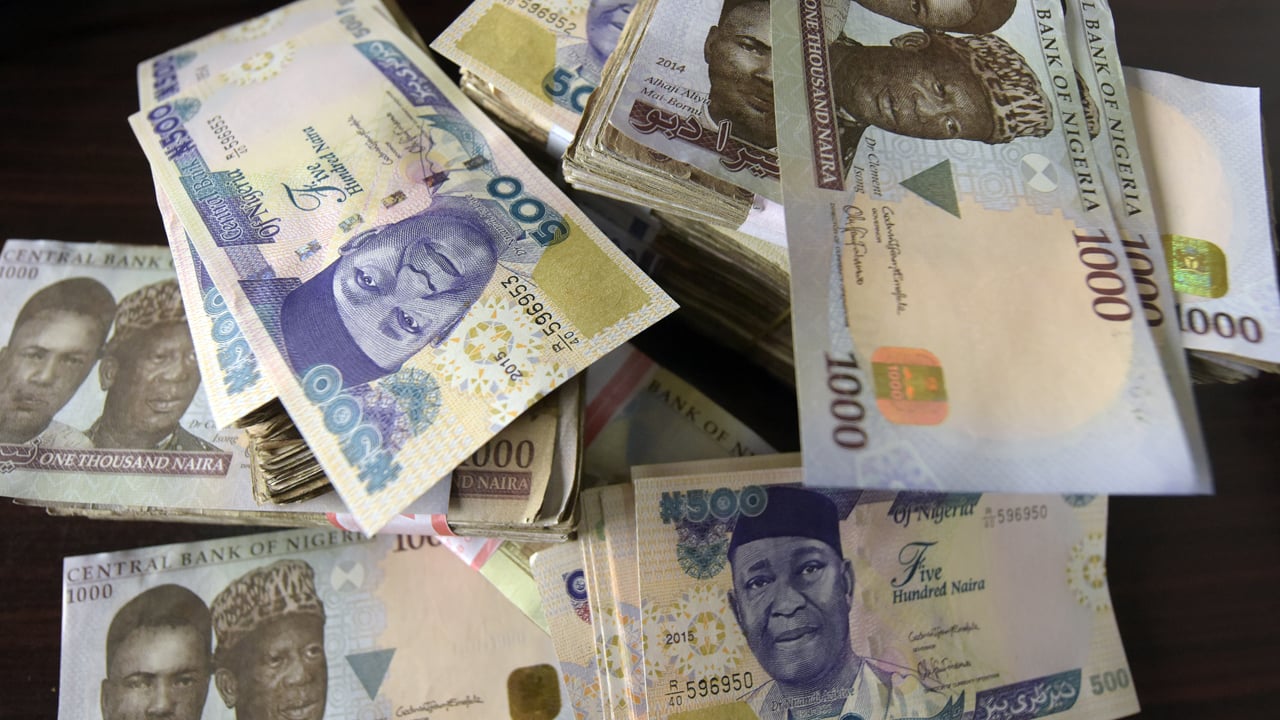
The Nigerian naira depreciated marginally against the U.S. dollar at the official foreign exchange window on Monday, settling at N1,420.5 per dollar as weakening global sentiment toward the greenback intersected with persistent domestic currency pressures.
According to data released by the Central Bank of Nigeria (CBN), the local currency lost ground from Friday’s close of N1,417.95 to the dollar, marking another session of modest decline at the official market despite improving conditions in the parallel segment.
The latest movement underscores the enduring structural fragility in Nigeria’s dual exchange rate system, where official and informal markets continue to operate at significantly different price levels. This divergence has widened even as global financial markets grapple with renewed uncertainty over U.S. economic prospects and geopolitical tensions that have rattled investor confidence in the dollar.
While the official rate softened, the parallel market—often considered a barometer of actual currency demand and supply dynamics—registered modest improvement. Data compiled by Nairametrics showed the naira strengthening to N1,483 per dollar on Monday, up from N1,490 last Friday.
However, the gap between the two markets has ballooned to N73 per dollar, the widest margin recorded since February 2025. This spread is a clear signal of ongoing foreign exchange supply constraints and the distortions that continue to plague Nigeria’s formal currency infrastructure.
The widening differential raises fresh questions about the effectiveness of recent policy measures aimed at harmonizing the exchange rate and improving market transparency. It also highlights the challenges facing monetary authorities as they attempt to balance liquidity management with the need to restore investor confidence in the official FX system.
Despite the day-to-day volatility, Nigeria’s exchange rate has displayed relative stability over recent months when viewed against the backdrop of 2024’s steep depreciation. The naira closed last year at N1,429 to the dollar on December 31, 2025—a 7.4 percent appreciation from the N1,535 rate recorded on the final trading day of 2024.
Yet analysts caution that this stability remains tenuous. The naira continues to face recurring pressure at the official market, with intermittent gains in the parallel segment offering little more than reprieve. Foreign exchange liquidity remains uneven across both markets, contributing to periodic swings and unpredictable spreads.
Market participants say confidence in the naira is still heavily dependent on sustained inflows of foreign exchange, clearer policy direction from the CBN, and the consistent implementation of ongoing structural reforms. These include efforts to deepen market liquidity, reduce speculative activity, and improve dollar supply from key sources such as oil revenues and diaspora remittances.
The naira’s latest decline comes against a backdrop of softening global dollar sentiment, driven by mounting concerns over the U.S. economic outlook and geopolitical risks. Investors have grown increasingly wary of factors including trade tensions, potential shifts in U.S. monetary policy, and instability in key global flashpoints.
For Nigeria, these external dynamics compound domestic challenges. The country’s foreign exchange earnings remain heavily reliant on crude oil exports, making the naira vulnerable to fluctuations in global energy prices and capital flows. Any deterioration in global risk appetite tends to trigger outflows from emerging markets like Nigeria, further straining dollar availability.
As the naira navigates these crosscurrents, attention is turning to the Central Bank’s next steps. Policymakers have repeatedly pledged to enhance transparency and liquidity in the FX market, but the persistence of a large parallel market premium suggests more work remains to be done.
Some economists argue that without addressing underlying supply-side bottlenecks—including boosting non-oil exports, attracting foreign direct investment, and rebuilding reserves—the naira will continue to face structural vulnerabilities regardless of short-term interventions.
For now, the currency’s trajectory will likely depend on a combination of global economic conditions, domestic policy execution, and the ability of Nigerian authorities to maintain investor confidence in a system still marked by deep-seated inefficiencies and fragmentation.
WHAT YOU SHOULD KNOW
The naira’s struggle continues to be defined by a dangerous split personality: while the official rate weakened to N1,420.5 per dollar on Monday, the parallel market improved—but the N73 gap between them, the widest since February, reveals the real story. Despite a 7.4% gain over 2024, Nigeria’s currency remains trapped between uneven dollar supply, global economic jitters, and a dual-market system that undermines confidence.
Until the CBN can close this widening divide and secure consistent foreign exchange inflows, any stability the naira enjoys will remain fragile and vulnerable to both external shocks and internal structural flaws. The naira’s fate hinges on fixing supply bottlenecks and restoring genuine market confidence—not just managing day-to-day fluctuations.