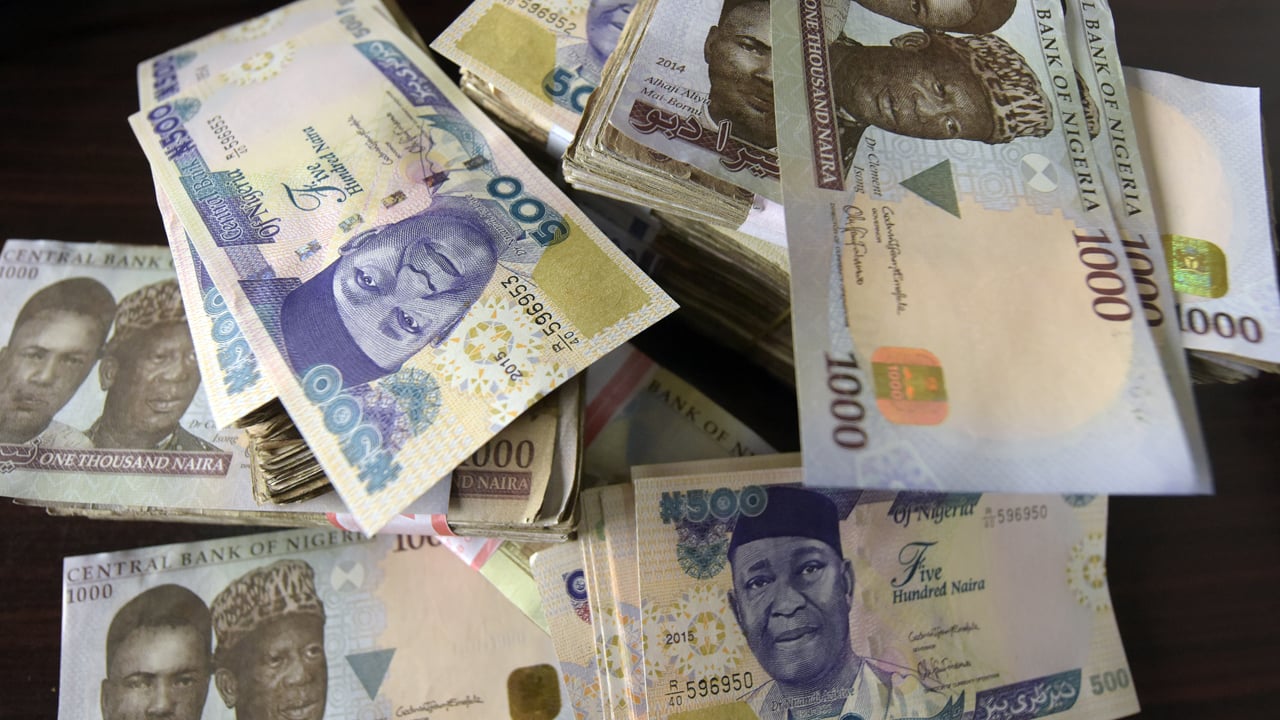
The naira posted a modest but consistent gain against the United States dollar in the second trading week of 2026, signaling early signs of improving sentiment in Nigeria’s foreign exchange market amid stronger external buffers and relative market calm.
Trading data from the official foreign exchange window showed that the local currency closed the week at N1,424.5 to the dollar, appreciating from N1,431/$ at the end of the previous week. The performance represents a steady upward movement that market watchers say reflects easing pressure on the naira as the year begins.
Within the week, the currency traded within a narrow band, underscoring limited volatility. The naira exchanged at N1,428/$ on Monday, firmed to N1,416/$ on Tuesday, before moderating slightly to N1,421/$ on Wednesday and Thursday, and eventually settling at Friday’s closing rate. Analysts described the trend as a mild but encouraging appreciation, citing improved liquidity conditions and a better alignment between foreign exchange demand and supply.
A year-on-year comparison also highlights the currency’s relative recovery. At the close of the second trading week of 2025 on January 10, the naira stood at N1,544.5/$, indicating a notable appreciation over the 12 months despite lingering structural challenges in the economy.
Supporting the naira’s performance was a marginal increase in Nigeria’s external reserves. Data from the Central Bank of Nigeria (CBN) showed that reserves rose to $45.62 billion on Tuesday, up from $45.60 billion on Monday. Although the increase was slight, it provided additional support for the local currency and helped stabilize market expectations.
The apex bank has maintained an optimistic medium-term outlook for the naira, projecting that external reserves could climb to about $51.04 billion in 2026, up from an estimated $45.01 billion in 2025. According to the CBN, the projection is anchored on easing foreign exchange pressures, improved oil earnings, planned sovereign bond issuances, and stronger diaspora remittance inflows.
The bank also identified Nigeria’s expanding domestic refining capacity as a critical structural factor that could strengthen the naira over time. Reduced reliance on imported petroleum products is expected to significantly lower foreign exchange demand, thereby easing pressure on the currency.
Economists note that a stronger and more stable naira would help curb imported inflation, boost investor confidence, and reinforce overall macroeconomic stability. Rising external reserves also enhance the CBN’s capacity to manage volatility in the FX market, while improved oil receipts and capital inflows strengthen the country’s balance of payments.
Commenting on the outlook, Dr. Muda Yusuf, Chief Executive Officer of the Centre for the Promotion of Private Enterprise (CPPE), described prospects for the naira in 2026 as largely positive, citing the strength of external reserves as a key stabilizing factor. He, however, stressed that sustaining the recent gains would depend on consistent policy implementation, stronger export earnings, and the continuation of foreign exchange market reforms.
WHAT YOU SHOULD KNOW
The naira’s modest appreciation in the second trading week of 2026 reflects improving foreign exchange stability, supported mainly by rising external reserves, better liquidity conditions, and renewed confidence in Nigeria’s medium-term economic outlook.