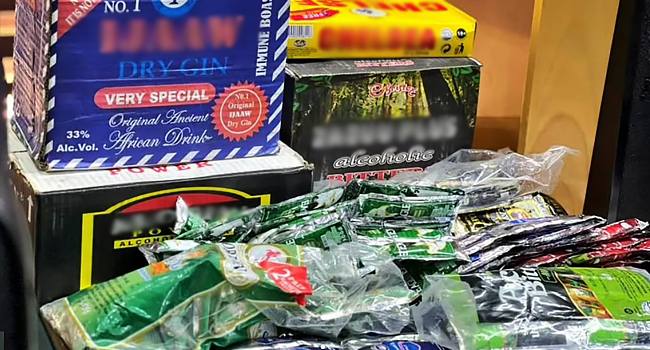
The National Agency for Food and Drug Administration and Control (NAFDAC) has announced a complete ban on the production and sale of alcoholic beverages packaged in sachets and bottles smaller than 200ml by December 2025.
NAFDAC Director-General, Professor Mojisola Adeyeye, made this known during a press briefing in Abuja, explaining that the decision was driven by growing public health concerns.
“The proliferation of high-alcohol-content beverages in sachets and small containers has made such products easily accessible, affordable, and concealable, leading to widespread misuse and addiction among minors and commercial drivers,” Adeyeye stated.
She linked the abuse of such alcoholic products to rising cases of domestic violence, road accidents, school dropouts, and social vices across communities, warning that the situation had reached a dangerous level.
According to Adeyeye, the directive follows a Senate resolution expressing alarm over the increasing availability of cheap sachet alcohol to minors, which has been contributing to moral and social decline.
NAFDAC had previously entered into a Memorandum of Understanding (MoU) with manufacturers and stakeholders to phase out sachet alcohol, initially setting the deadline for 2023 before extending it to December 2025. However, Adeyeye made it clear that there would be no further extensions, emphasizing that retailers and producers must adhere strictly to the new deadline.
“The Senate’s resolution is absolute and no further extension will be granted. We urge retailers and manufacturers to comply with this directive,” she warned.
Professor Adeyeye stressed that the policy was not meant to punish producers but to protect Nigerians, particularly young people, from the long-term dangers of alcohol abuse.
“This ban is not punitive; it is protective,” she said. “It is aimed at safeguarding the health and future of our children and youth. The decision is rooted in scientific evidence and public health considerations. We cannot continue to sacrifice the well-being of Nigerians for short-term economic gain. The health of a nation is its true wealth.”
She also disclosed that NAFDAC will collaborate with security agencies to ensure full enforcement of the ban starting January 2026.
See the press statement by NAFDAC’s boss below:
PRESS RELEASE BY DIRECTOR GENERAL, NATIONAL AGENCY FOR FOOD AND DRUG ADMINISTRATION AND CONTROL, PROF MOJISOLA CHRISTIANAH ADEYEYE
NAFDAC REAFFIRMS COMMITMENT TO ENFORCE THE BAN ON ALCOHOL IN SACHETS AND SMALL PLASTIC BOTTLES BY DECEMBER 2025
The National Agency for Food and Drug Administration and Control (NAFDAC) has reaffirmed its unwavering commitment to enforce the total ban on the production and sale of alcoholic beverages in sachets and small-volume PET/glass bottles (below 200ml) by December 2025, in line with the recent directive of the Senate of the Federal Republic of Nigeria.
This decisive action, ordered by the Nigerian Senate and backed by the Federal Ministry of Health and Social Welfare, underscores the Agency’s statutory mandate to safeguard public health and protect vulnerable populations—particularly children, adolescents, and young adults—from the harmful use of alcohol.
The proliferation of high-alcohol-content beverages in sachets and small containers has made such products easily accessible, affordable, and concealable, leading to widespread misuse and addiction among minors and commercial drivers.
This public health menace has been linked to increased incidences of domestic violence, road accidents, school dropouts, and social vices across communities.
In December 2018, NAFDAC, the Federal Ministry of Health, and the Federal Competition and Consumer Protection Commission (FCCPC) signed a five-year Memorandum of Understanding (MoU) with the Association of Food, Beverage and Tobacco Employers (AFBTE) and the Distillers and Blenders Association of Nigeria (DIBAN) to phase out sachet and small-volume alcohol packaging by January 31, 2024. The moratorium was later extended to December 2025 to allow industry operators to exhaust old stock and reconfigure production lines.
NAFDAC emphasizes that the current Senate resolution aligns with the spirit and letter of that agreement and with Nigeria’s commitment to the World Health Organization’s Global Strategy to Reduce the Harmful Use of Alcohol (WHA63.13, 2010), to which Nigeria is a signatory.
According to Prof. Mojisola Christianah Adeyeye, Director-General, NAFDAC:
“This ban is not punitive; it is protective. It is aimed at safeguarding the health and future of our children and youth. The decision is rooted in scientific evidence and public health considerations. We cannot continue to sacrifice the well-being of Nigerians for short-term economic gain. The health of a nation is its true wealth.”
NAFDAC reiterates that only two categories of alcoholic beverages are affected by this regulation—spirit drinks packaged in sachets and small-volume PET/glass bottles below 200ml. The Agency calls on all stakeholders, including manufacturers, distributors, and retailers, to comply fully with the phase-out deadline, as no further extension will be entertained beyond December 2025.
The Agency will continue to work collaboratively with the Federal Ministry of Health and Social Welfare, the Federal Competition and Consumer Protection Commission (FCCPC), and the National Orientation Agency (NOA) to implement nationwide sensitization campaigns on the health and social dangers associated with alcohol misuse.
NAFDAC remains resolute in its mission to ensure that only safe, wholesome, and properly regulated products are available to Nigerians.
Signed:
Prof Mojisola Christianah Adeyeye, FAS
Director-General
National Agency for Food and Drug Administration and Control (NAFDAC)
Abuja, Nigeria
Date:11th November 2025
What you should know
NAFDAC’s ban on sachet and small-bottle alcohol follows years of public health advocacy and Senate intervention.
The move aims to curb youth addiction and social problems linked to cheap, easily accessible alcoholic drinks, with full enforcement set to begin in January 2026.