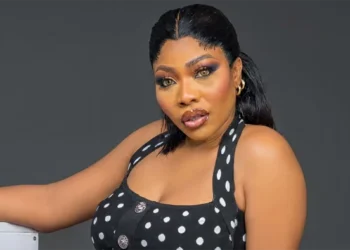
Nigerian media personality Toke Makinwa has broken her silence on the complexities surrounding her past marriage, offering rare insights into how public pressure and personal preservation led to her difficult decision to walk away from what she describes as a toxic relationship.
Speaking in a candid interview with renowned media host Chude Jideonwo, the actress and entrepreneur shed light on the often-misunderstood journey of survivors who emerge from difficult circumstances, challenging society’s tendency to minimize their experiences based on their ability to rebuild their lives.
Makinwa, who has built a successful career as a broadcaster, author, and businesswoman, addressed the pervasive misconception that survivors of difficult relationships couldn’t have faced severe challenges simply because they managed to move forward with their lives. Her comments highlight a troubling social tendency to measure trauma by its visible aftermath rather than its genuine impact.
“People like to say it must not have been that bad because you didn’t die,” Makinwa stated, her words cutting through the comfortable assumptions many make about resilience. “But if someone comes back 10 times stronger, it unsettles others. Instead of learning from it, they see your strength as a threat.”
This observation touches on a broader social phenomenon where society often responds to survivors’ recovery with skepticism rather than support, questioning the legitimacy of their struggles based on their ability to overcome them.
Perhaps most revealing was Makinwa’s admission that the public nature of her marriage played a decisive role in her choice to leave. The media personality acknowledged that in a private setting, she might have remained in the relationship longer, but the intensity of public scrutiny created an additional layer of pressure that made the situation untenable.
“Maybe I could have stayed if it wasn’t so public,” she reflected. “But the way I loved this person would have been dangerous for me. If I stayed, how I felt would have consumed my entire life.”
This candid admission reveals the double-edged nature of celebrity relationships, where personal struggles play out under intense public examination, sometimes serving as an unexpected catalyst for necessary change.
The mother of one emphasized that her decision ultimately came down to self-preservation—choosing her own well-being over remaining in what she characterized as a toxic environment. Her message resonates beyond celebrity circles, speaking to anyone who has faced the difficult choice between staying in a familiar but harmful situation or taking the uncertain path toward healing.
“Until you have walked in my shoes, don’t comment on it,” Makinwa declared, issuing a direct challenge to those quick to judge others’ decisions without understanding their full context.
Makinwa’s revelations arrive at a time when conversations about mental health, domestic relationships, and the pressure of public life are gaining increased attention across Nigeria and beyond. Her willingness to address these topics publicly contributes to a growing dialogue about the complexities of modern relationships and the courage required to prioritize one’s well-being.
The interview also highlights the unique challenges faced by public figures, whose personal struggles often become public entertainment, creating additional barriers to healing and recovery.
As Nigeria’s entertainment industry continues to grapple with questions of privacy, mental health, and public accountability, Makinwa’s openness provides a valuable perspective on the intersection of personal trauma and public life, reminding audiences that strength and survival come in many forms—and that judgment from the sidelines rarely reflects the full truth of anyone’s experience.
Her story serves as both a personal testimony and a broader call for empathy, challenging society to reconsider how it responds to those who find the courage to choose themselves over circumstances that no longer serve them.
WHAT YOU SHOULD KNOW
Toke Makinwa‘s candid revelation exposes a critical truth: society wrongly judges survivors by their recovery rather than their actual trauma, often mistaking resilience for evidence that “it wasn’t that bad.”
Her decision to leave a toxic marriage was driven by self-preservation, with public scrutiny serving as an unexpected catalyst that ultimately saved her from a relationship that could have “consumed her entire life.”