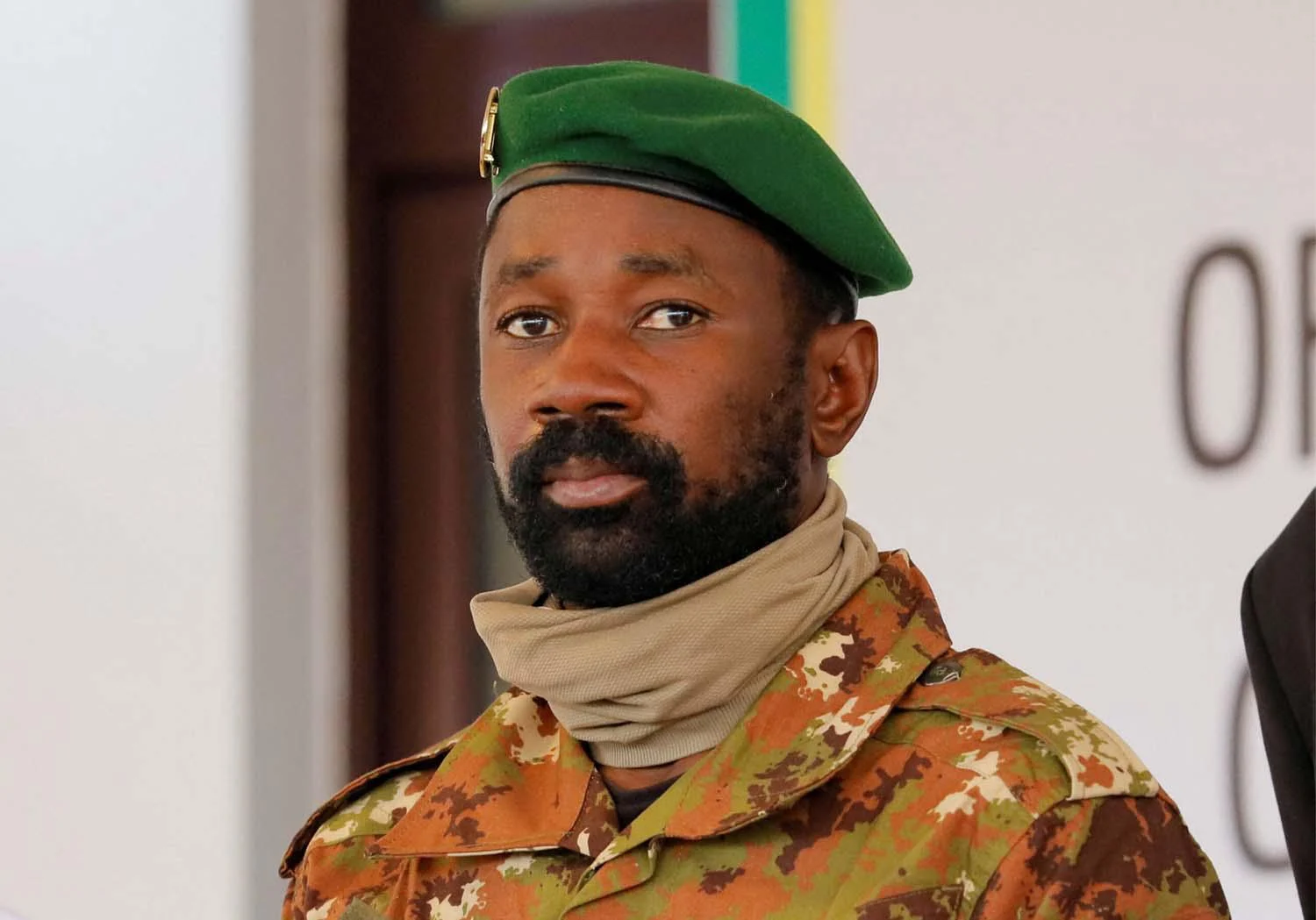
Mali’s transitional leader, General Assimi Goita, has signed a new law that effectively grants him an open-ended presidential mandate, allowing him to remain in power for at least the next five years and potentially indefinitely without the need for an election.
The decree, which had been anticipated for several days, was made public on Thursday after being leaked to the press. It was signed on Tuesday by Goita and had previously been approved by Mali’s military-appointed legislative body last week.
This legal maneuver marks a dramatic departure from the military government’s earlier commitment to returning the West African nation to civilian rule. When Goita seized power in a 2021 coup, he pledged to relinquish control by March 2024 through democratic elections. Instead, the latest law enshrines his authority to serve “as head of state for a term of five (05) years, renewable as many times as necessary, until the country is pacified.”
The provision signals a firm entrenchment of military dominance in Mali’s political landscape, drawing alarm from observers and civil society alike, especially as it follows a growing pattern of authoritarian consolidation across the Sahel region.
The Malian Council of Ministers had initially adopted the measure in June, setting the stage for its swift approval by the military-controlled legislature. Earlier this year, a national dialogue organized under junta direction — and boycotted by most mainstream political groups — recommended that Goita be installed as president for a five-year term without an election. That same body also proposed dissolving political parties and implementing stricter criteria for their reformation.
Since then, Mali’s military authorities have accelerated efforts to limit civic space. In May, the junta officially disbanded all political parties and associations, and imposed a ban on public gatherings. The political crackdown has coincided with repeated calls from the leadership for national unity behind the armed forces and their agenda.
Goita’s ascent to power was initially met with enthusiasm in some parts of the country, where he was heralded as a reformer capable of restoring stability and national pride. His rhetoric emphasized sovereignty, anti-corruption, and an aggressive campaign against jihadist violence, which has plagued Mali since 2012. Yet, his governance has increasingly mirrored authoritarian models, particularly in its suppression of opposition voices and postponement of electoral processes.
Beyond domestic implications, the new law also signals a definitive shift in Mali’s foreign alliances. Under Goita’s tenure, the country has severed longstanding partnerships with Western nations — most notably France — and realigned itself with Russia. Alongside Burkina Faso and Niger, Mali has helped form the Alliance of Sahel States (AES), a new regional bloc aimed at mutual defense and anti-insurgency efforts. The three countries have committed to deploying a joint military force of 5,000 troops and have expressed interest in further integration.
The Mali-Russia partnership has manifested not only in diplomatic coordination but also in the deployment of Russian mercenaries, now branded as the “Africa Corps,” who are accused of grave human rights abuses in operations conducted jointly with the Malian army. These units have been tasked with combating the Islamic State and al-Qaeda-linked jihadists who remain deeply entrenched in the country’s central and northern regions.
Despite the worsening security situation and concerns over state repression, Goita continues to enjoy support among segments of the population. His narrative of sovereignty, defiance against former colonial powers, and prioritization of national security resonates with many Malians disillusioned by years of instability and external interference.
Still, critics argue that Mali’s current trajectory poses serious risks for democratic governance and human rights. The extension of presidential powers without public mandate, coupled with the dissolution of political structures and clampdowns on freedoms, marks a significant erosion of democratic norms in a region already reeling from instability.
What you should know
General Assimi Goita has formally extended his rule in Mali through a law that gives him a renewable five-year presidential term without requiring an election. Originally promising to step down by March 2024, Goita now holds power at least until 2030.
His leadership has been defined by military alliances with Russia, dissolution of political parties, suppression of civil liberties, and strained ties with the West.