
Counsel to Nnamdi Kanu, Aloy Ejimakor, has vowed to challenge the life sentence handed to the Indigenous People of Biafra (IPOB) leader by the Federal High Court in Abuja on Thursday.
Justice James Omotosho sentenced Kanu to life imprisonment on counts one, four, five, and six, while also imposing 20 years on count three and five years on count seven, all to run concurrently and without an option of fine.
Speaking after the judgment, Ejimakor insisted the conviction had no legal foundation, calling it “a symbol of the travesty of justice that everybody has suspected.” He argued that the verdict was based entirely on speech rather than any proven action. “Today is the only day I have seen a man convicted for what he said, not what he did,” he said, adding that the punishment was “overboard, cruel and unusual.”

He announced that Kanu’s legal team would immediately proceed to the Court of Appeal, which he described as the only court that “sits as a jury,” and expressed confidence that the decision would be overturned. “If the Court of Appeal disagrees with us, we head to the Supreme Court. By God Almighty, Nnamdi Kanu will not stand convicted,” he vowed.

Ejimakor maintained that Kanu’s broadcasts did not incite violence and insisted that advocating for self-determination is not a crime. “Nnamdi Kanu is not a terrorist. He pursued change. Seeking a separate nation is not a crime,” he said. He argued that the conviction “cannot be grounded in logic,” stressing that no act of violence was directly linked to Kanu’s statements.
In his judgment, Justice Omotosho ruled that Kanu used threats, incitement, and directives to influence followers and thus orchestrated violent acts. He held that terrorism cannot be defended under any principle of law and noted that Kanu disrupted proceedings and refused to present a defence. Prosecutors had urged the court to impose the maximum punishment under the Terrorism Prevention Act.
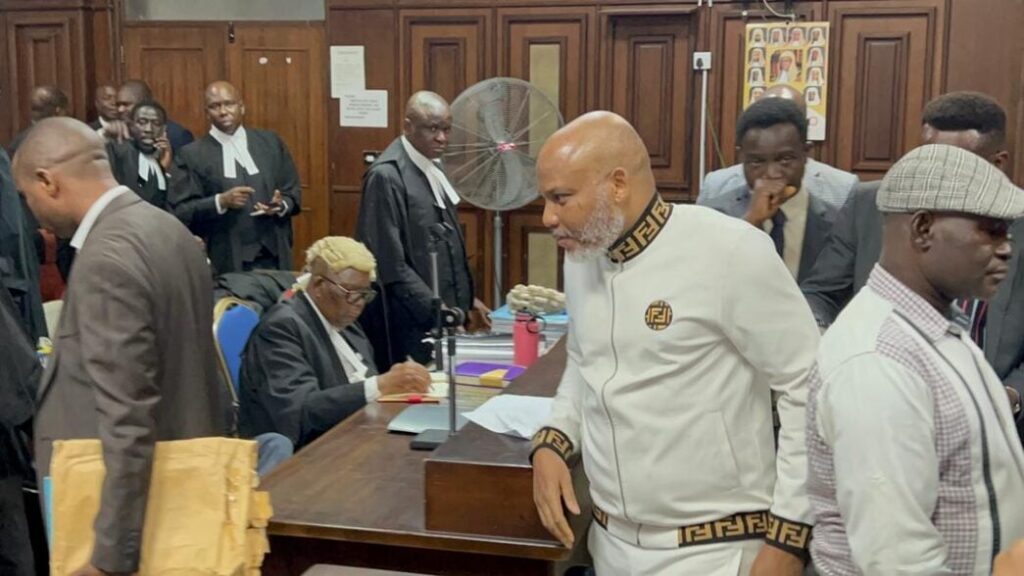
Kanu’s trial, which began in 2015 with charges of treasonable felony and terrorism, has been marked by controversies. After fleeing Nigeria in 2017 during “Operation Python Dance,” he was re-arrested in Kenya in 2021 in what his lawyers describe as an “extraordinary rendition.” The charges were later expanded to 15 counts, including terrorism and incitement. His legal team continues to dispute the legality of his rendition, extradition process, and the court’s jurisdiction.
What You Should Know
Aloy Ejimakor has rejected Nnamdi Kanu’s life sentence and is heading to the Court of Appeal, arguing that the conviction is based solely on speech and not on violent actions.
Justice Omotosho, however, ruled that Kanu’s words amounted to incitement leading to violence and imposed concurrent sentences under the Terrorism Prevention Act.
The case, ongoing since 2015, remains one of Nigeria’s most controversial, with Kanu’s lawyers insisting the trial is legally flawed and vowing to pursue appeals up to the Supreme Court.