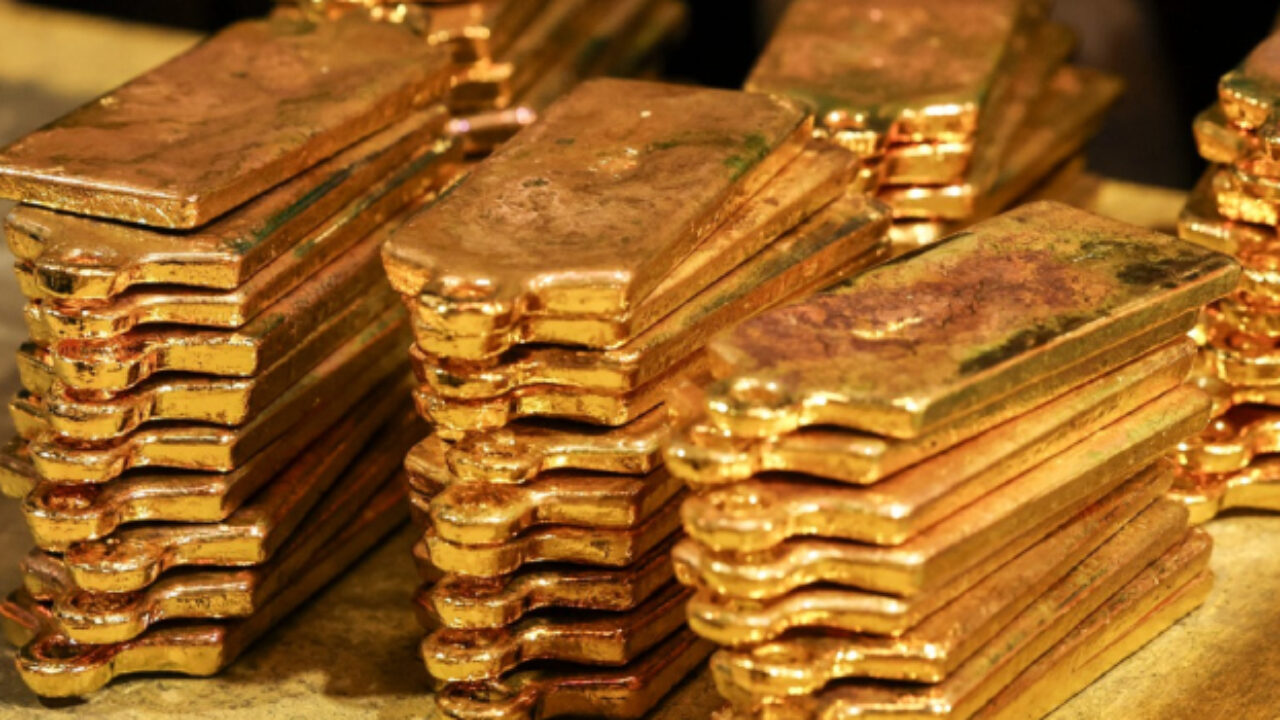
Gold prices rebounded modestly on Tuesday, supported by a weaker U.S. dollar and a sharp fall in oil prices after President Trump signaled a possible end to the Middle East war.
The precious metal’s gains come as investors weigh the implications of reduced inflationary pressures, which could pave the way for more accommodative monetary policies from global central banks.
Spot gold advanced 0.7% in early trading, reaching $5,174.49 per ounce as of 0631 GMT, while U.S. gold futures for April delivery surged 1.6% to $5,184. The uptick reverses some of the losses from Monday, when gold tumbled as much as 2% amid fears that skyrocketing energy costs would stoke inflation and delay interest rate cuts by the U.S. Federal Reserve.
The catalyst for Tuesday’s rally appears rooted in President Trump’s recent statements suggesting that the conflict in the Middle East—centered around Iran’s actions and the broader regional instability—could de-escalate imminently. “Due to the news flow from U.S. President Trump himself, stating that there is a potential for de-escalation… So what we could see is that potential inflation expectation starts to tone down given this dramatic fall in oil price,” explained Kelvin Wong, a senior market analyst at brokerage firm OANDA.
Trump’s comments triggered a more than 5% plunge in oil prices, providing much-needed relief to global markets battered by the war’s disruptions. The conflict has effectively paralyzed the Strait of Hormuz, a critical chokepoint that facilitates one-fifth of the world’s oil supply.
For over a week, tankers have been stranded, forcing major producers to curtail output as storage facilities overflow. This bottleneck had previously driven energy prices to multi-year highs, amplifying concerns over a war-induced inflationary spiral.
However, Trump’s olive branch was tempered by a stern warning: U.S. military responses could intensify dramatically if Iran attempts to obstruct tanker traffic through the strait further. This duality—hope for peace juxtaposed with threats of escalation—has kept markets on edge, with traders parsing every development for clues on future volatility.
The broader economic backdrop also favored gold, a traditional safe-haven asset that thrives in low-interest-rate environments. A 0.4% decline in the U.S. dollar index made dollar-denominated bullion more affordable for international buyers, enhancing its appeal. With non-yielding gold sensitive to opportunity costs, any respite from inflation could reduce the likelihood of central bank rate hikes, including the Fed’s.
Market participants are now laser-focused on upcoming U.S. economic data releases that could shape the Fed’s next moves. The consumer price index (CPI) for February is slated for Wednesday, followed by the Personal Consumption Expenditures (PCE) index—the Fed’s favored inflation metric—on Friday. According to CME Group’s FedWatch tool, investors overwhelmingly anticipate the Federal Reserve will hold interest rates steady at the conclusion of its two-day policy meeting on March 18.
The gold rally extended to other precious metals, albeit unevenly. Spot silver jumped 2% to $88.73 per ounce, reflecting its dual role as both an industrial and investment metal. Platinum edged up 0.7% to $2,196.35 per ounce, supported by similar safe-haven dynamics. In contrast, palladium dipped 0.3% to $1,685.01, pressured by ongoing supply concerns in the automotive catalyst market.
Analysts caution that while Tuesday’s gains signal short-term optimism, the Middle East’s geopolitical tinderbox remains volatile. Any reversal in de-escalation efforts could swiftly reignite energy price surges, potentially eroding gold’s momentum. “The market is pricing in a fragile peace, but one misstep could unwind it all,” Wong added in his commentary.
As global tensions simmer, commodities traders will continue monitoring diplomatic cables from Washington and Tehran, alongside economic indicators, for the next directional cue in gold’s trajectory. For now, the yellow metal’s resilience underscores its enduring role as a hedge against uncertainty in an increasingly unpredictable world.
WHAT YOU SHOULD KNOW
Gold prices rebounded today primarily due to President Trump’s signals of potential de-escalation in the Middle East conflict, which triggered a sharp drop in oil prices and eased fears of war-driven inflation. This reduced pressure on central banks to raise interest rates, supporting gold’s rally despite ongoing geopolitical risks.