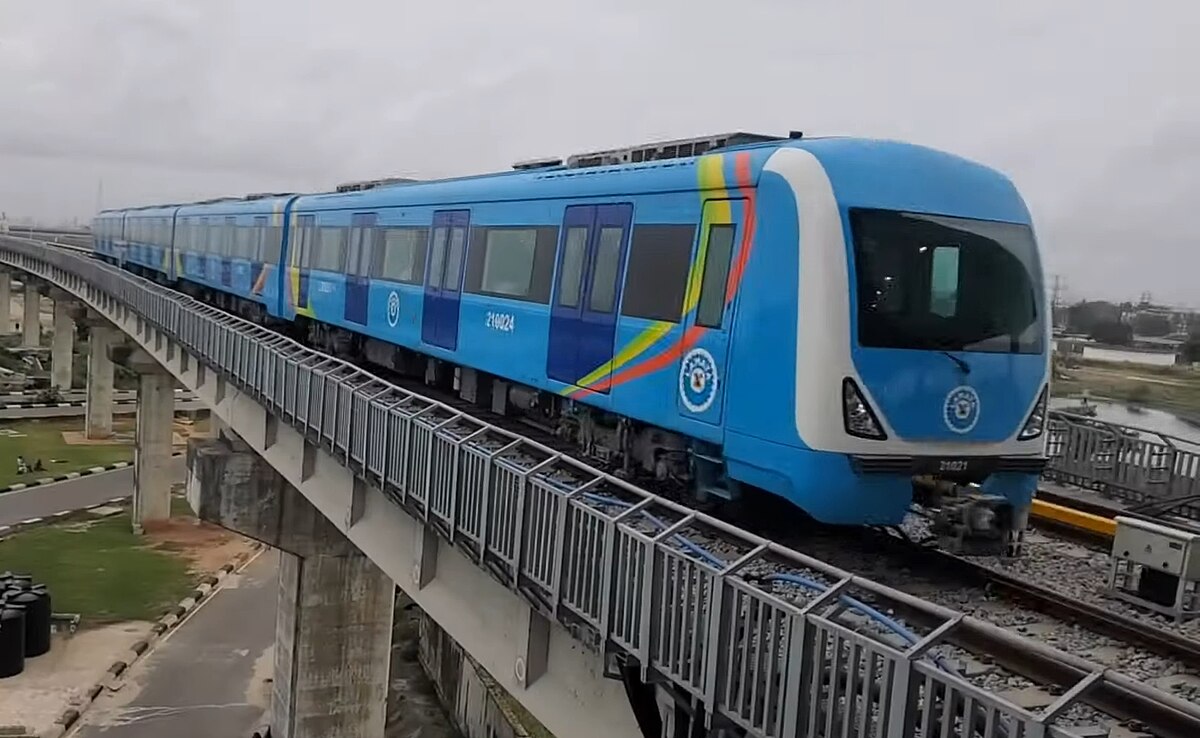
The Federal Government has proposed N102.3 billion in counterpart funding for the Lagos Green Line rail project in the 2026 appropriation, signaling sustained federal backing for one of Nigeria’s most ambitious urban transit schemes despite a reduction from the previous year’s allocation.
According to details contained in the 2026 Appropriation Bill submitted to the National Assembly, the allocation specifically targets Phase One of the 68-kilometer rail networks, which is designed to traverse key commercial and residential corridors from the Lekki Free Zone to Marina, connecting high-density areas including Victoria Island, Lekki, and Ajah.
The proposed funding represents a notable decline from the N146.14 billion earmarked for the same project in the 2025 budget proposal, though officials familiar with infrastructure financing suggest this may reflect the phased nature of the project rather than a scaling back of federal commitment.
The funds are designated for transfer to the Ministry of Finance Incorporated (MOFI), the government’s special purpose vehicle that manages federal equity participation, counterpart funding obligations, and structured financing arrangements for large-scale infrastructure ventures. This mechanism suggests the Green Line project continues to operate under a public-private partnership framework involving the Lagos State Government and potentially other development finance institutions.
The counterpart funding model typically requires the federal government to match or complement investments made by state governments and private sector partners, ensuring shared financial responsibility for infrastructure projects with national significance.
Beyond the Lagos Green Line, the 2026 budget proposal reveals an expansive railway modernization agenda spanning multiple regions. The Federal Government has allocated N68.5 billion under project code ERGP13247529 for consultancy services related to the Lekki–Ijebu Ode–Ore–Kajola railway corridor and the coastal railway line connecting Badagry, Apapa, and Tin Can Island.
A further N29.04 billion has been provisioned under project code ERGP13177707 for ongoing railway modernization efforts. This substantial allocation covers multiple priority initiatives, including the completion of the Abuja–Kaduna railway, additional works on the Lagos–Ibadan standard gauge line, and the rehabilitation of the Itakpe–Ajaokuta rail corridor.
The budget line items provide granular insight into the government’s rail development strategy. Funding has been allocated for the construction of 12 station buildings and track-laying operations at ancillary facilities in Agbor, Delta State. Additionally, provisions have been made for the design, manufacture, and installation of rolling stock—the locomotives and carriages essential for passenger and freight operations.
Technical infrastructure improvements include the supply of spare parts and maintenance equipment, critical for ensuring operational sustainability of existing rail lines. The budget also covers signaling and telecommunications systems for the Itakpe–Ajaokuta–Warri corridor and the deployment of acoustic sensing security surveillance systems on the Abuja–Kaduna route, a line that has experienced security challenges in recent years.
Looking ahead, the appropriation includes funding for feasibility studies on new standard-gauge rail lines and the engagement of transaction advisers for the proposed concession of the Abuja–Baro–Itakpe, Aladja–Warri Port, and Kano–Maradi rail projects. These concession arrangements suggest the government is exploring private sector-led operation and maintenance models to reduce the long-term fiscal burden of railway infrastructure while potentially improving service delivery.
The inclusion of the Kano–Maradi corridor—which would extend into the neighboring Niger Republic—underscores Nigeria’s strategic interest in regional connectivity and cross-border trade facilitation.
While the budget proposals demonstrate continued political will to advance railway modernization, questions remain about execution capacity and the government’s ability to meet counterpart funding obligations given competing fiscal pressures. Previous years have witnessed significant gaps between budgeted amounts and actual releases for capital projects, a pattern that has delayed completion timelines for several major infrastructure initiatives.
The Lagos Green Line project, in particular, has experienced delays since its inception, with completion dates repeatedly pushed back. The success of Phase One will likely determine the pace and scope of federal participation in subsequent phases of the ambitious network.
As the 2026 budget moves through legislative scrutiny in the coming weeks, stakeholders in Nigeria’s transport sector will be watching closely to see whether these allocations survive the appropriation process intact and whether the disbursement mechanisms can ensure the timely release of funds to keep critical rail projects on track.
WHAT YOU SHOULD KNOW
The Federal Government has committed N102.3 billion to the Lagos Green Line rail project in 2026—down from N146.14 billion in 2025—as part of a broader N199.84 billion railway modernization budget spanning multiple corridors nationwide.
While the allocation shows continued federal support for urban rail infrastructure, Nigeria’s track record of delayed releases and project implementation means actual progress will depend on timely fund disbursement and execution capacity—not just budget figures. The Lagos Green Line’s success could determine federal appetite for funding future phases of the 68-kilometer network connecting Lekki to Marina.