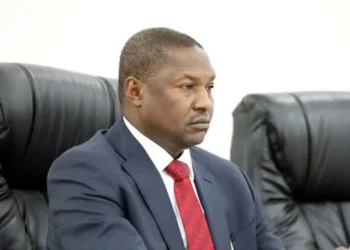
The Federal High Court in Abuja, on Wednesday, removed Julius Abure from office as the National Chairman of the Labour Party (LP).
In a judgement delivered by Justice Peter Lifu, the court leaned on the April 4, 2025, decision of the Supreme Court to affirm a former Minister of Finance, Senator Esther Nenadi Usman, as the legitimate leader of the party.

Following this finding, the court directed the Independent National Electoral Commission, INEC, to immediately recognise the Senator Nenadi Usman-led Caretaker Committee as “the only valid authority to represent the Labour Party,” pending the conduct of a national convention by the party.
The ruling arose from a suit marked THC/ABJ/CS/2262/2025, which was filed by the former minister before the court.
Apart from Abure, the Nigerian Labour Congress, NLC, was also joined as a defendant in the case.
Justice Lifu held that materials placed before the court clearly showed that Abure’s tenure as the national chairman of the LP had already expired.
In rejecting Abure’s argument that the dispute was an internal party matter and therefore non-justiciable, the court ruled that the establishment of the LP Caretaker Committee was “a necessity” that flowed directly from the directive of the Supreme Court.
The court recalled that after a prolonged leadership crisis within the LP, the party’s National Executive Committee, NEC, resolved to remove Abure from his position as National Chairman.
To address the leadership gap that followed, the party constituted a 29-member caretaker committee, appointing the former Finance Minister, Usman, as its chairman.
This resolution was reached at an expanded stakeholders’ meeting of the party held in Umuahia, Abia State, and hosted by Governor Alex Otti.
The meeting, which culminated in Abure’s removal, was presided over by his former ally and the Labour Party’s 2023 presidential candidate, Mr Peter Obi.
Unhappy with the outcome, Abure approached the Federal High Court in Abuja, seeking judicial validation of his position as the party’s National Chairman.
In an affidavit he personally swore to in support of the suit marked FHC/ABJ/CS/1271/2024, Abure told the court that following the death of the then National Chairman of the LP, he was duly elected as Acting National Chairman at a National Executive Council meeting held in Benin City, Edo State, on March 29, 2021.
He further stated that at the NEC meeting of April 18, 2023, held in Asaba, Delta State and monitored by INEC, the party resolved to renew the tenures of State Chairmen whose terms had expired.
According to him, the same meeting also approved the expulsion of some members accused of anti-party activities and filled vacancies created by those expulsions.
Abure maintained that, based on a consensus reached at that gathering, the party later held its National Convention on March 27, 2024, in Nnewi, Anambra State, where he was lawfully elected as National Chairman of the LP.
He added that under his leadership, the party successfully produced candidates for the governorship elections in Edo and Ondo states.
Although both the Federal High Court and the Court of Appeal initially upheld Abure’s position and ordered INEC to recognise him, those decisions were later overturned by the Supreme Court, which nullified the concurrent judgements of the two lower courts.
In the lead judgement prepared by Justice Inyang Okoro, the apex court upheld the appeal filed by the Chairman and Secretary of the Caretaker Committee, Senator Usman and Hon. Darlington Nwokocha, respectively.
The Supreme Court also dismissed a cross-appeal filed by Abure and admonished political parties to strictly adhere to their internal rules when appointing officers.
It further advised party officials whose tenures have expired to accept the need to vacate their offices when due.
What you should know
The leadership tussle within the Labour Party reflects a broader challenge facing many Nigerian political parties, where internal disputes often spill into the courts.
While lower courts initially sided with Julius Abure, the Supreme Court’s intervention became decisive, reinforcing the principle that party leadership must conform strictly to constitutional provisions and tenure limits. By recognising the Nenadi Usman-led Caretaker Committee, the judiciary has underscored the authority of the apex court and the importance of internal party democracy.
The ruling is expected to shape the LP’s organisational direction ahead of future elections.