In a dramatic escalation of regulatory enforcement, the Federal Competition and Consumer Protection Commission (FCCPC) on Thursday shut down the main premises of Ikeja Electric Distribution Company (IKEDC) in Alausa, Lagos, citing persistent violations of consumer rights and defiance of regulatory directives.
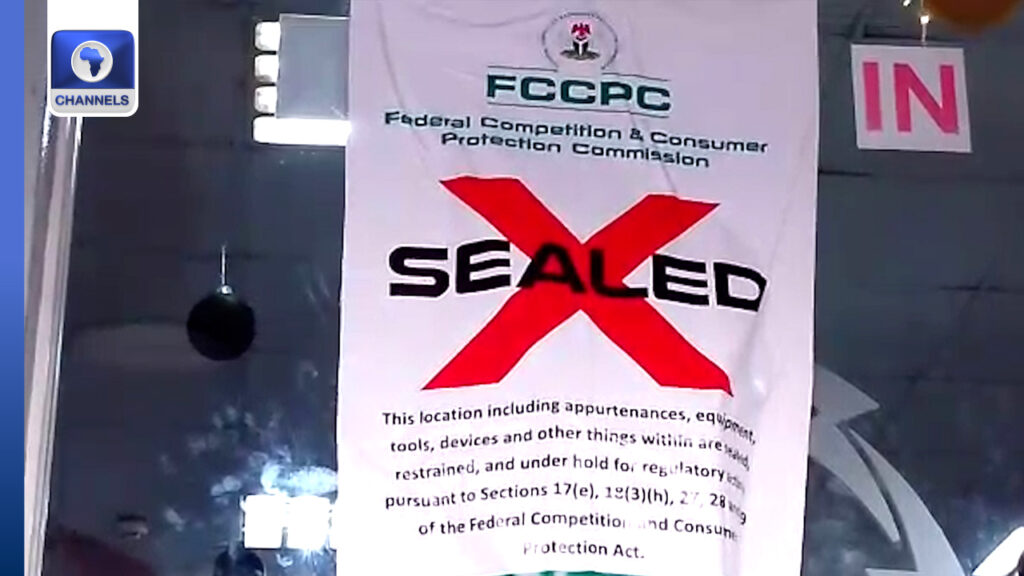
The closure marks a rare but significant exercise of enforcement powers by the consumer protection agency, coming after what officials described as exhaustive attempts at dialogue and compliance that stretched over months.
Speaking to reporters, Bola Adeyinka, the FCCPC’s Director of Surveillance and Investigation, emphasized that the commission had exhausted all administrative remedies before resorting to the seal. “Sealing this facility is a proportionate enforcement measure taken only after repeated engagement and several opportunities for voluntary compliance,” Adeyinka stated, underscoring the agency’s position that the action was a last resort rather than a first response.
The enforcement action, conducted under the authority of the Federal Competition and Consumer Protection Act (FCCPA) 2018, will remain in effect indefinitely. “The seal will remain in place until Ikeja Electric complies fully with the directives issued by both NERC and the FCCPC and provides written evidence of that compliance,” Adeyinda warned, making clear that the path to reopening requires concrete action, not promises.
At the heart of this regulatory standoff lies a single complainant who has been without electricity for over two and a half years—a situation the FCCPC characterized as both unjust and preventable.
According to the commission’s statement, the Nigerian Electricity Regulatory Commission (NERC), the sector regulator, had issued a binding decision directing Ikeja Electric to unbundle a Maximum Demand account into twenty separate non-Maximum Demand accounts. The directive was specific: recognize nineteen residential units and one service point as individual customer accounts, and provide the necessary metering and connections for each.
“Ikeja Electric did not carry out that decision,” the FCCPC statement noted bluntly. The commission further revealed that the complainant had fulfilled every financial and procedural obligation, paying all charges demanded by the distribution company. Despite this compliance, the residential units have remained non-operational due to lack of power supply—a situation that has prevented the property owner from utilizing the investment.
The FCCPC provided a detailed chronology of its enforcement efforts, painting a picture of an organization that moved methodically through escalating measures before reaching Thursday’s action.
In April 2025, the commission issued a directive to Ikeja Electric outlining specific steps required for compliance and establishing clear timelines. That directive, according to officials, was ignored entirely.
Six months later, on October 2, 2025, the FCCPC escalated with a formal Compliance Notice, giving the distribution company seven business days to rectify the situation. Once again, no action was taken.
“The company still did not comply,” the commission stated, its frustration evident in the stark simplicity of the words.
The sealing of Ikeja Electric’s premises sends a clear signal to Nigeria’s often-criticized electricity distribution sector, where consumer complaints about billing disputes, poor service delivery, and regulatory non-compliance are commonplace. Ikeja Electric serves as one of the major distribution companies in Lagos, Nigeria’s commercial nerve center, making the closure particularly significant.
Industry observers note that the action could represent a turning point in regulatory enforcement within a sector that has long struggled with accountability. The use of physical sealing—rather than mere fines or warnings—demonstrates the FCCPC’s willingness to deploy its full statutory powers when faced with intransigence.
As of press time, Ikeja Electric had not issued any official statement regarding the closure or the underlying consumer complaint. Attempts to reach company officials for comment were unsuccessful.
The silence from the distribution company leaves unanswered critical questions about why the directives were ignored, whether the company disputes NERC’s original order, and what steps, if any, it plans to take to resolve the matter and reopen its sealed facility.
For now, the sealed premises stand as a stark reminder that even major utility companies are not above regulatory enforcement when consumer rights hang in the balance—and that patience, even among government agencies, eventually has its limits.
WHAT YOU SHOULD KNOW
Nigeria’s consumer protection agency has shut down Ikeja Electric’s Lagos headquarters after the power company ignored regulatory orders for over eight months—leaving a paying customer without electricity for two and a half years.
The closure sends an unprecedented message: utility companies can no longer disregard consumer rights and regulatory directives with impunity. The facility remains sealed until Ikeja Electric complies with orders to properly meter and connect nineteen residential units that have been left in darkness despite the customer meeting all payment obligations.
This marks a potential turning point in holding Nigeria’s often-criticized electricity distribution companies accountable to both regulators and consumers.