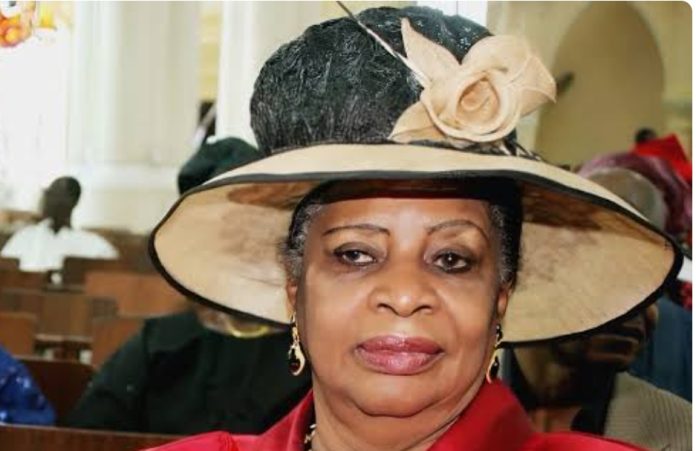
Chief (Mrs.) Leila Fowler, a pioneering figure in Nigerian education and one of the country’s early female legal practitioners, died on Saturday at the age of 92, marking the end of an extraordinary life dedicated to empowering young women through education.
The Yeye Mofin of Lagos, who founded the renowned Vivian Fowler Memorial College for Girls in 1991, passed away, leaving behind a legacy that has shaped thousands of young Nigerian women over more than three decades.
Born Leila Moore on March 23, 1933, in Lagos during the colonial era, Fowler’s journey exemplified the breaking of barriers that would define her life’s work. After completing her early education at CMS Girls’ School and Queen of the Rosary College in Onitsha, she embarked on a remarkably diverse career path that spanned education, healthcare, and law.
Her professional journey began in teaching before she pursued nursing training at the prestigious St. Thomas’ Hospital in London. However, she decided to study law at Middle Temple, which would establish her as a trailblazer. Called to the Bar in 1962 and to the Nigerian Bar in 1963, Fowler joined the ranks of Nigeria’s pioneering female lawyers at a time when the legal profession was overwhelmingly male-dominated.
Specializing in insurance law and consultancy, Fowler built a distinguished legal career while simultaneously engaging in public service. Her civic involvement included serving as a councillor on the Lagos City Council from 1978 to 1980, demonstrating her commitment to community development and governance.
Fowler’s influence extended far beyond her legal practice. She was actively involved with several prominent organizations, including the Nigerian Bar Association, the Nigerian Red Cross, and the Corona Schools Trust Council, positioning herself as a key figure in Nigeria’s professional and philanthropic circles.
However, it was the establishment of Vivian Fowler Memorial College for Girls in 1991 that would become her most enduring contribution to Nigerian society. Founded in memory of her late daughter, the school was born from personal tragedy but transformed into a beacon of educational excellence.
Under Fowler’s guidance, the institution grew from its modest beginnings into one of Nigeria’s premier all-girls schools, renowned for its rigorous academic standards and emphasis on leadership development. The school’s approach reflected Fowler’s own belief in the transformative power of education for young women, a philosophy shaped by her own groundbreaking career.
Fowler’s personal life was marked by both achievement and loss. She was widowed in 2015 following the death of her husband, Professor Vidal Fowler, but continued to lead and inspire well into her later years. Her contributions to Lagos society were formally recognized when she was honored with the traditional title of Yeye Mofin of Lagos by Oba Adeyinka Oyekan II.
Colleagues and former students remember Fowler not just for her professional accomplishments but also for her maternal approach to mentorship. The school’s statement emphasized her “motherly warmth” and described how she built “not just a school, but a community dedicated to excellence.”
As news of her passing spreads, tributes are pouring in from across Nigeria’s educational and legal communities. The Vivian Fowler Memorial College, which announced her death in a heartfelt statement on Sunday, described their founder as “a true pioneer, an erudite lawyer, and a visionary educationalist.”
The institution she built continues to embody her vision, having graduated thousands of young women who have gone on to excel in various fields across Nigeria and beyond. Many of these graduates credit the school’s emphasis on confidence-building and academic rigor with preparing them for leadership roles in their respective careers.
Fowler’s death represents the end of an era for Nigerian education, particularly for women’s empowerment through learning. Her life spanned nearly a century of Nigerian history, from colonial rule through independence to the modern era, and her contributions helped shape the educational landscape that continues to benefit young women today.
At 92, Chief Leila Fowler leaves behind more than just an institution—she leaves a blueprint for how education can be used as a tool for social transformation and women’s empowerment. Her legacy lives on in every graduate who walks through the halls of the school she built from love, loss, and an unwavering belief in the potential of young Nigerian women.
WHAT YOU SHOULD KNOW
Chief Leila Fowler’s death at 92 marks the loss of a true Nigerian pioneer who transformed personal tragedy into lasting social impact. A groundbreaking lawyer in the 1960s and visionary educator, her most significant achievement was founding Vivian Fowler Memorial College for Girls in 1991 in memory of her late daughter.