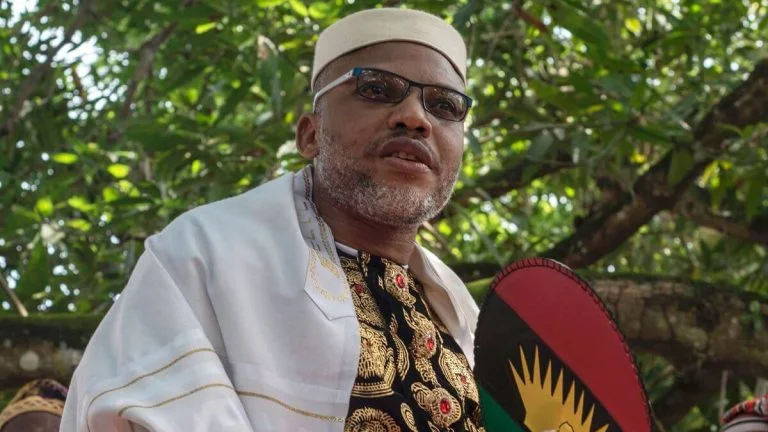
The Department of State Services has transferred the convicted leader of the proscribed Indigenous Peoples of Biafra, Nnamdi Kanu, to the Nigerian Custodial Centre in Sokoto in compliance with a Federal High Court judgement in Abuja.
According to reports, a source within the DSS confirmed that the transfer was carried out after Kanu’s conviction and sentencing on terrorism charges.
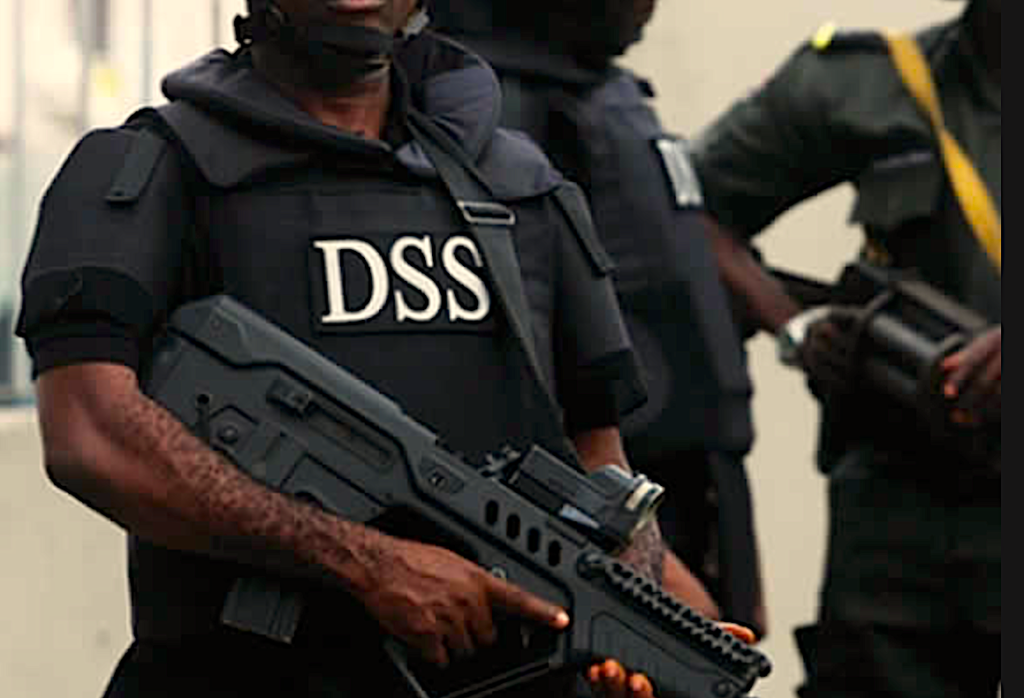
On Thursday, Justice James Omotosho of the Federal High Court in Abuja delivered the ruling ordering the secret police to relocate Kanu to any correctional facility in the country except the Kuje Custodial Centre in Abuja.
Justice Omotosho convicted and sentenced Kanu to life imprisonment on a seven-count terrorism charge. In the judgement, the court upheld the DSS allegations that Kanu used terrorism as part of his agitation, including calls for the secession of South-Eastern and South-South states, along with parts of Benue and Kogi, from the Federal Republic of Nigeria.
Kanu’s former lawyer and consultant, Aloy Ejimakor, also confirmed the transfer in a statement posted on his X handle on Friday. Ejimakor expressed worry that relocating Kanu to Sokoto places him far from his legal team, family members, and supporters. He stated, “While urging #Ndigbo to remain calm, I must question the wisdom of sending #MNK to Sokoto prison. When Awolowo was convicted in 1963, he was sent to the East, a neutral zone in his feud with the North. Pres. Tinubu can still halt this drift, as I said in this video.”
Kanu was first arrested by Nigerian authorities in 2015 and faced charges of treasonable felony, terrorism, and other offences tied to his role as the head of IPOB, which has been declared a proscribed separatist organisation. After fleeing the country, he was brought back to Nigeria from Kenya in 2021.
What You Should Know
The DSS has moved Nnamdi Kanu to the Sokoto Custodial Centre after being sentenced to life imprisonment for terrorism.
His transfer follows a court directive limiting his detention to facilities outside Kuje. The decision has stirred concern among his supporters and former legal adviser, who argue that the relocation isolates him from his defence team and family.
The development adds another chapter to Kanu’s long-running legal and political confrontation with the Nigerian state.