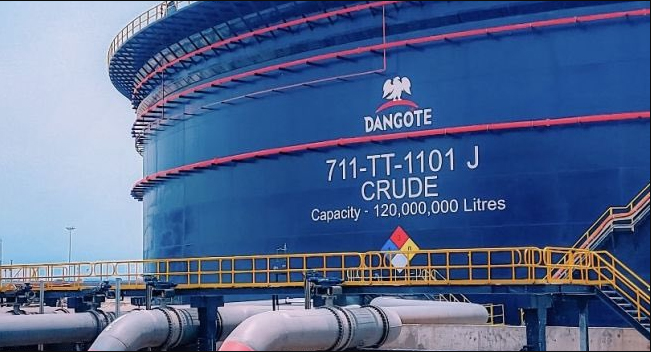
The Dangote Petroleum Refinery abruptly reversed a price cut announced just days earlier, restoring its ex-depot price for Premium Motor Spirit (PMS) to ₦1,175 per liter and triggering an immediate freeze in fuel sales across depot hubs nationwide.
The reversal, which caught marketers off-guard, came less than 72 hours after the refinery had offered what many consumers and operators had welcomed as rare relief. On March 10, the refinery issued a revised pricing template, cutting its gantry price by ₦100 to ₦1,075 per liter—the first reduction after three consecutive hikes that had pushed fuel costs sharply higher in recent weeks.
Depot operators had barely begun adjusting their operations, selling at an average of ₦1,100 per liter, before the refinery pulled the rug from beneath them.
With the new directive to revert to ₦1,175, transactions at depots across multiple distribution hubs ground to a halt almost immediately. Operators who had purchased or committed to stock at the lower price now found themselves stranded in a pricing no-man’s-land—unable to sell at a loss and unwilling to proceed without clarity on the new structure.
Compounding the disruption, loading operations at the refinery were also suspended to allow for what a refinery source described as stock reconciliation and alignment with the new pricing directive, a process that industry insiders warn could take days and ripple through the downstream supply chain.
The explanation from within the refinery points squarely at the extraordinary volatility gripping global crude markets. Dangote Refinery’s Managing Director, David Bird, had earlier warned that the facility was not shielded from global energy shocks, noting that oil surged from the mid-$60 range to nearly $120 per barrel in just one week, disrupting every segment of the global energy supply chain.
The latest price restoration reflects that crude has climbed back into triple-digit territory, with Brent crude trading around $100 per barrel, up from the $88–$89 range that had prompted the brief March 10 reduction.
The conflict involving the United States, Iran, and Israel had earlier pushed global oil prices higher, contributing to rising petrol prices in Nigeria, with Brent briefly nearing $120 per barrel as Tehran announced a new supreme leader and the Strait of Hormuz faced a potential blockade. The refinery, which sources all its crude at international benchmark prices plus a premium, has no buffer against such swings.
The refinery has stated that all crude processed at the facility is purchased at the global benchmark price, plus a premium of $3 to $6, with foreign exchange payments made at the prevailing market rate and no subsidies applied to either crude or forex. This means every tick upward in Brent crude translates almost directly into higher refining costs and, ultimately, higher prices at the gantry.
The whiplash has left depot owners frustrated and consumers anxious. Despite the brief March 10 reduction, petrol at retail outlets in many parts of the country had remained stubbornly high, with filling stations in Lagos selling between ₦1,170 and ₦1,250 per liter, while Abuja outlets had only just begun passing through the savings. With the ex-depot price now back at ₦1,175, any hope of pump price relief appears extinguished for the near term.
The suspension of loading operations adds a further layer of uncertainty. Supply gaps at filling stations could emerge within days if the reconciliation process extends beyond the weekend, particularly in cities heavily dependent on Dangote as their primary domestic supply source.
The Dangote Refinery, located in the Lekki Free Trade Zone in Lagos, is the largest single-train refinery in the world, with a refining capacity of approximately 650,000 barrels per day, and is widely expected to be a stabilizing force in Nigeria’s fuel supply and pricing dynamics. Yet, as this week’s rapid-fire price swings demonstrate, the refinery’s fortunes and, by extension, those of every Nigerian motorist, remain tightly bound to geopolitical tremors thousands of kilometers away.
For ordinary Nigerians, who have endured successive rounds of fuel price hikes since the removal of the government subsidy, the latest reversal is yet another reminder of how exposed the country remains to the brutal arithmetic of global oil markets, even with Africa’s biggest refinery now operating on home soil.
WHAT YOU SHOULD KNOW
The Dangote Refinery’s brief ₦100 price cut proved short-lived, reversed within 72 hours as surging global crude prices, climbing to $100 per barrel, made the reduction economically untenable.
As Nigeria prices its domestically refined fuel at international crude benchmarks with no subsidies or forex buffers, ordinary Nigerians remain fully exposed to global oil market volatility.
Having Africa’s largest refinery at home offers supply security, but not price security, and until that structural reality changes, fuel price stability will remain elusive.