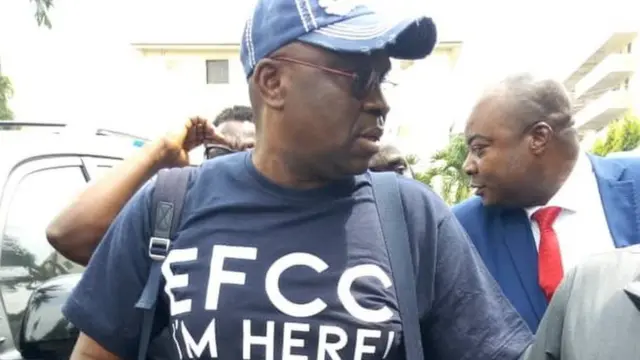
Former Ekiti State Governor Ayodele Fayose has been discharged by the Federal High Court in Lagos over charges bordering on money laundering and theft involving a sum of ₦6.9 billion.
In a decisive ruling delivered by Justice Chukwujekwu Aneke, the court upheld the no-case submission filed by Fayose’s legal team, concluding that the prosecution failed to establish any concrete link between the former governor and the alleged criminal acts.
The case, which has been in the judicial system for years, came to a halt on Tuesday as Justice Aneke ruled that the Economic and Financial Crimes Commission (EFCC) did not present sufficient evidence to justify continuing the trial or inviting the defendant to enter a defence. The court emphasized that a prima facie case was not made out against Fayose to warrant further legal proceedings.
Earlier, on May 20, the court had reserved judgment after listening to detailed arguments from the lawyers involved. Representing Fayose, the 1st defendant, was Senior Advocate of Nigeria (SAN) Chief Kanu Agabi. Olalekan Ojo SAN represented Spotless Investment Limited, the 2nd defendant, while Rotimi Jacobs SAN stood for the EFCC.
Fayose had initially been arraigned before Justice Mojisola Olatoregun in 2018. However, following an application by the EFCC, the matter was reassigned to Justice Aneke. Upon reassignment, both Fayose and Spotless Investment Ltd were re-arraigned on an amended 11-count charge that included allegations of money laundering and theft.
According to the EFCC, Fayose allegedly accepted ₦1.2 billion in cash to support his 2014 gubernatorial campaign and received an additional $5 million from former minister Musiliu Obanikoro without passing through formal financial institutions, thus violating the Money Laundering (Prohibition) Act of 2011. The charges also alleged that Fayose used over ₦1.6 billion—through companies like De Privateer Ltd and Still Earth Ltd—to acquire properties under false pretenses and via proxy arrangements.
Fayose’s legal team, however, disputed these allegations robustly. Chief Agabi, in his submission dated July 16, 2025, argued that the EFCC had not succeeded in tying any of the alleged offences to Fayose. He pointed out significant procedural and evidentiary flaws in the prosecution’s case, particularly the absence of key figures like Abiodun Agbele from the trial. Agbele had allegedly participated in the transactions in question but was never charged alongside the former governor, a fact which Agabi said undermined the EFCC’s conspiracy theory.
“With due respect, the predicate offences on which these charges are based do not hold water. Criminal breach of trust and conspiracy are distinct, and no co-conspirator was charged alongside the defendant,” Agabi argued. He urged the court to dismiss the charges on the grounds that they were fundamentally flawed and unsupported by compelling evidence.
Justice Aneke, after reviewing the submissions and the totality of the evidence brought before the court, concluded that the prosecution had failed to meet the threshold required to continue the trial. Consequently, Fayose was discharged of all charges.
The ruling brings an end, at least for now, to a protracted legal battle that has attracted public and political interest since 2018. It also raises questions about the EFCC’s handling of high-profile cases and its approach to evidence gathering in politically sensitive matters.
What you should know
Ayodele Fayose, former Governor of Ekiti State, has been discharged by the Federal High Court in Lagos after a no-case submission was upheld in his ₦6.9 billion money laundering trial.
The court ruled that the EFCC failed to establish a sufficient link between Fayose and the alleged crimes, nor did it present a prima facie case to warrant a defence.