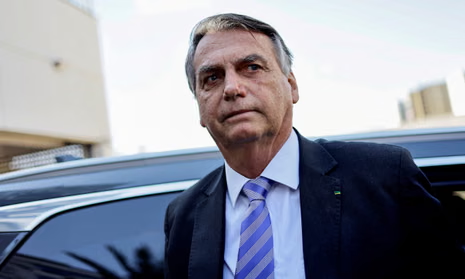
In a deepening confrontation with Brazil’s judiciary, former president Jair Bolsonaro has been placed under house arrest by a Supreme Court judge for breaching restrictions on social media engagement.
The ruling, issued on Monday, follows Bolsonaro’s ongoing trial over allegations that he conspired to cling to power after losing the 2022 presidential election to Luiz Inacio Lula da Silva.
Justice Alexandre de Moraes, presiding over the case, acted swiftly after Bolsonaro’s allies posted footage online showing him in conversation with his son Flavio during a rally in Rio de Janeiro, defying a court order prohibiting him from making public statements.
Though Bolsonaro is already banned from social media for the duration of his trial, and third parties are similarly barred from sharing his remarks, the footage circulated online sparked immediate judicial backlash.
Moraes accused Bolsonaro of attempting to mock the authority of the court by leveraging his political influence, stating that the judiciary would not allow itself to be treated with contempt. Citing the former president’s continued disregard for court-imposed restrictions, Moraes ordered his house arrest at his residence in Brasilia, forbade visits except from his legal team, and prohibited the use of mobile phones.
Authorities also seized multiple mobile phones from his home, further tightening the noose around the former leader. Moraes had previously mandated that Bolsonaro wear an ankle monitor and restricted his movement during the trial.
The Supreme Court’s measures have drawn sharp criticism from US officials. On Monday night, the State Department’s Bureau of Western Hemisphere Affairs condemned the ruling via a statement on X, denouncing Moraes—already under US sanctions—as a judicial figure using national institutions to silence dissent and undermine democracy. “Let Bolsonaro speak!” the bureau posted, emphasizing that collaborators with sanctioned behavior would be held accountable.
Eduardo Bolsonaro, one of the former president’s sons and a sitting lawmaker, reposted the US statement and accused Brazil of no longer functioning as a democracy. He also launched a scathing attack on Moraes, branding him an “out-of-control psychopath.” The younger Bolsonaro had been lobbying Washington to take action against Brazilian officials involved in the case.
The diplomatic friction intensified when President Donald Trump imposed economic sanctions on Brazil, criticizing what he described as a politically motivated campaign against Bolsonaro. Trump also responded to Moraes’s actions by banning him from entering the United States and freezing his American assets. Despite backlash in Brazil, Trump’s stance has won support among Bolsonaro’s conservative base. Over the weekend, rallies held in Rio, Brasilia, and Sao Paulo featured American flags and signs thanking Trump for his show of solidarity.
Bolsonaro did not attend the rallies due to court orders requiring him to remain home during nights and weekends. Prosecutors allege that he and seven associates plotted to overturn the 2022 election results but failed to secure military backing, leading to the collapse of the scheme. If found guilty, Bolsonaro could face up to 40 years in prison. The trial is expected to conclude in the coming weeks.
The crisis has revived memories of the January 2023 attack on Brazil’s congress by Bolsonaro’s supporters, echoing the January 6 Capitol riot in the United States. Though banned from seeking office, Bolsonaro remains determined to return to the political arena and is aiming for a comeback in Brazil’s 2026 presidential race.
Meanwhile, President Lula, aged 79, has indicated a willingness to run for a fourth term, contingent on his health. He was hospitalized last year due to a brain hemorrhage resulting from a fall.
What you should know
Jair Bolsonaro’s recent house arrest marks a pivotal moment in Brazil’s political turbulence. The former president is on trial for allegedly attempting to overturn the 2022 election outcome, and his repeated defiance of judicial orders has only intensified the legal stakes.
The move by Supreme Court Justice Alexandre de Moraes to restrict Bolsonaro’s movements and communication stems from the broader accusation of anti-democratic behavior.
The situation has ignited international tensions, with the US criticizing Brazil’s judicial actions while simultaneously sanctioning Moraes. As Bolsonaro eyes a future political comeback, his current legal troubles—and his alliance with Trump—remain at the center of global scrutiny.