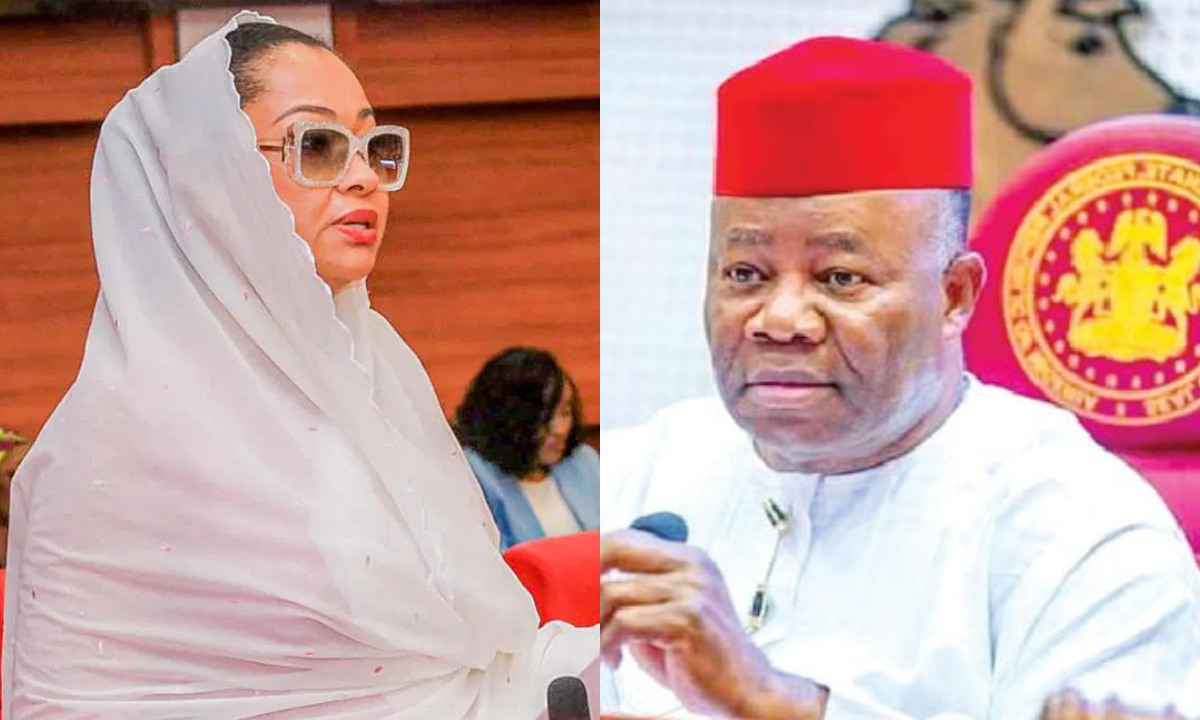
Senate President Godswill Akpabio has taken legal action to contest the ruling of the Federal High Court in Abuja, which directed the reinstatement of Senator Natasha Akpoti-Uduaghan to the upper chamber following her suspension.
In a notice of appeal filed before the Court of Appeal, Akpabio is challenging the July 4 decision rendered by Justice Binta Nyako, arguing that the ruling intrudes on the internal workings of the National Assembly and violates constitutional provisions.
Akpabio’s legal team, in an appeal comprising 11 grounds, contests the jurisdiction of the lower court, claiming that the case falls within the exclusive domain of legislative autonomy and should not have been entertained under Section 251 of the 1999 Constitution. According to them, the matters raised—relating to legislative discipline, words spoken during plenary sessions, and internal Senate resolutions—are matters protected by the Legislative Houses (Powers and Privileges) Act and cannot be subjected to judicial interpretation or intervention.
The Senate President also took issue with the High Court’s dismissal of his preliminary objection, asserting that the judge acted beyond her powers by delving into parliamentary matters shielded from external scrutiny. Akpabio contends that Akpoti-Uduaghan’s case was prematurely brought before the court, bypassing existing mechanisms designed to resolve such disputes internally—specifically, the Committee on Ethics, Privileges and Public Petitions as stipulated in the Senate Standing Orders of 2023 (as amended).
In his appeal, Akpabio claimed that his right to a fair hearing was compromised, as the trial judge allegedly introduced new legal questions not canvassed by either party during proceedings. One such question, according to him, was whether Senator Akpoti-Uduaghan’s suspension was excessive, an issue that was not raised or debated in court but was considered by the judge in reaching the verdict.
He further alleged procedural anomalies in the court’s handling of the case, particularly the merging of interim reliefs requested by Akpoti-Uduaghan with her substantive claims, despite the fact that the reliefs were repeated and overlapped. Akpabio argued that such consolidation of reliefs violated legal standards and introduced confusion into the trial’s trajectory.
Moreover, he maintained that the senator’s legal action should have been struck out entirely for breaching Section 21 of the Legislative Houses (Powers and Privileges) Act, which mandates a three-month notice period to be served on the Clerk of the National Assembly before any court proceeding can be initiated. According to the appeal, failure to comply with this statutory requirement invalidates the suit from the onset.
In addition to requesting the Court of Appeal to set aside the Federal High Court’s ruling, Akpabio also seeks a dismissal of the entire case for lack of jurisdiction. He urged the court to strike out the repetitive reliefs contained in Akpoti-Uduaghan’s applications and to dismiss what he described as the lower court’s “advisory opinions” regarding Senate practices, including suggestions to amend Senate rules or facilitate the recall of a suspended member.
Akpabio is also calling upon the appellate court to invoke Section 15 of the Court of Appeal Act to directly address his preliminary objection, effectively resolving the jurisdictional question and terminating the case at the appellate stage.
The appeal marks a critical juncture in the ongoing confrontation between legislative authority and judicial oversight, potentially setting legal precedence on the boundaries of judicial intervention in the internal workings of Nigeria’s legislative houses.
What you should know
Senate President Godswill Akpabio is challenging a Federal High Court ruling that ordered Senator Natasha Akpoti-Uduaghan’s recall to the Senate.
He argues that the judgment intrudes on the internal affairs of the Senate, violates the constitution, and bypasses legislative dispute mechanisms. He wants the Court of Appeal to overturn the decision, citing lack of jurisdiction, procedural errors, and an infringement on legislative privilege.