Biography and Early Life
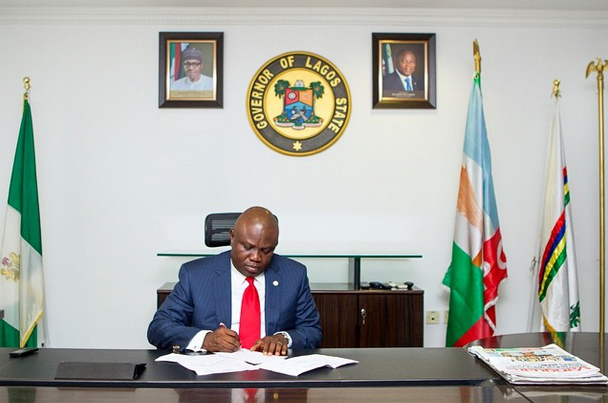
Akinwunmi Ambode was born on June 14, 1963, at Epe General Hospital, Epe, Lagos State, Nigeria, as the sixth of ten children. His late father, Festus Akinwale Ambode, was a teacher who dedicated his life to education, while his mother, Christianah Oluleye Ambode (née Oresanya), was an entrepreneur who ran a successful sewing business.
In 1967, when young Akinwunmi was just four years old, his father moved the family to the mainland part of Lagos and continued his teaching career until he died in 1981—a loss that occurred when Ambode was just 18, during his final year of secondary school. This early tragedy forced maturity and self-reliance, shaping his character and drive for success.
Growing up in Lagos during Nigeria’s post-independence period, Ambode witnessed the city’s evolution and challenges, experiences that would later inform his governance approach when he became Lagos State’s governor.
Educational Background
Ambode’s educational journey reflects exceptional academic brilliance from an early age:
St. Jude’s Primary School, Ebute Metta (1969-1974): Began primary education in Lagos, where he demonstrated early academic promise.
Federal Government College, Warri (1974-1981): While still in Primary 5, Ambode sat for the National Common Entrance Examinations in 1974 and was admitted to Federal Government College, Warri, Delta State. He spent seven years at this prestigious institution, completing both his Ordinary and Advanced Levels.
In 1981, Ambode achieved the remarkable distinction of scoring the second-best result in all of West Africa in the Higher School Certificate Examinations—an extraordinary academic achievement that demonstrated his intellectual capabilities and set the stage for his future success.
University of Lagos (1981-1984): At just 18, Ambode gained admission to study Accounting at the University of Lagos, graduating with honors at age 21. His choice of accounting reflected both his mathematical aptitude and practical career orientation.
Master’s Degree: He obtained a Master’s degree in Accounting from the University of Lagos, specializing in Financial Management. By age 24, he had both qualified as a Chartered Accountant and completed his Master’s degree—remarkable achievements for someone so young.
Fulbright Scholar (1998): Ambode was awarded the prestigious U.S. Fulbright Scholarship for the Hubert H. Humphrey Fellowship Program at Boston University, Massachusetts. His fellowship year was spent studying Public Leadership with emphasis on Finance and Accounting. During this program, he had professional internships at:
- The Federal Reserve Bank of Boston
- The Cabinet Office of Administration and Finance (Governor’s Office)
- City of Boston Treasury Office
- The World Bank and International Monetary Fund (IMF)
Executive Education: Ambode attended executive programs at world-class institutions, including:
- Wharton School, University of Pennsylvania: Advanced Management Program
- Cranfield School of Management, England
- Institute of Management Development, Lausanne, Switzerland
- INSEAD, Singapore
- Harvard Kennedy School of Government, Cambridge, USA
Professional Qualifications: Fellow of the Institute of Chartered Accountants of Nigeria (ICAN) and Member of the Nigerian Institute of Management.
This exceptional educational background—combining outstanding academic performance with international fellowships and executive training—positioned Ambode as one of Nigeria’s most professionally qualified public finance experts.
Civil Service Career (1984-2012)
Ambode’s 27-year civil service career in Lagos State is a remarkable story of progression through merit and competence:
Early Career
Lagos State Waste Disposal Board (now LAWMA): After his National Youth Service Corps (NYSC), Ambode commenced his career as Accountant Grade II, simultaneously enrolling for the Institute of Chartered Accountants of Nigeria (ICAN) exams while pursuing his Master’s degree on a Federal Government Scholarship.
Local Government Service (1988-2001)
Assistant Treasurer, Badagry Local Government (1988-1991): At just 25, Ambode’s fast-tracked career led to this appointment, demonstrating early recognition of his capabilities.
Auditor, Somolu Local Government (1991): Posted to Somolu LGA as Auditor, continuing to build experience across Lagos’s local government system.
Council Treasurer: Subsequently served as Council Treasurer at Alimosho Local Government, Somolu Local Government, and Mushin Local Government, gaining a comprehensive understanding of local government finances across Lagos’s diverse communities.
Acting Auditor-General for Local Government (2001): Following his Fulbright fellowship, Ambode became acting Auditor-General for Local Government, a position later confirmed by the Lagos State House of Assembly—a significant achievement recognizing his expertise.
Senior State Positions
Permanent Secretary, Ministry of Finance (January 2005): Redeployed to mainstream public service as Permanent Secretary of the Ministry of Finance, overseeing state-level financial operations.
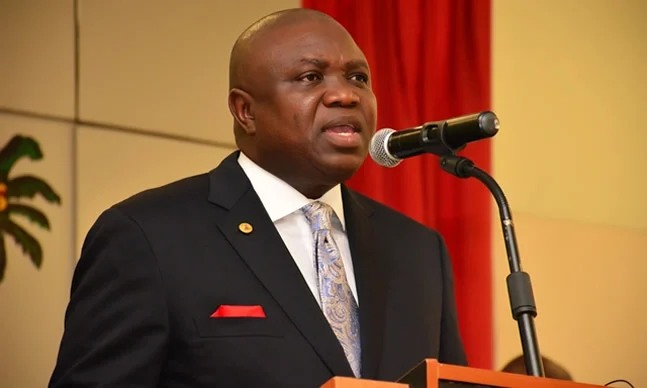
Accountant General of Lagos State (February 2006-2012): By February 2006, Ambode was given the additional responsibility of Accountant General for Lagos State, making him responsible for all financial activities of the state and directly supervising over 1,400 accountants in state service.
Revolutionary Financial Management
Under Ambode’s watch as Accountant General, the State Treasury Office (STO) revolutionized how Lagos State finances were raised, budgeted, managed, and planned. His innovations included:
- Modern financial management systems and controls
- Improved budget performance, averaging 85% annually—remarkable for any government
- Enhanced revenue collection mechanisms
- Better financial planning and forecasting
- Treasury management reforms that increased efficiency
- Creative financial engineering that helped Lagos survive federal government pressures on local governments
These reforms positioned Lagos State as Nigeria’s best-managed state financially, attracting international recognition and investment.
Voluntary Retirement (2012)
After 27 years of distinguished service, Ambode voluntarily retired in August 2012 at age 49, becoming the first Permanent Secretary in Lagos State civil service history to voluntarily retire. This decision demonstrated his confidence in his abilities and desire to pursue new challenges beyond civil service.
Private Sector Experience
Brandsmiths Consulting Limited
Following retirement, Ambode founded Brandsmiths Consulting Limited, a firm specializing in Public Finance and Management Consulting services to governments at all levels, their parastatal agencies, and other agencies.
In collaboration with PricewaterhouseCoopers (PwC), Brandsmiths trained government accountants and finance personnel to prepare them for transition to the International Public Sector Accounting System (IPSAS), demonstrating Ambode’s commitment to modernizing Nigerian public finance management even from the private sector.
Community Leadership and Philanthropy
Federal Government College Warri Old Students Association (FEGOCOWOSA)
Ambode is credited with revitalizing the Lagos branch of his alma mater’s alumni association. He served as:
- Two-time Chairman of the Lagos State Branch
- National President of FEGOCOWOSA for three years
During his tenure as National President, he executed key projects in the school to improve educational and living standards for students, demonstrating a commitment to giving back to the institution that shaped him.
La Roche Leadership Foundation (2013)
In 2013, Ambode founded the La Roche Leadership Foundation, a non-profit organization focused on developing the next generation of leaders. The foundation’s recent goal included installing Nigerian and Lagos State flags in all government-owned schools in Lagos State, promoting patriotism and civic education.
Governor of Lagos State (2015-2019)
2015 Gubernatorial Election
In 2013, Ambode emerged from retirement to contest for Lagos State governor under the All Progressives Congress (APC) platform. His candidacy represented continuity with the developmental agenda of his predecessors, particularly Governor Babatunde Fashola, whose finance systems Ambode had helped design.
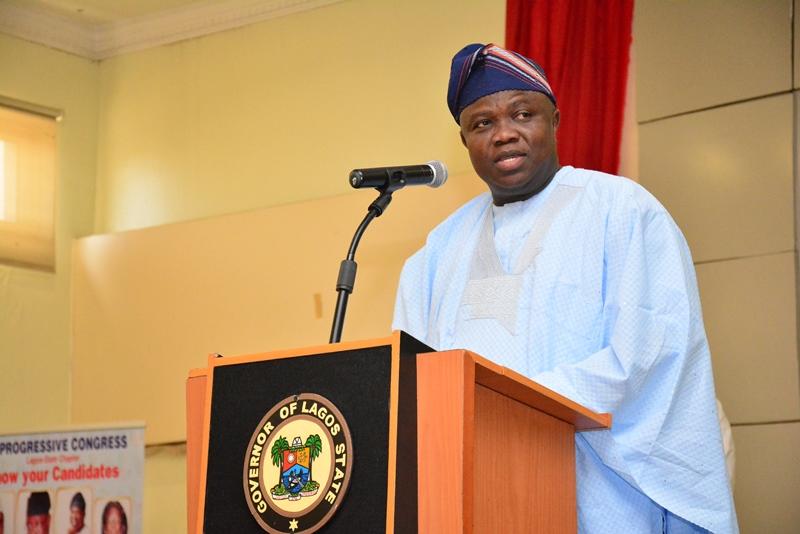
In the April 11, 2015 gubernatorial election, Ambode won decisively, defeating Jimi Agbaje of the People’s Democratic Party (PDP) with 811,994 votes (58.6%) against Agbaje’s 659,788 votes (47.6%)—a margin of just over 150,000 votes. He was inaugurated on May 29, 2015, becoming the 14th Governor of Lagos State.
Governance Philosophy
Ambode’s governance approach reflected his financial management background:
“Light Up Lagos”: Major focus on improving street lighting and security across Lagos, transforming the city’s nighttime appearance and safety.
Infrastructure Development: Massive road construction and rehabilitation projects across Lagos’s 20 local government areas and 37 Local Council Development Areas (LCDAs).
Technology Integration: Emphasis on e-governance, technology in education, and modern management systems.
Security: Investment in security infrastructure, including cameras, patrol vehicles, and improved emergency response systems.
Urban Renewal: Beautification projects, parks, and public spaces transformation.
Budget Performance: Applied his financial management expertise to maintain Lagos’s strong budget execution rates.
Major Projects and Achievements
Road Infrastructure: Ambode’s administration constructed and rehabilitated hundreds of kilometers of roads, including major arterial routes and inner-city roads.
Imota Rice Mill: Initiated the 32-metric-ton-per-hour Imota Rice Mill project aimed at boosting food security and agricultural development.
Five New Stadia: Embarked on the construction of five new stadia across the five divisions of Lagos State to mark the state’s golden jubilee anniversary in 2017.
Healthcare Upgrades: Remodeled and equipped numerous Primary Healthcare Centers (PHCs) and general hospitals across the state.
Education Infrastructure: Renovated schools and improved educational facilities statewide.
Lagos State Consumer Protection Agency (LASCOPA) (2017): Established for speedy redress of consumer complaints.
Safety Arena, Oshodi: Built to bring all departments and agencies responsible for safety and emergency management under one roof.
Oshodi-Abule Egba BRT Lane: Commissioned the 13.68km BRT corridor to improve public transportation.
Light Up Lagos Project: Extensive street lighting across Lagos, improving security and aesthetics.
Controversies During Governorship
Street Trading Ban: His renewed enforcement of the Street Trading and Illegal Market Prohibition Law 2003 was criticized as unfair to the poor, with critics arguing government failed to create sensible alternatives.
Yellow Bus Removal: His plan to phase out yellow commercial buses (danfo) and replace them with new buses was controversial, affecting the livelihoods of bus operators and drivers.
Project Costs: Questions arose about the costs of some projects and contract awards.
Communication Style: Critics suggested his administration could have been more consultative and inclusive in decision-making.
Political Isolation: Gradually became isolated from key party stakeholders, setting the stage for the 2018 primary defeat.
The 2018 Primary Defeat
Background to the Crisis
By mid-2018, Ambode’s relationship with APC stakeholders, particularly party godfather Bola Tinubu and members of the Lagos State House of Assembly, had deteriorated. The exact reasons remain debated, but include:
- Alleged independence and failure to consult adequately with party leaders
- Budget disputes with the State House of Assembly
- Perceived deviation from the party’s master plan for Lagos development
- Personal conflicts with key stakeholders
- Claims of financial impropriety in governance
The Primary Campaign
In September 2018, Babajide Sanwo-Olu emerged as a challenger for the APC gubernatorial ticket, reportedly with Tinubu’s backing. The campaign became increasingly acrimonious:
Ambode’s Allegations (September 30, 2018): At a world press conference, Ambode made serious allegations against Sanwo-Olu, claiming he had been arrested for forgery in the United States and had undergone rehabilitation in a Lagos hospital for an unspecified problem. These allegations were widely criticized as desperate and inappropriate.
Tinubu’s Endorsement (October 1, 2018): Two days before the primary, Tinubu publicly endorsed Sanwo-Olu for the first time, stating that Ambode’s government had deviated from the development blueprint and Lagosians had suffered as a result.
Party Structure Defection: Virtually the entire party structure abandoned Ambode:
- 36 out of 40 Lagos State House of Assembly members rejected him
- His own deputy governor, Idiat Adebule, voted for Sanwo-Olu
- Local government chairmen and party officials backed Sanwo-Olu
- Traditional rulers and community leaders withdrew support
The Primary Election (October 2, 2018)
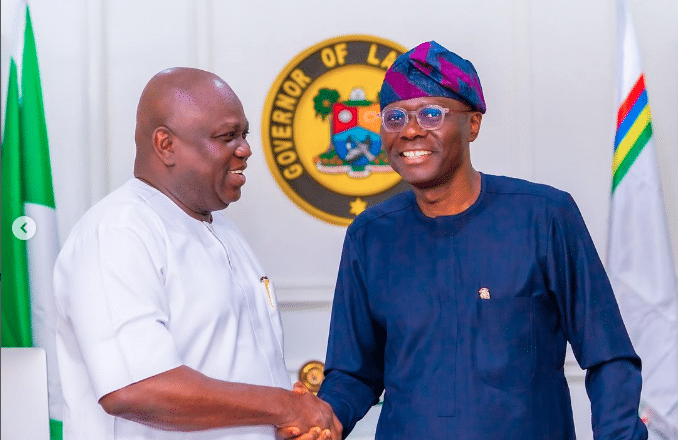
The primary election held on October 2, 2018, was marked by controversy:
Overwhelming Defeat: Sanwo-Olu won with 970,851 votes (93%) against Ambode’s 72,901 votes (7%)—a humiliating landslide loss for a sitting governor.
Violence Allegations: Reports of violence and intimidation at polling centers, with videos showing Sanwo-Olu loyalists threatening anyone who voted for Ambode.
Initial Cancellation: The APC National Working Committee initially cancelled the election, citing irregularities and a lack of proper supervision.
Result Confirmation: On October 3, 2018, the committee reversed its decision and confirmed Sanwo-Olu’s victory.
Ambode’s Concession
On October 3, 2018, Ambode held a televised press conference conceding defeat:
“The interest of our beloved state must always supersede that of any person or group. It is in this regard that I wholeheartedly congratulate the winner of Lagos State APC primaries, Babajide Sanwo-Olu, and urge all Lagosians to immediately support our party’s gubernatorial candidate.”
Reasons for Concession: Reports suggested Ambode conceded to avoid impeachment proceedings that party leaders were considering. His graceful acceptance was praised by some as statesmanlike, while others saw it as a surrender to political godfatherism.
Transition: True to his word, Ambode ensured a smooth transition, working with Sanwo-Olu’s team and handing over peacefully on May 29, 2019.
Post-Governorship (2019-Present)
Since leaving office, Ambode has maintained a relatively low public profile:
No Political Defection: Despite speculation he might join PDP or another party, Ambode remained in APC and did not contest the 2019 general election.
Private Life: Returned to private business and consulting, staying largely out of the political limelight.
EFCC Investigation (August 2019): Shortly after leaving office, the Economic and Financial Crimes Commission (EFCC) froze three bank accounts linked to Ambode, containing approximately ₦9.9 billion. He was accused of allegedly misappropriating funds during his governorship. The investigation’s outcome has not been fully publicized.
Continued Recognition: Despite the political defeat, Ambode received recognition, including:
- 2019 Best Performing Governor in Nigeria Award (National Image International Magazine)
- 2018 Political Brand Personality of the Year (Marketing Edge Magazine)
- 2018 Most Innovative African Leader in Governance Award (Security Watch Africa)
60th Birthday (June 2023): Governor Sanwo-Olu publicly congratulated Ambode on his 60th birthday, praising his contributions to Lagos State as accountant-general and governor, suggesting some reconciliation.
Personal Life
Akinwunmi Ambode married Bolanle Patience Odukomaiya in 1991. They have three children together—twin boys and a girl. Ambode is a devoted Christian and has maintained his faith throughout his career.
Known for his quiet, analytical demeanor and attention to detail, Ambode’s personality reflected his accounting background—methodical, data-driven, and process-oriented. Unlike some Nigerian politicians, he avoided flamboyant displays, preferring to let projects speak for themselves.
Legacy and Assessment
Ambode’s governorship and political career present a complex, cautionary narrative:
Achievements
Financial Management Excellence: His 27-year civil service career, particularly as Accountant General, transformed Lagos State’s financial management, creating systems that continue benefiting the state.
Infrastructure Delivery: Delivered tangible infrastructure, including roads, street lighting, healthcare facilities, and public amenities.
Light Up Lagos: The comprehensive street lighting project significantly improved security and aesthetics across Lagos.
Professionalism: Brought technocratic competence and professionalism to governance.
Peaceful Transition: Despite the humiliating primary defeat, he ensured a smooth transition, prioritizing Lagos’s interests over personal bitterness.
Failures and Controversies
Political Naivety: His inability to manage relationships with party stakeholders despite his administrative competence proved fatal to his political career.
First Incumbent Loss: Became the first incumbent Lagos State governor to lose his party’s ticket for re-election—a historic humiliation.
Poor Political Judgment: His September 2018 press conference, making unsubstantiated allegations against Sanwo-Olu, damaged his credibility and dignity.
EFCC Investigation: Post-tenure investigation and account freezing raised questions about financial propriety despite his accounting background.
Communication Deficit: Critics argue he failed to communicate effectively with party structures and constituents about his projects and vision.
Godfather Challenge: His experience exemplifies the challenges Nigerian governors face in balancing administrative performance with political stakeholder management.
Balanced Perspective
Akinwunmi Ambode represents both the promise and limitations of technocratic governance in Nigeria’s political environment. His extraordinary qualifications—second-best result in West Africa, Chartered Accountant by 24, Fulbright Scholar, Harvard Kennedy School alumnus, revolutionary Accountant General—made him arguably Lagos State’s most professionally qualified governor.
His infrastructure delivery, particularly the “Light Up Lagos” project and road construction, demonstrated administrative competence. The 85% budget performance rates he achieved as Accountant General and maintained as governor represented world-class financial management.
However, his crushing primary defeat despite these credentials illustrates a fundamental reality of Nigerian politics: administrative competence alone is insufficient without political acumen and stakeholder management. His inability to maintain relationships with Tinubu, the House of Assembly, and party structures—despite delivering projects—proved that in Lagos politics, you need both performance AND political skills.
The allegations he made against Sanwo-Olu damaged his dignity and suggested desperation rather than statesmanship. His subsequent graceful concession and transition partially redeemed his reputation, but couldn’t erase the reality that he became the first Lagos incumbent to lose re-nomination—a historic failure that overshadows his achievements.
Comparative Assessment
Among recent Lagos governors:
- More Qualified: Ambode was arguably more professionally qualified than his predecessors or successors
- Strong Administrator: Delivered infrastructure and maintained financial discipline
- Poor Politician: Lacked the political skills to manage relationships and secure re-election
- Technocrat’s Tragedy: Exemplifies how professional excellence doesn’t guarantee political success in Nigeria’s environment.
Akinwunmi Ambode’s story is both inspiring and cautionary—from a rural teacher’s son to second-best student in West Africa to distinguished Accountant General to governor to historic primary defeat. His exceptional qualifications and administrative achievements couldn’t overcome political missteps and stakeholder alienation. Whether remembered primarily as the technocrat who modernized Lagos’s finances, the governor who “lit up Lagos,” or the first incumbent to lose re-nomination will depend on which aspect of his multifaceted career history is emphasized. What seems certain is that Ambode’s experience provides valuable lessons about Nigerian politics: performance matters, but relationships matter more; competence is necessary, but insufficient without political wisdom; and in Lagos politics, particularly, ignoring the godfather is politically fatal, regardless of how many roads you build or lights you install. His legacy serves as a reminder that governing successfully requires both administrative excellence AND political acumen—a lesson future technocrat-governors would do well to remember.