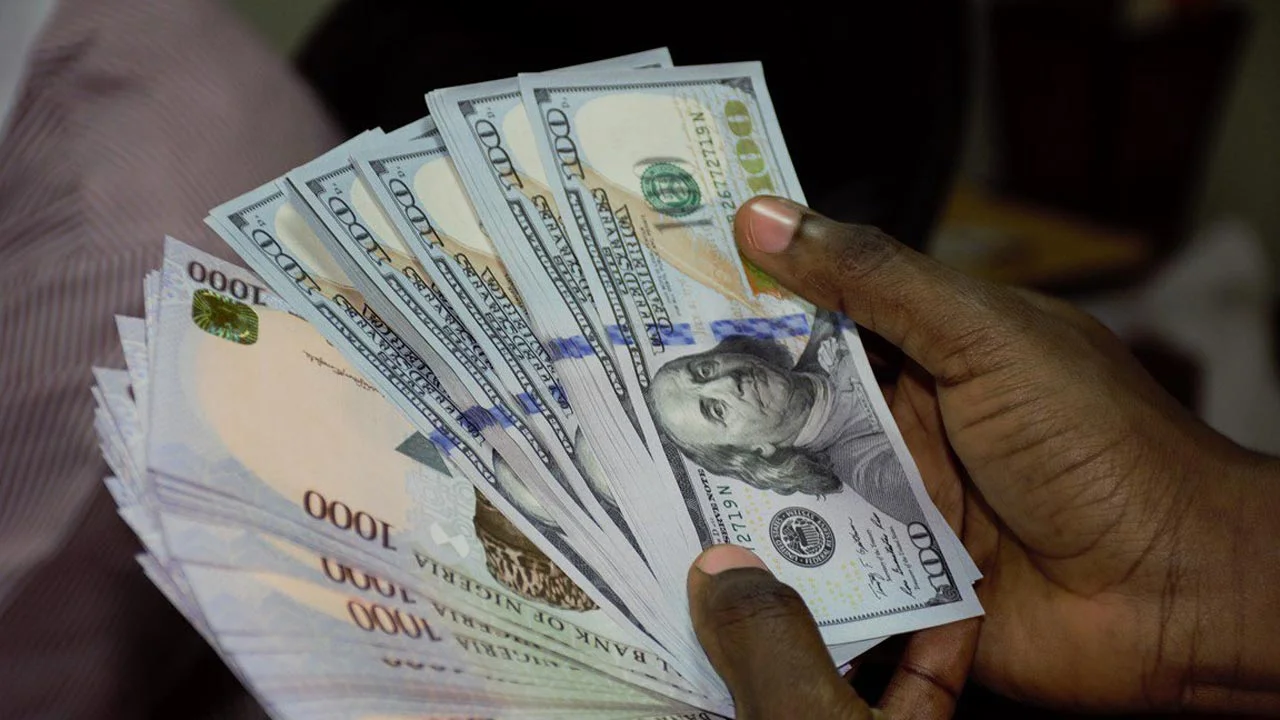
The naira eased into the new trading week largely unchanged, holding its recent gains against the US dollar even as the gap between Nigeria’s official and parallel foreign exchange markets stayed stubbornly wide.
At the official window, the local currency was quoted at roughly ₦1,321.68 to the dollar, a figure drawn from the latest available data on the Nigerian Foreign Exchange Market (NFEM). A note of caution for anyone tracking the numbers closely: the Central Bank of Nigeria’s published NFEM table still lists September 4 as its most recent dated entry, at ₦1,321.2160 per dollar.
That makes Monday’s ₦1,321.68 figure an indicative reading rather than a confirmed CBN trading close, a small but important distinction for analysts and businesses making decisions off the official rate.
Cross the road from the regulated market, however, and the picture looks noticeably different. Parallel market dealers tracked by Aboki Forex quoted the dollar at ₦1,390 to buy and ₦1,400 to sell on Monday.
In plain terms: a Nigerian looking to offload dollars could expect to walk away with about ₦1,390 for every greenback, while someone needing to buy dollars would have to part with closer to ₦1,400 figures that, as always in the informal market, shift by dealer, by city, and by the size of the transaction.
Do the math, and the divide between the two markets comes to roughly ₦78.32 per dollar, the difference between the indicative official rate and what street dealers charge to sell.
Scale that up, and the numbers become more concrete: $100 that would cost about ₦132,168 at the official rate would set a buyer back closer to ₦140,000 in the parallel market.
That gap has been a persistent feature of Nigeria’s currency landscape even as the naira has clawed back ground at the official window in recent weeks.
Earlier reporting this month pegged the naira’s official-market appreciation at around 1.5 percent through August, a period in which the parallel market barely budged, inching forward by a fraction of a percent by comparison.
Officials have pointed to improved dollar liquidity, stronger external reserves reportedly near $53.51 billion in August, and record formal remittance inflows, which touched roughly $947 million in July, as factors underpinning the official market’s relative strength.
Yet none of that has fully closed the divide with the street. Parallel-market quotes have continued to hover well above ₦1,390 in recent days, underscoring how the two markets, while both watched closely, are not moving in lockstep and shouldn’t be treated as interchangeable benchmarks.
For importers pricing goods, businesses budgeting in dollars, and everyday Nigerians sending or receiving money from abroad, the spread between the two rates is more than an academic curiosity; it’s a real cost. Someone relying on the official rate to estimate expenses could find themselves short by tens of thousands of naira once they actually step into the parallel market to transact.
The Central Bank has continued to reiterate that the official NFEM rate, calculated as a volume-weighted average of the day’s transactions, is the recognized benchmark, even as the parallel market continues to operate as a separate, unregulated channel shaped by its own supply-and-demand dynamics.
As with any single-day snapshot, Monday’s figures are a moving target. Currency rates, official and parallel alike, can shift over the course of a trading day. Anyone planning an actual transaction would do well to confirm the live rate with a bank, a licensed Bureau de Change, or a trusted dealer before completing an exchange, rather than relying on a headline figure that may already be stale by the time money changes hands.
WHAT YOU SHOULD KNOW
The naira held roughly steady at the official window (~₦1,321.68/$) on September 7, but the parallel market told a costlier story, with dollars selling at ₦1,400, a gap of about ₦78 per dollar (nearly ₦8,000 extra on every $100).
The official and parallel rates are not interchangeable**, and anyone budgeting or transacting off the “official” figure alone risks being caught short. Always confirm the live rate with a bank or licensed BDC before exchanging.